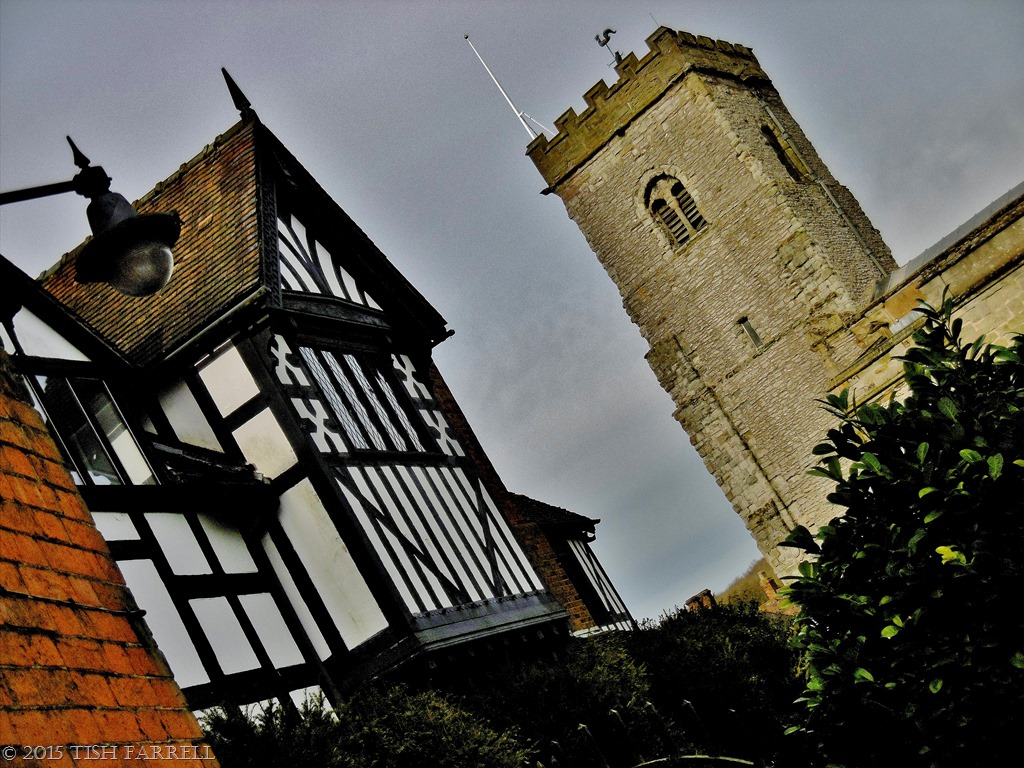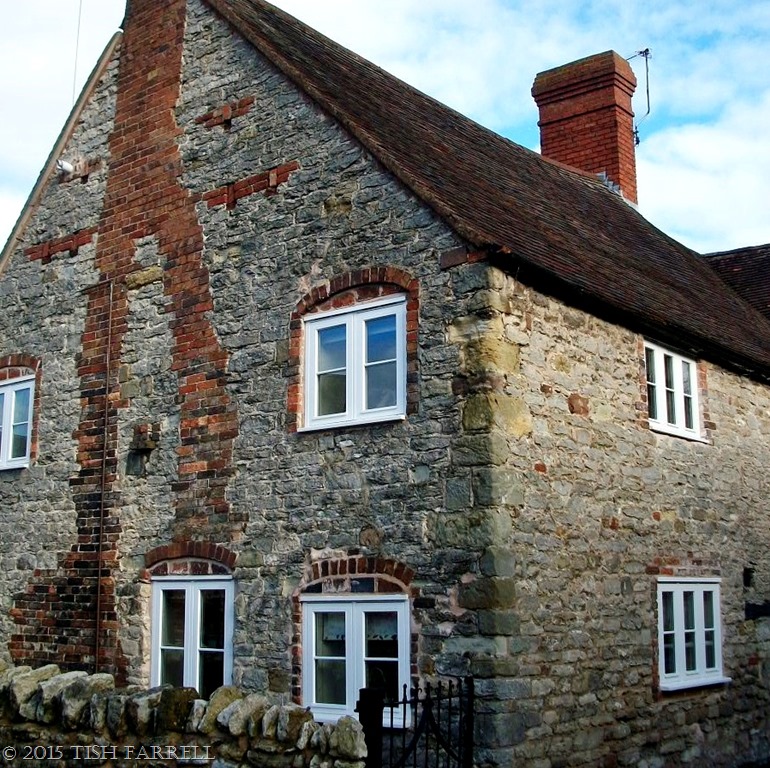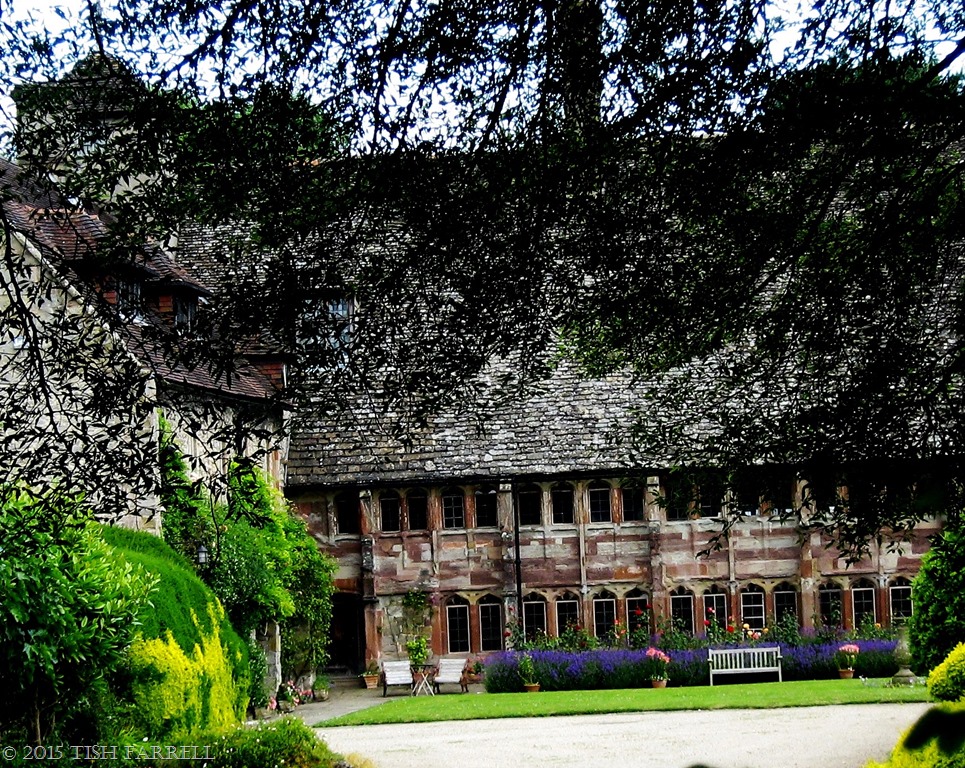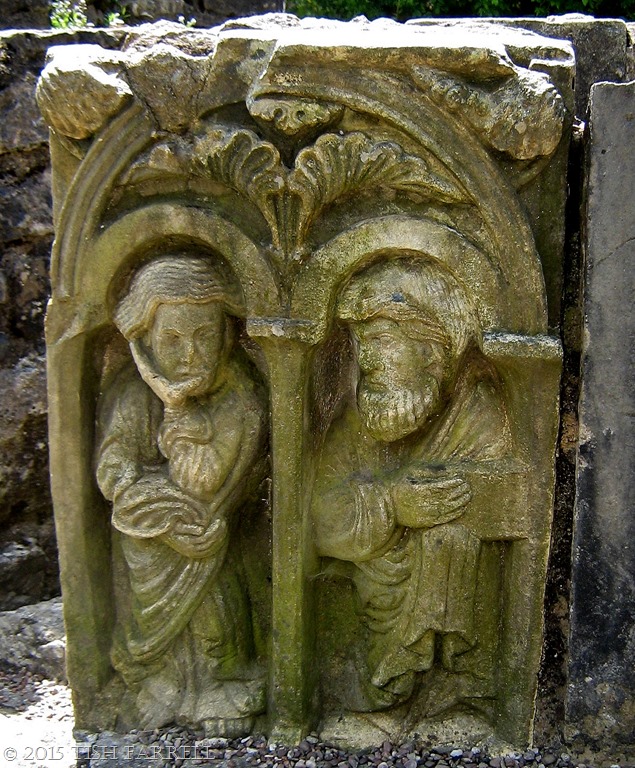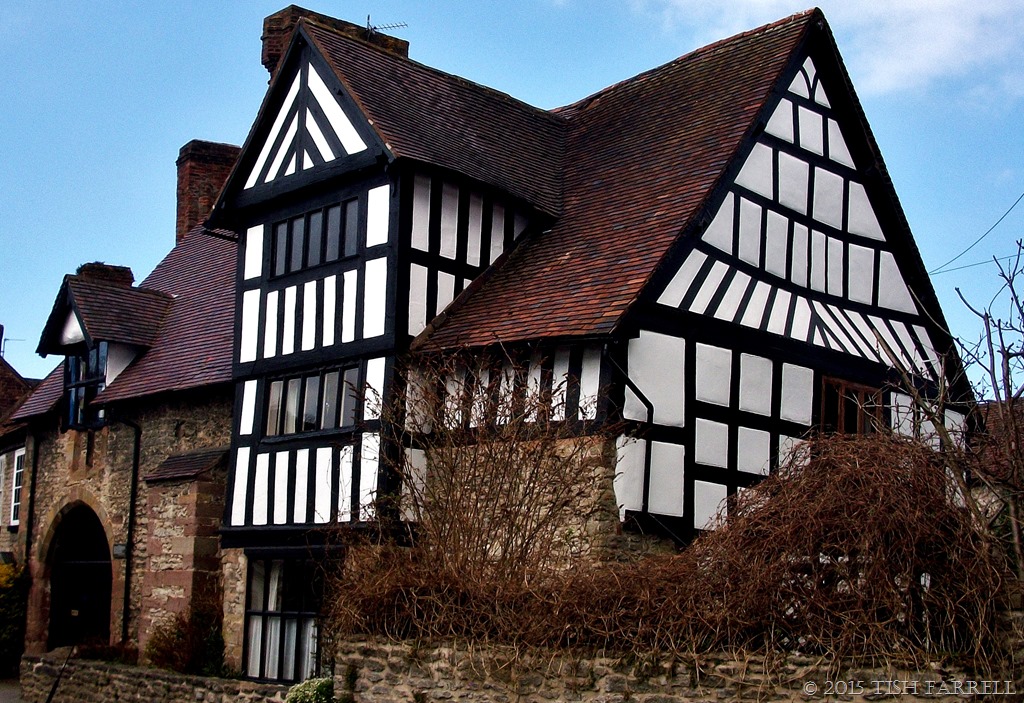
For the final post in this Hidden Wenlock series I thought I’d show you Ashfield Hall, one of the most impressive houses on the High Street. Yesterday I said how many of the town’s ancient timber-framed buildings had become hidden within later stone exteriors. With this house it was rather different.
The left-hand wing with the arch was built some time between 1396 and 1421 by one William Ashfield, a town resident. The impressive timbered wing was added in the 1550s for Richard Lawley. He and his brother, Thomas, were members of a leading local family, and it was they who, after the Dissolution of the Monasteries, bought the Priory and its estate from Henry VIII’s physician, the Venetian, Augustino Augustini.
Augustino seems to have been a slippery type, always short of money. He had been Cardinal Wolsey’s physician before Wolsey lost royal favour. He then became embroiled in the intrigues of King Henry’s ‘fixer’, Thomas Cromwell, who had also been a Wolsey retainer. One of Augustino’s missions was to go to Germany to lobby support for Henry’s divorce from Catherine of Aragon. The Priory was thus his reward for services rendered. He wasted little time in selling it off, and the Lawleys paid him £1,606 6 shillings 8 pence for it. On the proceeds of the deal he then headed home to Italy.
In the 17th century Ashfield Hall became the Blue Bridge Inn, named after the bridge that crossed the malodorous stream, the town’s open sewer that ran down the main street, and was known for good reason as the ‘Schet Brok’.
Despite the insalubrious quarter, legend has it that King Charles I stayed at the Blue Bridge in 1642, en route for Oxford and the Battle of Edgehill. Thereafter, the place went seriously downhill, and became a lodging for itinerant labourers.
But there are earlier stories than these relating to Ashfield Hall. The High Street used to be called Spital (Hospital) Street, and it is believed that the archway probably gave access to the Hospital of St. John whose existence is first documented in 1267. In 1275 an appeal went out for the Master and Brethren of the hostel “to which lost and naked beggars are frequently admitted for their relief, the house being in great poverty.” Merchants coming to town with grain and other goods to trade were called on to give some assistance. By 1329 the Priory was taking over the premises, although it is not known if they continued to run the charity.
This reminds me, though, of a statistic I read years ago in an economic history of Medieval Europe. It shocked me at the time, but it seems it was the norm pretty much everywhere in the Middle Ages for 20% of the population to be beggars (professional or otherwise) and living off lordly charity. Giving to the poor was apparently an important means by which the rich got over their guilt at being rich, and so gained grace. It was how society worked.

By the 18th century, we have a different story. Much Wenlock has some of the most comprehensive pre-1834 English Poor Law records still surviving. The dismal picture they paint is more about local bureaucrats trying to save the town from the expense of supporting any more poor than it absolutely has to. The destitute were mostly women and children. The women, often no more than girls who had been sent off as apprenticed labour and returned, impregnated by their overseers and masters, were subjected to pre-birth, and post-birth bastardy examinations to determine their right to stay in the parish. If churchwardens and overseers found against them, they were subject to removal orders. Pauper children were sent as indentured apprentices to anyone in need of cheap labour. I have a copy of a Much Wenlock churchwardens’ indenture of 1805 which places
Thomas Williams aged eight years or thereabouts, a poor Child of the said Parish ~ Apprentice to James Barker of Madeley Wood, Whitesmith…with him to dwell and serve…until the said Apprentice shall accomplish his full Age of twenty one years ~
In return, James Barker is to train the lad in the business of a whitesmith (tin working), and give him “sufficient (the quantity is unspecified) meat, drink, apparel, lodging, washing and other things necessary and fit for an apprentice.”
It’s a sobering glimpse of life for the powerless and underprivileged. It shows, too, the disparities between rich and poor, the respectable and socially unacceptable in a small, but largely prosperous town like Much Wenlock.
Which rather brings me back to the Schet Brok, the town’s once infamous open sewer. In fact it was not until Victorian times that the stream was finally enclosed and culverted, and a proper sewerage system installed. These improvements were down to the town’s good physician, Dr William Brookes, he who also masterminded the Wenlock Olympian Games and inspired the modern Olympic movement.
The brook still causes the town problems, even though (mostly) we can no longer see it. Come heavy storms on Wenlock Edge, and the culvert has been known to cause terrible flooding, the last event being in 2007. But that, as they say, is another story, although I’ll leave you with some pictures courtesy of Much Wenlock’s Flood Action Group. It is a good example of how the doings of the past, hidden though they may be, can be very much with us.
copyright 2015 Tish Farrell
![collagehighst[1]](https://tishfarrell.com/wp-content/uploads/2015/05/collagehighst1.jpg "collagehighst[1]")
5 Photos 5 Stories Challenge
Pauline at Memories Are Made of This nominated me to take up this challenge. The idea is to “post a photo each day for five consecutive days and attach a story to the photo. It can be fiction or non-fiction, a poem or a short paragraph, and each day nominate another blogger for the challenge”.
So today I would like to nominate Anke at Life in Baku. She has been living and working in the capital of Azebaijan since 2012. Her blog is an on-going quest to reveal in words and photos, places and people, their ways of life. Join her on this fascinating journey.
P.S. To those who are taking up my challenges, I gather from Jo at Restless Jo (who is also doing it this week) that it should be ONE photo. Oh well.
Reference: W F Mumford Wenlock in the Middle Ages