
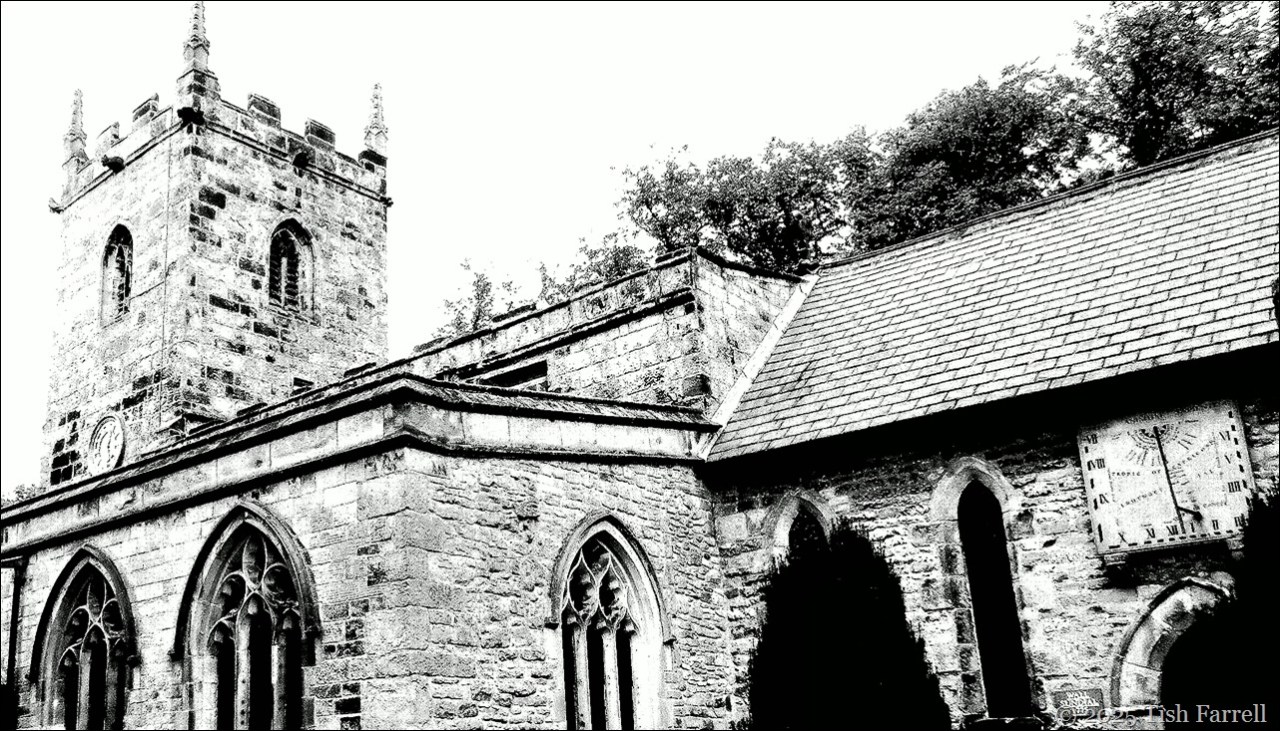
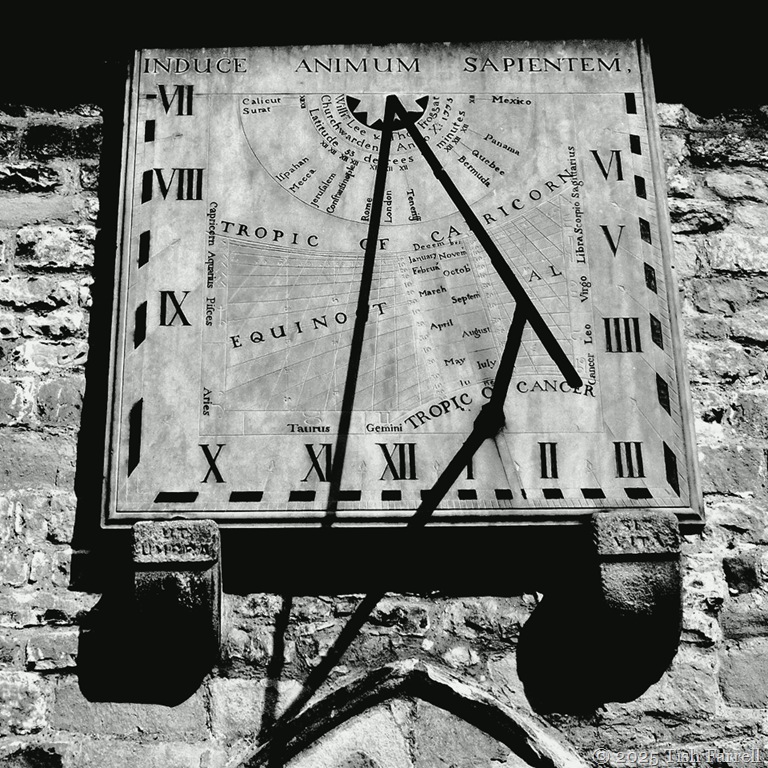
This magnificent sundial clock hangs on the wall of Eyam parish church in Derbyshire. It is extraordinarily intricate; something of a world-view 18th century style. It was installed in 1775 by a vicar with illustrious, wide-reaching connections, although the face itself was carved by local stonemason William Shore.
Eyam is probably best known as ‘the plague village’, the isolated High Peak community that chose to isolate itself completely during the 1665-1666 outbreak of the Black Death. A more recent discovery concerning the village is that the DNA analysis of living descendants of survivors shows a marker which indicates immunity to the disease. Amazing to think this can be detected.
Back in the 17th century, Eyam’s inhabitants made their living mostly from farming and lead-mining. The two pursuits went together, the mining carried out in the winter months in open-cast field seams called rakes. I have ancestral connections here. One Robert Fox, yeoman farmer and lead miner, who looks to have arrived in the area post-plague, married second wife Margaret Mower at Eyam church on the 4th June 1682. They are probably 6th great grandparents, but at the very least 6th great uncle and aunt. There are also much earlier Bennet ancestors around Eyam. They intersect with Foxes in the 19th century, that link arriving via 4th great grandfather, hatter, farmer, lead miner and property owner, Robert Jackson. He married Hannah Eyre at Eyam in August 1826. They would have known this clock.
And about that clock. You have to wonder how far Eyam villagers would have been impressed to know the time difference between their spot on the globe and Calicut, Mecca, or Quebec. The single shadow also marks the solstice and equinox days and, for good measure, the months of zodiac are included too. All these intricate details apparently suggest to clock sundial specialists that the designer was the eminent Derby scientist and clockmaker John Whitehurst FRS.
Besides a time marking facility, the clock includes some thought-provoking inscriptions. On the supporting corbels is says: Ut Umbra – Sic Vita – life is but a shadow. And across the top: Induce Animum Sapientem – cultivate a wise spirit.
This last should be a rallying call for our times. For all our, wizkiddery, wise minds seem sorely lacking. This 250 year old clock might be just the device for cultivating a little capacity for critical thinking. It certainly tests mine.
Monochrome Madness: clocks and timepieces This week Margaret at From Pyrenees to Pennines is setting the theme at Leanne’s Monochrome Madness

Fascinating, Tish, especially the “plague”. Like much of medicine, there is a diversity of opinions about Eyam. The genetic mutation CCR5 has been shown to give some protection to HIV, but mice with the same mutation were not protected from plague. And the epidemiology of the outbreak suggests that it might not have actually been plague which killed half the village. We will probably never know. But it is a great story.
Many thanks for some technical in-put, Ian. There was a little niggle in the brain cells as I was repeating this DNA narrative, although much has been made of it. Also you’ve reminded me that there was some fresh analysis regarding the Black Death, i.e. if it was the actual culprit. Or some form of flu? (Also contentious?) Several members of one family related to my putative family tree died in 1665-6. They were all beneficiaries in a will, and didn’t live long after receiving the bequests.
It’s an amazingly compact device which uses almost all the information that you can get about the relation of the sun and a point on earth. When you look at this you can understand why the 18th century is called the age of enlightenment.
Thank you for that fulsome comment, I.J.
What a high tech sundial. Quite beautiful. Thanks for the backstory too.
Thank you, Rebecca.
Goodness, this is a bit deep for the time of day, Tish. I can accede to being but a shadow, but don’t count me in for the rest xx
Oh, come on, Jo, you bright spark you 🙂
I’m a very dim spark this afternoon, Tish xx
Oh dear. Sending a hug.
A bit too much socialising lately. Thanks, though xx
Life is but a shadow, wow! That’s grim isn’t it? Love all that family lore and history. Had a Fox I was friends with in the States who was a great guy. All of us from the same dirt and stone, shadows too right? Tic tock
I’m very much liking that mix of dirt and stone and shadow, Bill. Nice to speak on the this gloomy soggy day 🙂
Ditto, same vibe here. Post Remembrance Day umbrage and what have you
love your informative posts Tish – always lots of interest. The complex sundial seems out of place for farmers and lead miners but there was always some bright spark of an engineer in their midst – I think of John Harrison solving the conundrum of longitude for navigation. And yes – let’s bring back critical thinking!!
p.s. I only live half an hours drive from here so really ought to visit, maybe in the Spring
It’s an interesting village. Also some very jolly women were manning the little museum when we were last there.
How awful of me. I don’t remember that sundial clock, yet have ‘done’ Eyam quite thoroughly … I thought. Thanks for putting me right!
It does blend quite well with the wall. Also it’s easy to be distracted by the fine Saxon cross which is close by.
I’ll use that as my excuse then.
I remember reading a fiction book that was set in this village during the plague it was so fascinating. I love history so thank you for all the information. I’ve just spent at least half an hour with Google maps looking it up and exploring it the only way I can now. Fascinating clock too, I’ve never seen anything like it.
So happy to have sparked your interest, Leanne. It’s an exposed and gritty landscape, starkly beautiful, and the lead mining history goes back centuries. The lead miners considered themselves answerable only to the miners’ barmote courts and the monarch who laid claim to all the nation’s mineral rights.
Some very interesting facts here Tish. Isolation from plagues was tried with covid too. What an amazing brain created the clock.
Yes, the brain that designed the clock – pretty astonishing, Pauline. As to the isolation during the Eyam plague, I seem to recall reading that some of the wealthier inhabitants did not stay!
Wonder if they survived 🤔
Sun dials are such wondrous things … and best of all, you only need a stick and a clear patch of ground. 😀 … or the side of a church! 😀
I remember as a small child being fascinated by them.
An amazingly intricate bit of 18th century technology! The story of Eyam during the plague has always fascinated me, and your account of this sundial adds another dimension to the village’s history.
Thanks, Sarah.
These are beautiful
Thank you, Ritva.
goodness that is some clock – what connections to have to get this, guessing some pennies too
It’s said the vicar had a patron – the Duke of Devonshire 🙂
ahha!
A fascinating post that certainly ticked my boxes. Being a bit of a genealogical nut, I often wonder how the ancestors were affected by events in history.
That’s something I wonder about too, especially when there seemed to be so much hardship as people moved from the countryside to town and city living.