
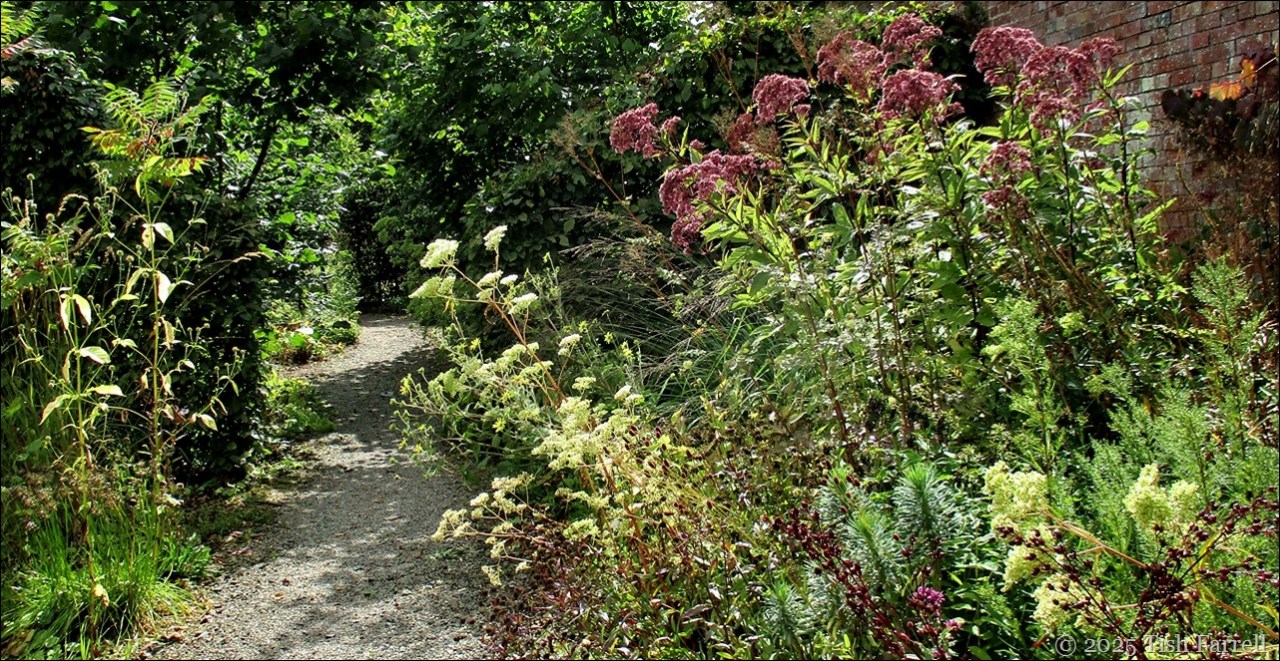
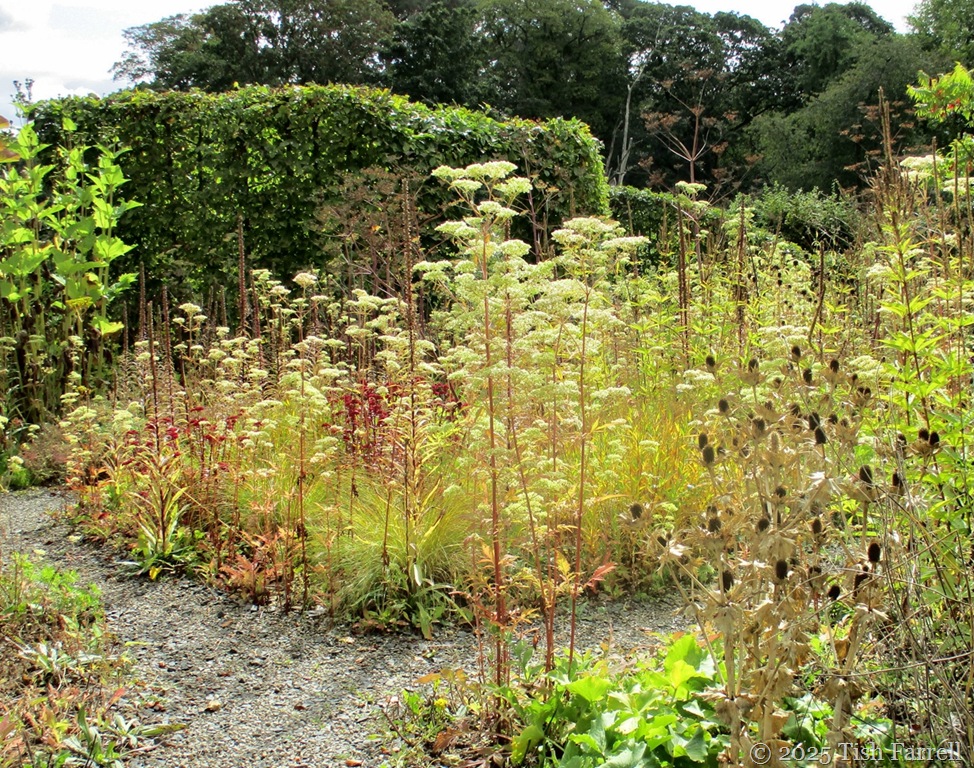
These first few photos aren’t from my garden (if only), but here to illustrate gardener’s lust [1] ~ that moment when a new plant begins to root itself in the psyche, aka mental compost, until you know that you simply have to have it.
Well, that’s what happened last week when we went to visit the walled garden of Wildegoose Nursery here in Shropshire. (See previous 2 posts). It was a hazy day, but everywhere the garden was alight with the frothy, apple green seedheads of Patrinia monandra/aff punctiflora [2] a tall and gracious plant, and one quite new to me. (And yes, it does seed itself everywhere, but I was told unwanted stems pull up easily).
At Wildegoose it sets off not only the reds and bronzes of late summer sedums, Eupatorium, and Heleniums, but also the fading stems of Verbena, Sea Holly, Echinacea and Hydrangea:
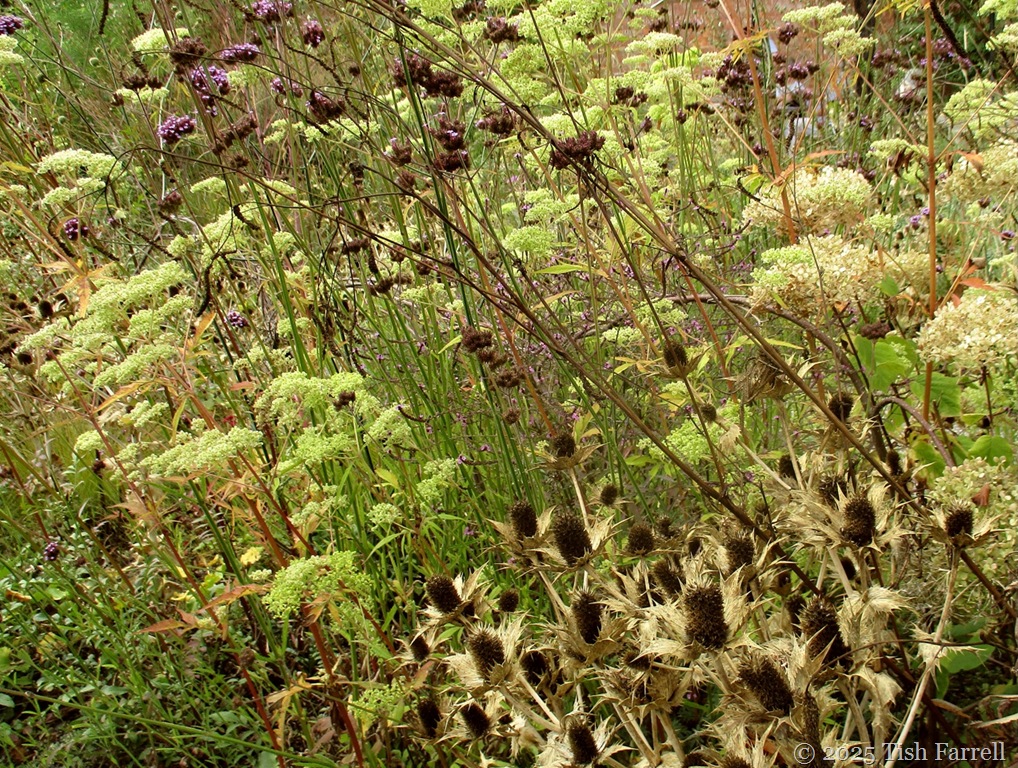
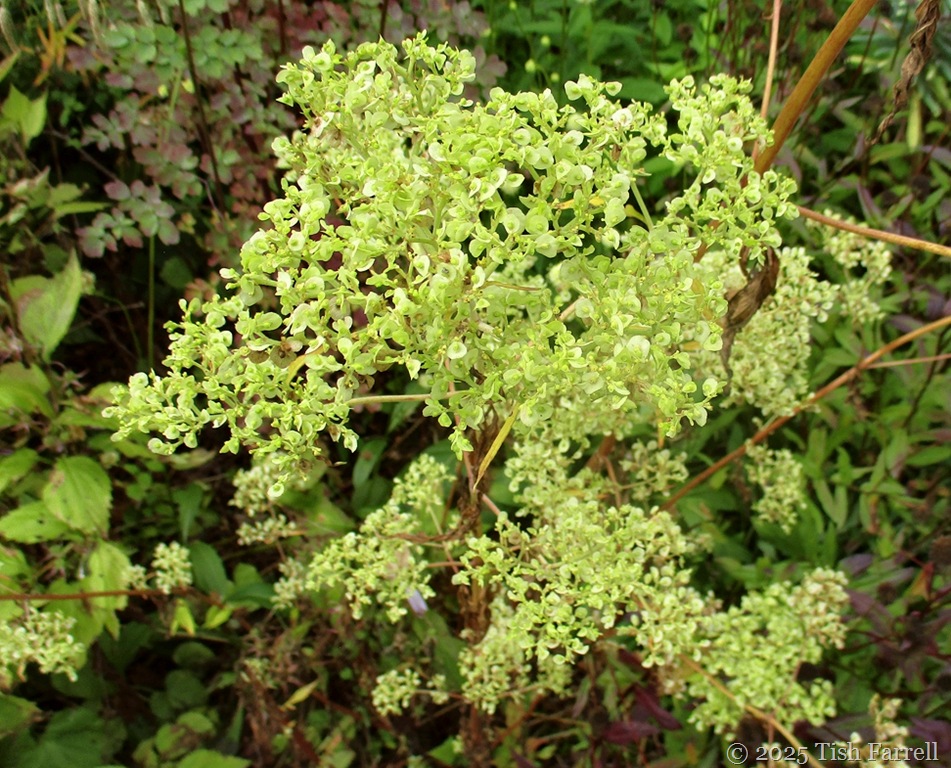
It’s a perennial, clump forming (50cm wide), hardy plant, with spreads of tiny yellow flowers from July to September. The seedheads, though, can last well into the winter. The plant was first collected in China by the Gothenburg Botanic Garden, or so the Beth Chatto site tells me.
And the reason I was looking there, was because it was only later when we arrived home, and I was scanning through the photos that I suddenly saw how lovely Patrinia might look in our so much smaller garden. And I knew Wildegoose was about to close for the winter, and that we were unlikely to get there before it did…And so to postal sources, although of course the plant, if ordered now, will naturally come pruned of those lovely seedheads…(Oh, the self-inflicted anguish of the besotted and too impatient gardener!)
*
Meanwhile, back at The Gables we’ve been having a week of thunderous downpours with intermittent spells of warm September sunshine; April showers on steroids. The lawn is quite rejuvenated, although I hate to tell it, now it isn’t rock hard, I’m going to dig more of it up to make a new strawberry bed. (Psst. Don’t tell Graham).
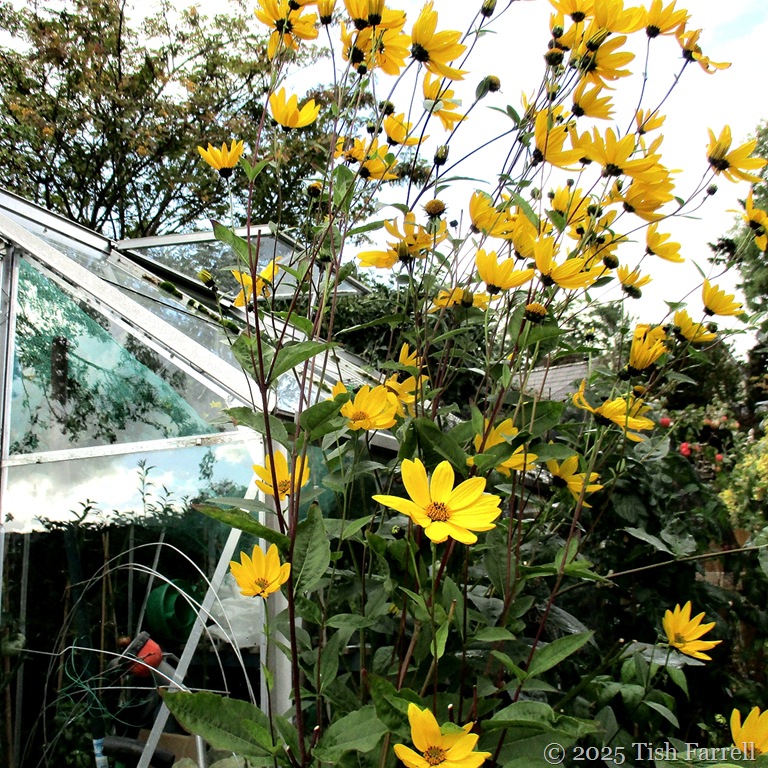
So yes, we are heartily glad of the rain, even if it comes like swift deliveries from Niagara Falls. The Helianthus [3] by the greenhouse is certainly having a new lease of life. It’s lighting up one of the shadier parts of the garden, an unexpected full-on display when it’s already been flowering for weeks.

*
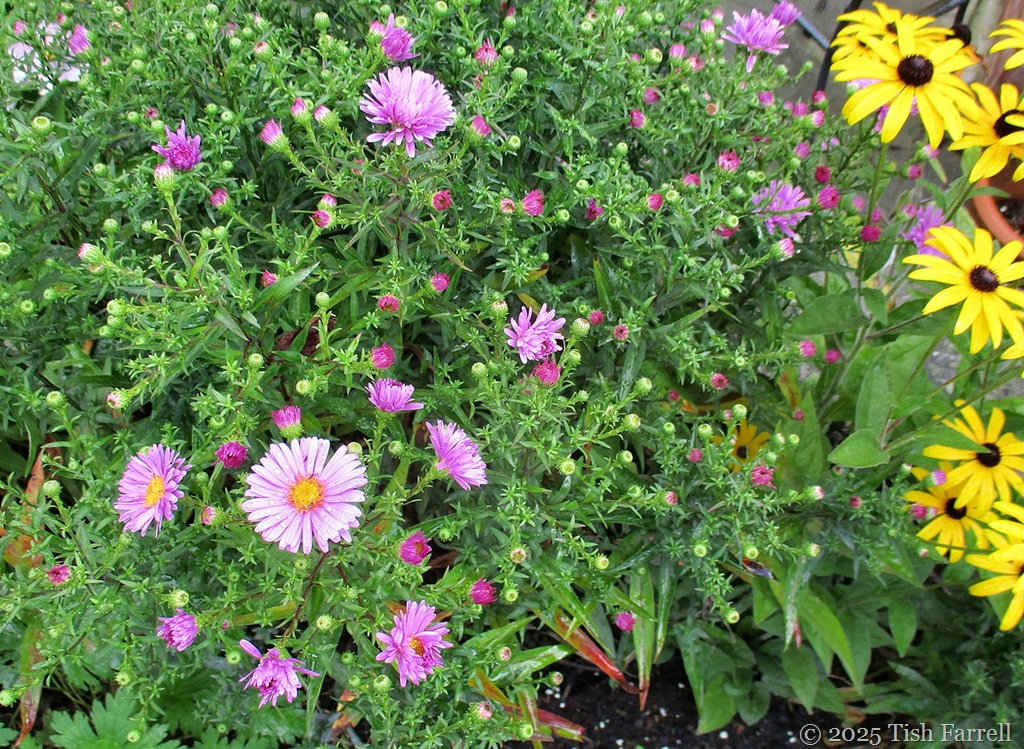
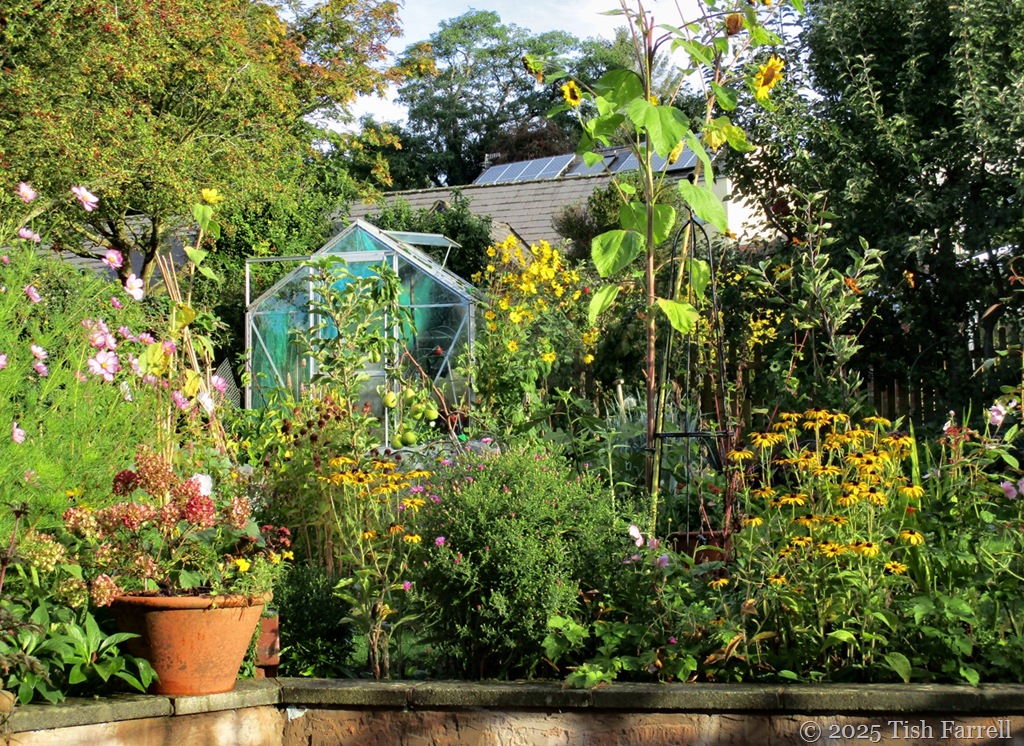
In the border along the terrace wall, the Michaelmas Daisy [4] is at last beginning to flower. It’s been a mass of buds all summer, but was obviously saving itself for more autumnal days. It should be splendid in a week or so, and especially if the Rudbeckia keeps going.
*
Further along the border, between the Japanese Anemones and Selinum, St. Cecilia rose [5] has been spurred into a second flowering. We inherited her with the garden. She was in a poorly state, but though the flowers, when fully open, are rather wan and saintly, and thus none too remarkable, I decided to nurture her. She anyway smells quite nice, and is appealing when the buds are seasonally dewdropped and seen beside the presently seeding heads of Selinum.


*
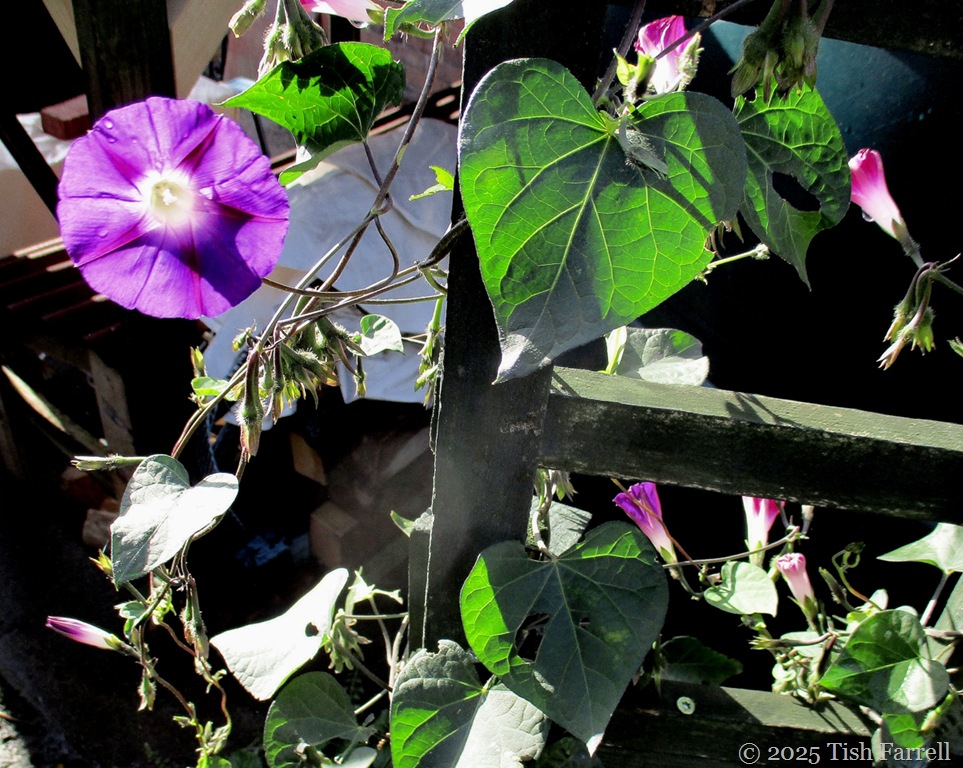
And finally the Morning Glory [6] growing on the trellis by the oil tank looks to be enjoying the cooler, wetter days. I’m surprised it’s still going after the torrential downpours, the flowers lasting longer through the day too.
Happy gardening, folks, whatever your hemisphere.
Six on Saturday Please visit Jim in Cornwall for his week’s garden news.

Lovely, Tish, your garden. Such a solace it must be in these wild times. And good luck with the Patrinia which seems to have the look, a little, of your milk parsley.
Yes, very like the milk parsley, but a little more self-supporting. And thank you for the lovely comment about the garden. Solace, indeed.
I meant to add that there are reports that Patrinia was first used in cultivated gardening by Piet Oudolf. I do hope you know of his lovely landscaping using all kinds of plants. I think you would relish his ideas if you have not yet come across him.
He is new to me, Sarah. I’ve just had a quick trawl, and oh, what wonderful planting. Thank you so much for that intro. I must dive in deeper.
Oh yes, ‘April showers on steroids’ perfectly describes the weather we’ve been having lately! I can quite see why you’re hankering after those delicate seedheads, they’ll look beautiful in your garden 🙂 I enjoyed seeing your Michaelmas Daisy as they always bring back memories of my childhood – our first garden was full of them. And St. Cecilia actually looks really gorgeous to me, as I love delicate roses like that!
Thanks for the garden visit, Sarah. I’m thinking St. Cecilia will come more into her own when she develops into a good size bush, and there are more flowers at one go. They don’t cope very well with a lot of rain though.
What a beautiful garden Tish. I love your enthusiasm and dedication. You are a true gardener. It seems like you are having California weather: dry and then pouring rain; then dry.
The weather is indeed challenging, Anne. I knew I was going to be cross when the rain came back in larger quatities than quite required in anyone moment. We gardeners are always muttering about something 😉
My immediate thought was – ‘That Patrinia looks great. But maybe not so much in Tish’s smaller space?’ But you beg to differ. And you’re the one with the intimate knowledge of your garden, and the vision, so I’m looking forward to hearing how it all slots together.
I see your point, but the plants themselves take up more vertical than horizontal space: you can look through them. We also have the strange boundary wall ‘raised bed’ effort where I already have a clump of hugely tall rudbeckia, between us and next door’s garage, which might look good with some different heights of wafty plants from front to back.
You’ll make it work, and work well!
Thank you for that vote of confidence. It’s good to have you challenge my notions 🙂
Mmm… Patrinia monandra is tempting. Something tall with flat-topped flower heads could work with my grasses. I have tried achillea but failed miserably and yet the wild stuff grows well. Your garden is looking gorgeous in September – all those yellows with the touch of purple.
The Patrinia does look to be very self-supporting (high gales notwithstanding. And there are other similar variations. My achillea’s gone all over the place this year – really floppy. So yes, with grasses, especially our newly acquired Anemanthele lessoniana. Beth Chatto stocks Patrinia aff punctifolia aka Monandra. But I’ve just found Great Dixter’s website and ordered some from there. I hope they actually have it in stock. It’s wonderfully curated and very focused collection of plants there too.
I acquired a plant of Melanoselenium decipiens just yesterday at the NGS plant swap; have Orlaya seedlings just germinating and am waiting for my Selenium wallichianum to produce seed so I can grow more of it. Oh, and there’s a packet of Ammi to sow as well. There are too many white flowered umbellifers to grow them all but how else do I find out which performs best in my conditions? I have to say the Patrinia in your pictures is very lovely.
Oh goodness, Jim. Now you’ve tempted me with another wholly new to me umbellifer. What a plant is Melanoselenium decipiens! Stunning. (And what a mouthful of a name). The thing about Patrinia is that I suspect I’m only going to really love it in its seeded stage. The preceding acid yellow flowers might be a challenge. We’ll see.
The colors of all your photos are very fall-like, and beautiful! The St. Cecilia rose, in particular, is a gorgeous color and shape. Happy Six!
Thanks for visiting my garden, Beth.
Your garden looks great Tish. Despite Tláloc…
(I learnt what a Michaelmas daisy is… I thought it was only an odd English name for the Fall term or something like that…)
Take good care of yourself…