
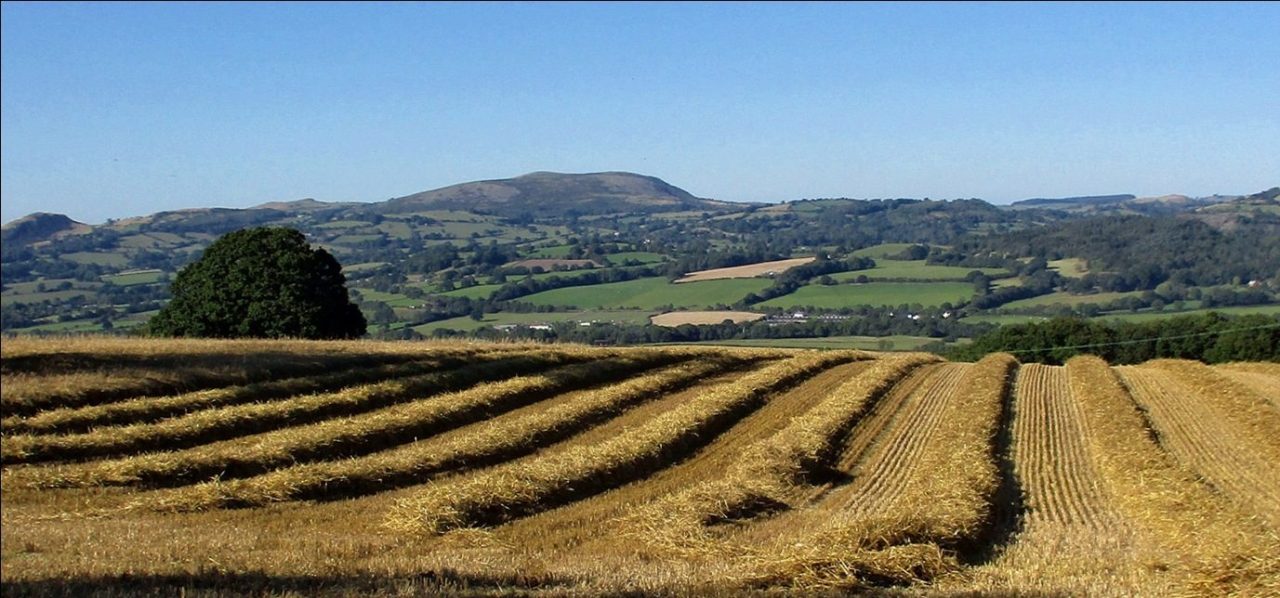
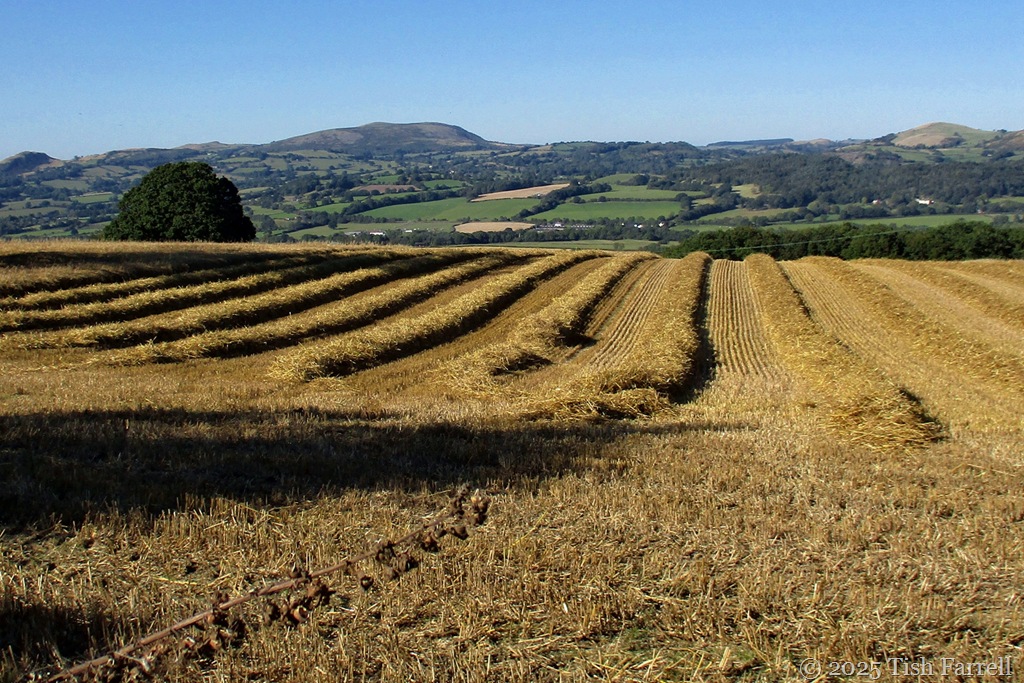
Come August and this year’s harvest has already been and gone. A good month earlier than usual. And somehow we missed it, we who live in the midst of rural Shropshire. In fact, when we drove out of Bishop’s Castle last Saturday, it was quite a shock: wherever you looked the wheat and barley fields lay shorn, the straw baled, or rolled in roundels, the remnant stubble pale and parched. Fields stripped.
How could we have missed so much activity and industry. Did we not hear the combines’ drone?
Along the lanes, too, the hedgerows had that dull and dusty out-grown look of late September. Dock and hogweed gone to seed: russet and deep umber shades of autumn. And again: how could this be? Had we been asleep, Rip-Van-Winkel-like, and lost a chunk of summer? Or had time skipped a month or two?
No. Simply distraction on the home front, gardening and household pursuits. Letting the world pass us by through weeks of day-on-day sun and rainlessness, which of course is the reason why the harvest was so early.
But now it has me reflecting on the beguiling looks of stubble fields, and thus a posting of photos of harvests past, of pared down textures, bare lines and simple colour palette of monocrop farming. I find myself attracted to the spareness of these humanscapes, although wary, too, of the high high-techery that produces such results. This is not the kind of farming I grew up with, the cut wheat stacked in stooks to dry, the arrival of the threshing machine, a monstrous sight over our garden wall, the contraption that, hung in sacking shrouds, throbbed and shuddered, spewing out clouds of chaff as it garnered precious grains from stalks and husks.
Hey-ho. More time slippage.
[The header and final photos were taken mid-September last year above Bishop’s Castle. The in-between shots are from Townsend Meadow, below Wenlock Edge]
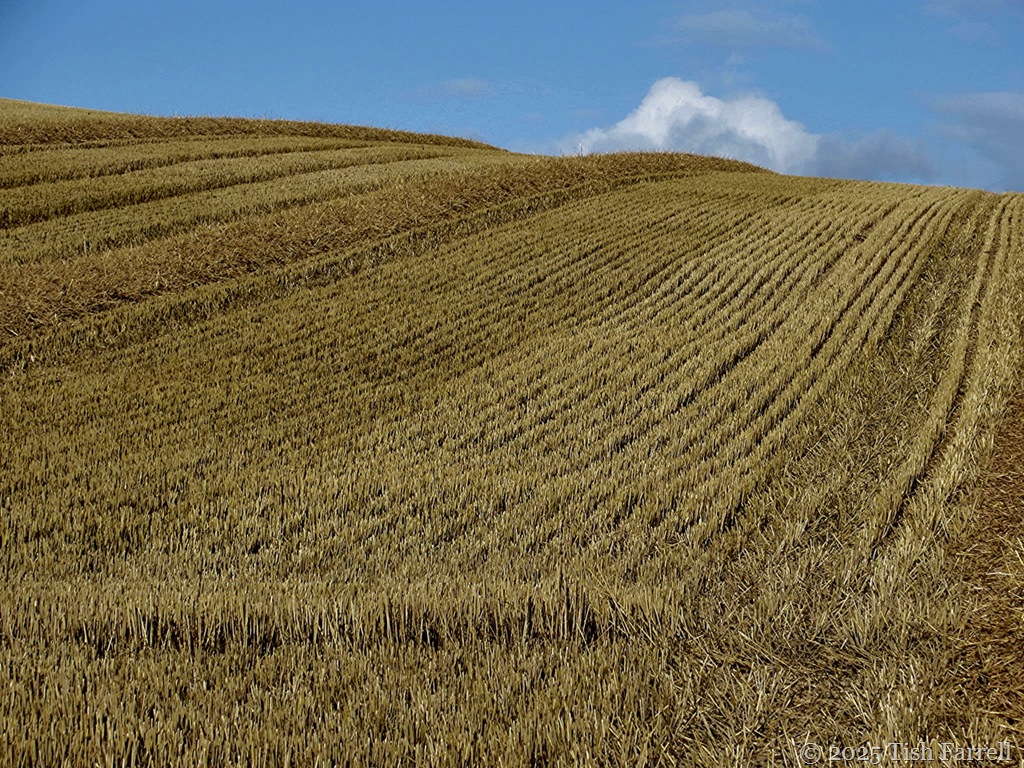
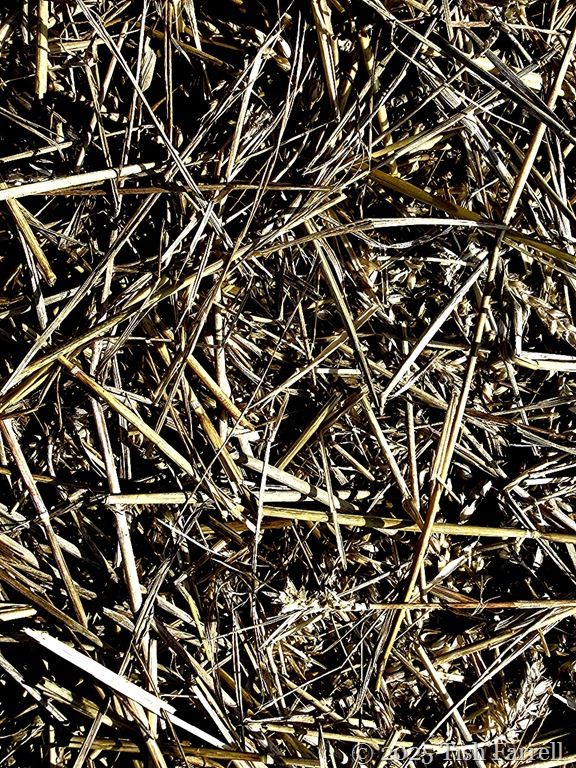
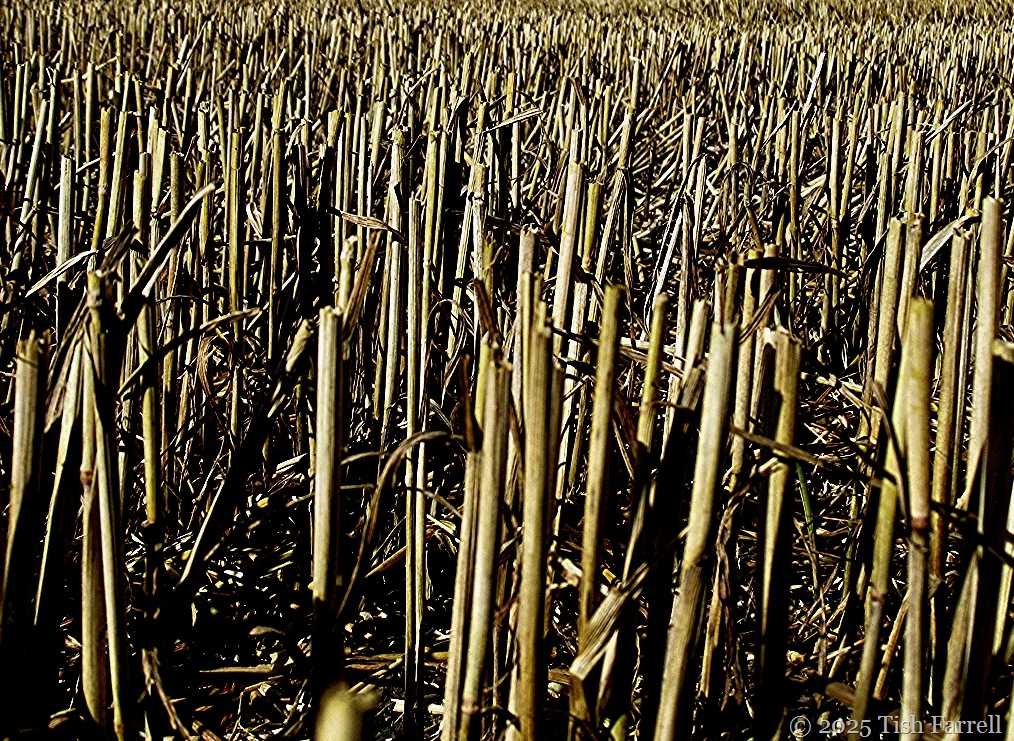
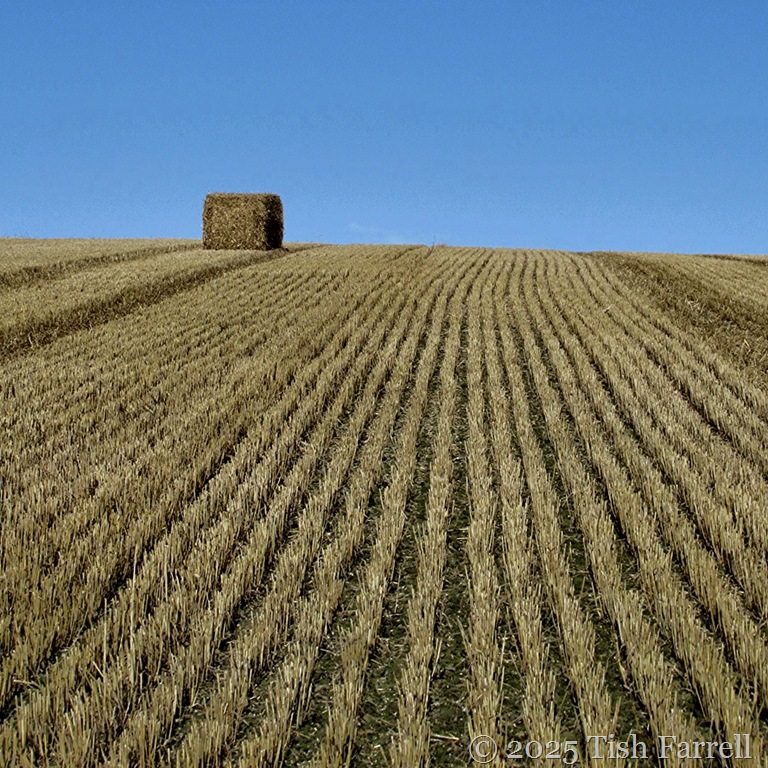

Lens-Artists: Lines, colours, patterns Johnbo asks us to explore these tools of photo composition.

Nice post
Thank you, Satyam.
Welcome Farrell 🎸
I’m with you, Tish: leaf and flower of whole species have passed and I didn’t witness their coming this year.
I don’t have the excuse of house works. More it has been the getting used to immense amounts of bizarre, dangerous political noise in the US, disruption of livelihoods and even the related illness and deaths in Ethiopia and elsewhere; and the disturbances of the weather: huge amounts of rain with intermittent high heat.
Most comforting though, is that the natural cycles persist, adapt and flourish; and that there remain farmers and others skilled and alert who keep watch.
Coincidentally, we visited friends on their acreage in the Minnesota countryside. As we sat outside in the shade of a giant oak tree, we heard the sounds of mechanized agriculture busily gathering the neighbor’s harvest. A windrow of trees and shrubs blocked our view of the industry being accomplished.
That’s a very pleasing scene you conjured there, John.
A marvellous illustration of the spareness of these humanscapes….
Many thanks, Sue.
Oh, terrific! I love the use of harvested fields to illustrate these compositional tools. Great post.
Many thanks for that comment, Joanne. I dithered about a bit before settling on this series of pix.
Yes, our harvest has long been and gone. One last late field being ‘done’, way into the night just a couple of nights ago. I seem to remember harvest festival at school was well into the autumn term. You’ve used the post-harvest landscape, which I’m slightly less keen on at you, to very good effect for this challenge. I especially like your header and last shots.
It’s amazing how early the harvest was this year, but once wheat is ready, it’s ready. It would be interesting to know how the yield has been affected by the lack of rain during the growing period.
We’re told that locally, the yield is less than they usually hope for 😒. We’ll all feel this in our pockets later.
Grain prices operate in their own universe so it’s hard to know what will actually happen. But as you say, usually some kind of knock-on effect – real or contrived.
Indeed. Possibly real, at least to some extent this time.
Bringing back a sackful of childhood memories, Tish. I grew up in Mickleover, now absorbed into the city of Derby but more detached back then. Our house backed on to the fields where as a child I would race home from school to watch the farmer at work….ploughing, sowing, harvesting…following the agricultural year as it unfolded. Fond memories of long summer evenings when we would run out across the stubble to climb up on the stacks of hay bales, chat on the top then slide back down. Reading this post I could once again smell the straw and feel the red rash on my ankles. Wonderful memories from a happy childhood. Don’t you just love reading something which so clearly evokes happy memories?
That’s lovely to hear, that my memories have converged with yours.
Some say the time lines are or have changed..I dont understsnd anyof this but guess it may be the cause .
We’ve had a very dry spring and summer, so the wheat has ripened more quickly, even if it hasn’t grown as well as it usually does. Last year wheat and barley farmers were confounded by endless rain when they wanted to combine, and so then there was a problem of trying to sell grain with too much moisture/having to artificially dry it out.
they’re almost alien looking after harvesting
Yes, you’ve put your finger on the thing that probably fascinates me.
Most people have no idea the challenges farmers have.
You are right. They don’t.
Beautiful images Tish! One year, we missed the Almond trees in blossom. Then another, the sunflower blossom. Sometimes it’s not meant to be.
Thank you for those words of experience, Anne. I think I’ve not quite adjusted to our new surroundings. In our previous small town, I had busyness at the front, and open countryside at the back, so I could keep my eye on both ‘camps’ with no effort at all.
😍
Tish, these are such beautiful images. I totally loved the lines and patterns in your photos.
That’s very lovely of you, Egidio 🙂
Things have changed so much in the farming world since the 1950’s/60’s when I was involved . No more small oblong bales that could be thrown onto a trailer by hand and the joy of the team working together, then at the end of the day enjoying a cold drink. Now one man enclosed in his machine does it all.
Indeed, Pauline and those machines are utterly stunning in their in-cab hi-techery. But heavens, when things go wrong with the power-belts. Or if rats nibble the electric cables.
🫢
Those fields certainly look so beguiling. It would have been a surprise to see them prepared. Lovely photos, Tish.
Thanks, Flavia.
Funny how we’re reminded of the passage of time in so many different ways Tish. Loved your interpretation this week and the images are terrific. They take me back to times spent in more rural areas. Lovely choice for the challenge
Much appreciate all those kind words, Tina 🙂
Tish, you have captured the beauty of the harvest in these images.
Thank you, Beth.
Love the shot of the cubical and clyndrical wheat-beasties. 😀
And I live that description, Widders, especially the ‘cubical’.
Beautiful read and wonderful, perfectly picked photos for the challenge, Tish. It feels like the end of season, but is it, really?
Many thanks, Sofia. And yes it does feel like the end of season. It’s most disorientating.
I know the feeling, Tish. But you have captured the harvest so well – a beutiful post and words making us think…I too knew the old ways and loved the work together with everybody in the team. And the after drink and eat. Being happy to see what we had achieved.
Thank you for sharing your memories of harvest time, A-C. It was special when everyone we knew was working (and celebrating the hard work done) together.
♥ I am grateful to have those memories. I think you are too.