

In 1992-1993, during the first years of Zambia’s multi-party democracy, we were posted to Lusaka, Zambia’s capital. Graham was charged with organising the distribution of European Union food aid to drought-stricken Zambians. (Part 1 is HERE and part 2 HERE and part 3 HERE)
*
It is early December 1992, barely two weeks into our Zambia posting, when Graham is despatched ‘on mission’, the European Union Delegation’s term for out-of-town business. He is told to attend a Monday morning meeting at a railway depot in Livingstone, some 300 miles south of Lusaka, a six hour drive away.
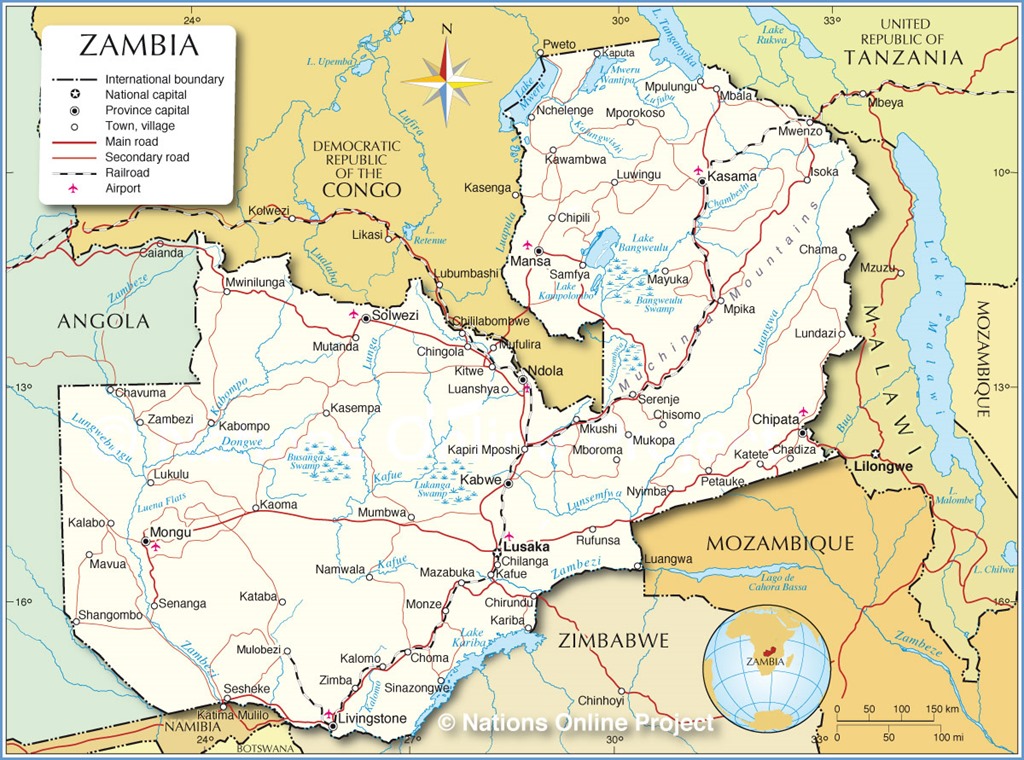
And the actual mission? To inspect a newly arrived shipment of maize from South Africa, via Zimbabwe, part of the 100,000 tonnes of food aid being brought in by the European Union. There has been talk of organised theft along the line of rail, of some local big man who has the power to divert trains to his own mill. It is thus important to check the consignment is intact.
Graham’s boss, Bernard, suggests he drives down the weekend before. He further suggests that I go too. It is a chance to see Victoria Falls, he says, and not to be missed. Later I suspect he is also being kind. We’ve scarcely adjusted to Lusaka living and he will not unnerve us by spelling it out: that Lusaka’s diplomatic quarter is a regular target for cross-border armed raids by unpaid members of President Mobutu’s Congolese army.
But on the Saturday morning as we leave the city under big skies, I’m not thinking about this; only of the journey ahead, of what we might see.
*
Once out of the city we head ever onward on the South Road. The single carriageway is wide and straight with few pot holes, and for the most part empty of traffic. After nine months of bumping along the ragged tracts of the Nairobi-Mombasa highway, stuck behind fumy trucks, it is sheer luxury. On either hand the savannah woodland runs green and lush and reminds me more of central France than of Africa. At Kafue we cross the wide expanse of the Kafue River, wooded uplands all around. But as I find later, this is the only significant landmark until Livingstone some five hours later.
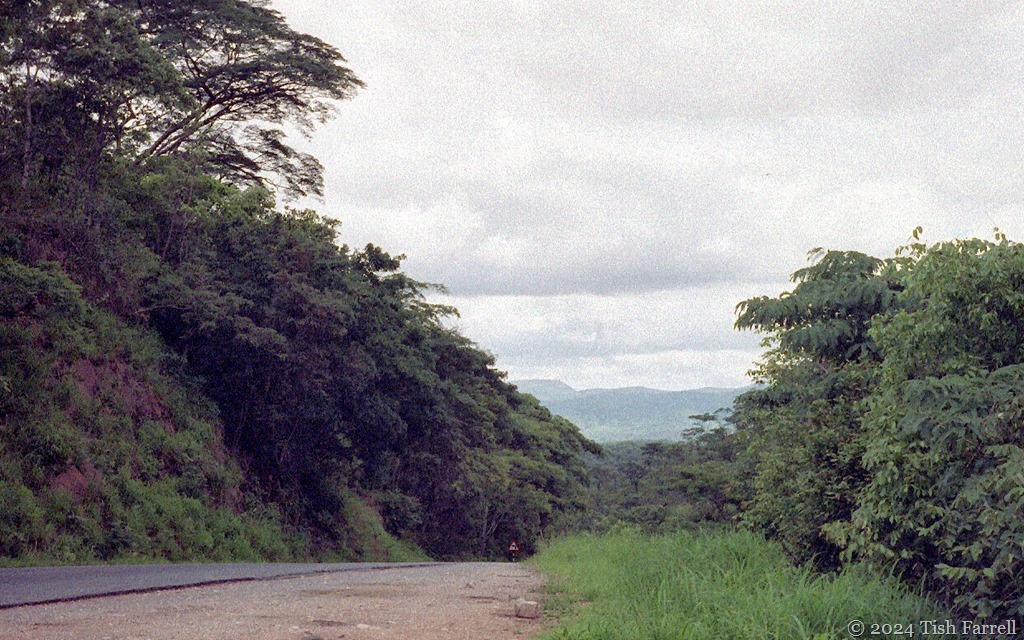
A view of Zambian savannah miombo woodland, Southern Province
*
We pass through neat small trading centres – Mazabuka, Monze, Kalomo, Zimba. Sometimes we glimpse thatched roofs through the roadside vegetation. Sometimes there are lads holding out fistfuls of mushrooms, their caps big as dinner plates. But over all there is a sense is of quietness, an undramatic treescape sparse in humanity.
And then we’re in Livingstone, once Zambia’s capital, back in the days when Northern Rhodesia was a British Protectorate. In 1992 it strikes us as little more than a village. Its wide main street has a colonial air; all is neat; tree-lined pavements, arcaded stores; whitewashed, zinc-roofed, verandaed bungalows. When we check into the Intercontinental Hotel the time-warp feeling thickens. We are served afternoon tea on the tree-shady lawn, watched by ducks, guinea fowl and vervet monkeys.
By now I can wait no longer. The light may be poor, the sun blanked out, but there’s a world wonder to see, and the hotel’s garden path takes us right there…
*
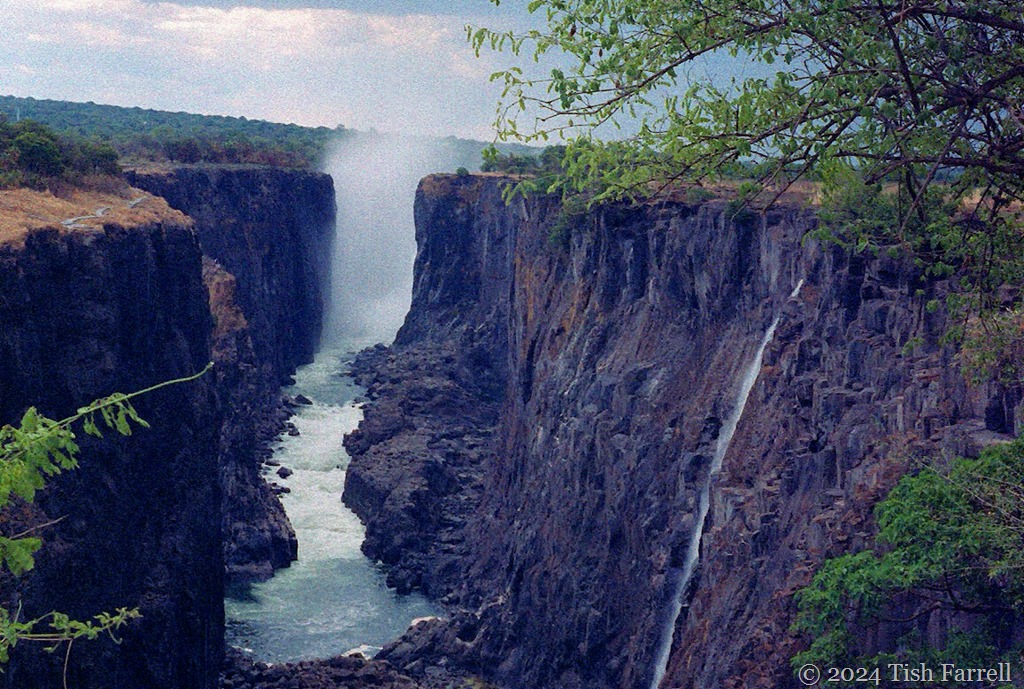
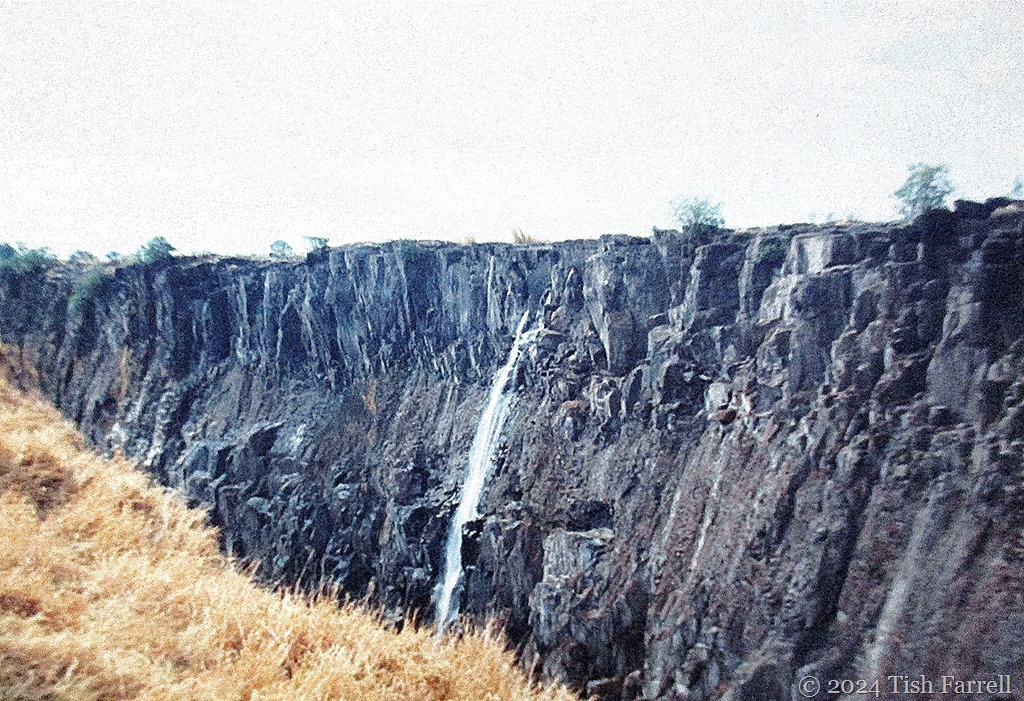
I don’t know whether to laugh or cry. It is too hard to absorb, this bare basalt cliff. The mighty Zambezi reduced to a trickle.
The long drought has much to do with it. But Zambia also abstracts large quantities of water to run its hydroelectricity scheme. Graham then tells me the best view of the Falls is on the Zimbabwe side of the cataracts, and that if we’d remembered to bring my passport we could have walked over the bridge to see them.
Ah, well. Another time perhaps. We walk along the path beside the waterless precipice, but this alien landscape soon has me thinking of Tolkein’s Mordor; I expect the eye of Sauron to burn through the cloud any second. We give it up and go back to the hotel.
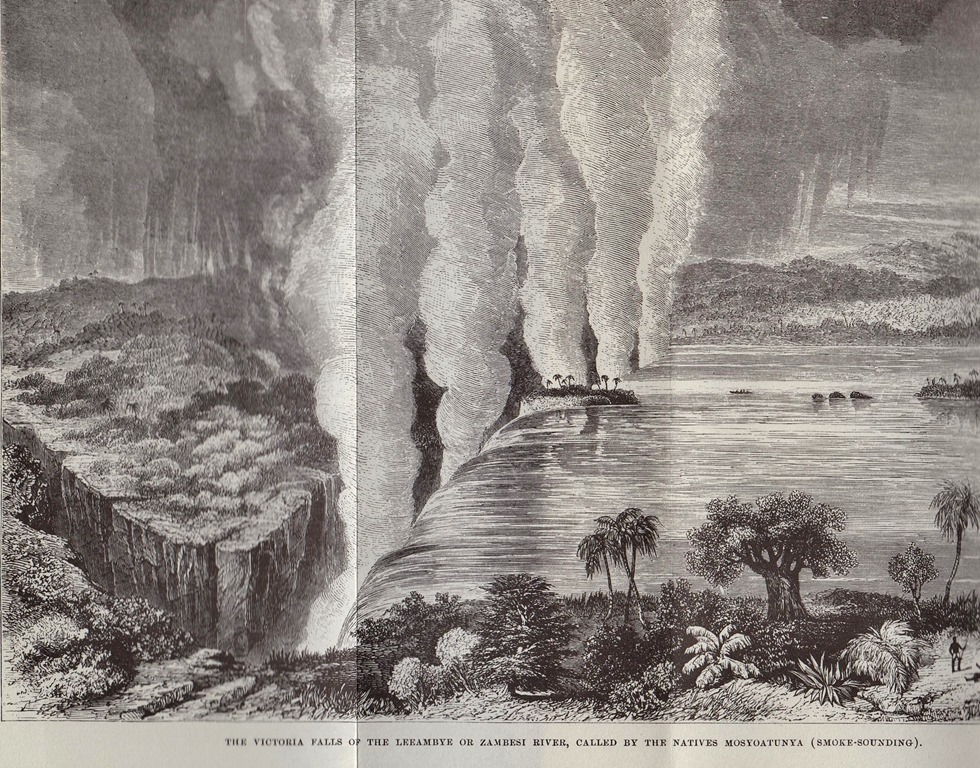
The Falls as seen by David Livingstone in 1855. Engraving from Missionary Travels and Researches in South Africa 1857
*
It was David Livingstone who named the Falls after Queen Victoria. This was in 1855, and probably he was the first European to clap eyes on them. Of course they already had local names, Mosi-oa-Tunya, the smoke that thunders, being the Tonga people’s name for them. These somewhat reclusive farming folk inhabited much of the Zambezi Valley including the portion now occupied by Lake Kariba. It’s pleasing to learn that the UNESCO World Heritage citation at least gives precedence to the Tonga name.
*
In theory our hotel room has a river view, but all we see is a vast expanse of dry bed with odd clumps of palm trees and scatters of huge boulders. But on Sunday afternoon, under a bright sun, I notice people picking their way across. I persuade Graham we should join them.
We’ve hardly started out when a boy appears from nowhere and offers to guide us ‘to the best Falls’ viewpoint.’ And so we follow, but it’s not easy going, picking our way around oily pools and stagnant crevices, clambering through a maze of mammoth boulders, trying to ignore piles of fresh elephant dung.
We are so busy watching our feet we don’t notice the storm clouds gathering. And when I do, I’m suddenly nervous. I’ve read about flash-floods engulfing dried up river beds. I keep glancing upstream as if that will do any good. I worry, too, about rounding a boulder as big as an elephant and meeting an actual elephant.
Then the rain comes and that’s all I can think of – the fat freezing drops that stab the skin. (How can African rain feel so cold?) We follow the boy to cover, crouch under trees on Livingstone Island, the very spot from where the explorer had first viewed the Falls in 1855 (see the engraving: island in the foreground). For ages we crouch with the boy under dripping trees until, thoroughly cold and soaked, Graham asks him if the good view is much further.
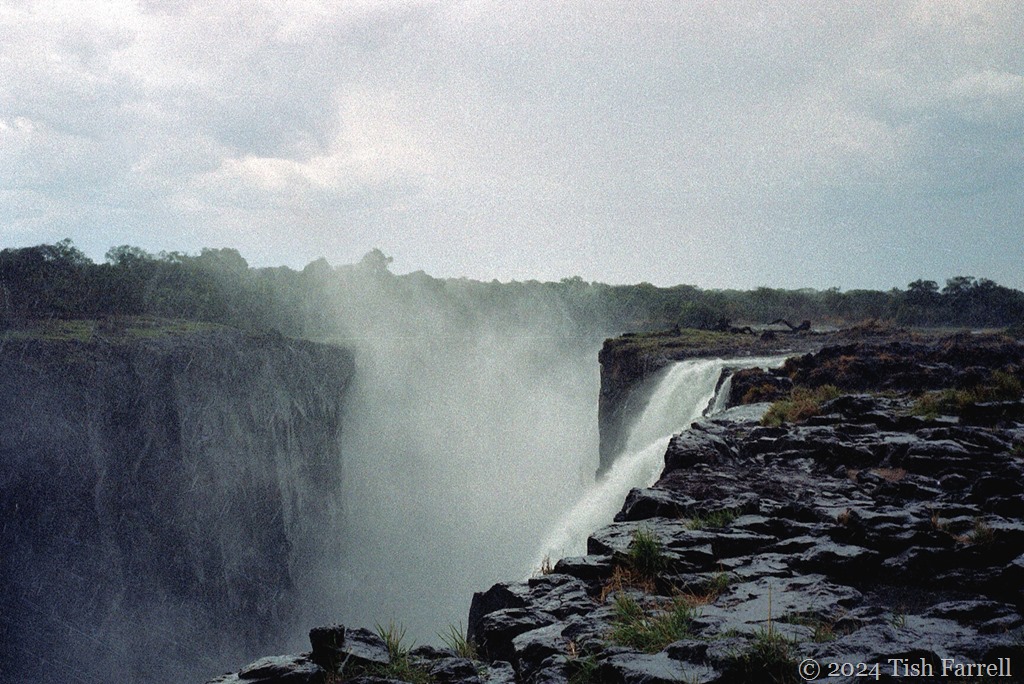
No, no, it is close by. We make a final dash. And here it is. The view:
*
Not much to see with spray rising up and rain pouring down. Except there we were on the knife-edge with a 300 foot drop below. I quickly take this photo, and stow my camera. Then hold my kanga-wrap (which I’d brought to keep off the sun) over my head to stem the downpour. And it’s then a sudden gust of wind snatches the sopping cotton. I feel the slight lift and step back in shock. I’ve had more than enough of Mosi-oa-Tunya.
So has the boy. We turn to see him sprinting away without waiting for a tip, and now I really am worried. Leaving without his kwacha? What does he know that we don’t? Watching him go, my heart sinks. The hotel looks very far away, the boulder-strewn riverbed between us and it, increasingly nightmarish. Overhead the sky is black, now and then fractured by great shafts of fork lightning. We slip and slide on wet rocks. More phantom elephants. More imaginary flash floods. More scrambling out of megalithic cul de sacs.
Of course it’s all panic and little substance. After a hot shower and a bottle of Mosi beer back at the hotel, it seems like a great adventure, though we do wonder if the part of Livingstone Island where we’d sheltered was in Zambia or if we’d entered Zimbabwe without the necessity of passports.
That night I am taken ill, probably the start of an amoebic assault that is later diagnosed in Lusaka. And so the next day when Graham has to visit grain depots, first in Livingstone, and then two Red Cross grain stores on the way back to Lusaka, I am happy to sit in the car and doze. It will be another seven months before I finally see the western cataract of Mosi-oa-Tunya.
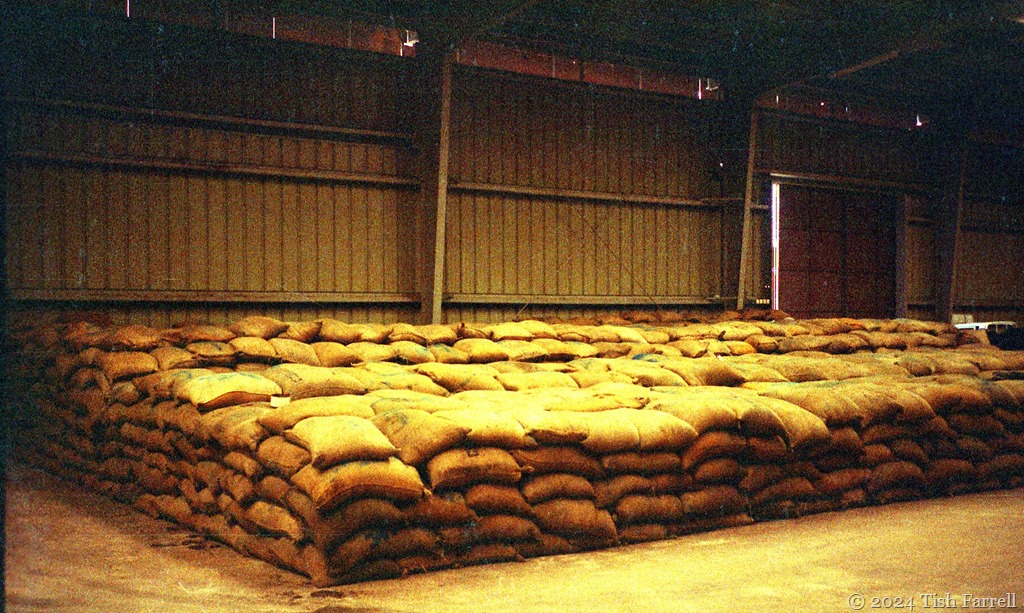
Maize consignment safely arrived in the Livingstone depot
Copyright 2024 Tish Farrell

What an amazing adventure. I’m off to pick up the beginning posts!
Many thanks, Rebecca 🙂
Wow, Tish, another great adventure. You must have been scared when your guide ran off. Looking forward to more!
Many thanks, Anne. Yes, it was a surprising event losing one’s guide before we’d tipped him. Definitely a bit worrying. I think he was probably worried we’d be cross with him because we got so wet.
Would an adventure be any fun without a few slip ups..I’m sure there were many more..but you made it..Thanky you for sharing.
Thanks, Beverly. I was glad not to make the ultimate slip up – i.e. over the edge 🙂
lucky for us all
The things you get up to, woman! Paragliding over the Victoria Falls, is it?
Quite a tale, Tish. Logic said you survived – but it was a tense read!
magnificent story
Incredible adventure. To see things not from a tourist perspective but experience nature in all its glory.
Thanks for reading, Marie.
So fresh on the page, Trish, this seems as though it is a past which is always present. And beneficial, not to speak of wondrous.
Is this right? If yes, then perhaps the Welsh word ‘hiraeth’ is here with its melancholic and joyful insights to infuse a life?
So enjoying this, Trish.
Oh, Sarah. Hiraeth. Yes, exactly. I learned that word a while ago at a poetry workshop with Welsh poet Menna Elfyn – and what did it spark but an instant off-the-cuff vision of the Great Rift Valley.
And yes the past and present in one plane. Writing, or rather re-writing these Zambia pieces, does somehow bring it into the now. I feel as if I’ve been travelling there this weekend. Thanks so much for your perceptive (as always) comment.
So glad of this and of the fact that you are writing this now, in what seems to be a similar and second ‘homecoming’! It is wonderful and full with the blessing we receive for no earned reason…
That is beautifully put, Sarah.
Actually, I’ve been meaning to tell you of a curious Ethiopia connection with Bishop’s Castle. Emperor Haile Selassie was given a civic reception here in 1936. He was staying on nearby Walcot Hall (once home of Clive of India!!!). This Shropshire Star story gives the gist, though sorry about the horrid ads:
https://www.shropshirestar.com/news/features/2020/02/08/emperors-wife-was-chauffeur-driven-shopper/
Thank you for the link to HSI’s visit to Shropshire. It is coming the 50th anniversary of the end of his empire and so we are thinking about him and the history of this passing.
Another timely link then. These connections across time and space are more than a touch brain tingling.
oh my goodness, what an adventure. Glad you got to see the funny side, and that you got to see the falls in a bit more glory. Not so great are becoming unwell though
It did have its slightly hair-raising moments, Becky. And yes, I could have done without the parasites! Being ill in Africa was not a great experience, but we always had brilliant treatment, whether from pharmacies or medics.
excellent you always got good care
What a tale to tell – though it seems as if it ended rather badly and that the health difficulties might continue …
I was ill for a week or so, but 3 days of enormous antibiotic tablets did the trick.
Phew!
from your description , vivid as usual, I was there!
That is very nice to know , Cora.
Fantastically descriptive account of an amazing adventure! I felt as if I were right there with you – although having seen the falls in full flood I’m quite glad I wasn’t 😀 I’m glad you got to see them again later in a better light. And thanks for including that old engraving – I’d not seen it before and it’s interesting to compare it with the photos I took!
That engraving is wonderful, isn’t it. So pleased you found it interesting to make comparisons with your photos.
Absolutely absorbing, particularly as we are travelling right now through these very spots, though with 30 years of change between us. I can only imagine the emotive feelings as your young guide ran for cover, he must have been properly scared of something or other. Such a good read, Tish. I wonder if you’re still following our journey through Africa. Some things very different, many haven’t changed one bit.
Just been catching up with whistle-stop tour of Lusaka. The city was a very different place in our time. It felt like the 1950s. There was a small Chinese shopping mall just out of the centre, but I seem to remember it was hard to find one’s way into it. The big department store on Cairo Road had very little in it, and the main shopping for basics were in Asian stores on a parallel street. Europeans did their shopping in Harare we were told, and we could understand why when we went there on a trip.
I think our Mosi oa Tunya guide probably ran off because his tour went so badly, what with the downpour and lightning. Avoiding us being cross with him (which we wouldn’t have been of course).
Yep, in that case things have definitely changed in the intervening years, Tish. There are definitely some modern aspects in amongst the clashes which make up Lusaka in the modern day.
What an adventure! And what an unfortunately amoebic outcome. I picked up a middle eastern version of that while I lived there and brought it back with me from a business trip.
Your pictures always thrill me.
They have done the same thing to many of the falls around here, literally closing them down if the water gets low. And, as it turns out, all those dams are not solving any problems, but are causing many. Personally, I would have been very afraid to be out there on wet rocks in bad weather. I have a serious fear of falling that I occasionally overcome, but typically, I am overcome by.
We get casual about water when rain comes when needed and are gripped with terror when it doesn’t. I know they want to remove our 46 dams along the Blackstone, but are afraid of all the poisonous earth used in erecting them will turn the river septic again … so we still have the dams. I doubt we will ever see them gone.
Water, as in river management, is not something most of us think about, unless we live in a flood prone area. Most of the big UK reservoir systems date from Victorian times, and our major cities still rely on them.
The thought of your 46 dams is mind boggling. The thought of removing them even more so. They way we humans tinker around with the planet…
How incredible to have seen the Falls so dry! Your venturing out to the “best Falls viewpoint” must have been daunting, especially after your guide ran off and you had the rain and wind and anxiety to contend with. Glad you got back safely but getting that infection must have been a bit grim – glad to read you got better with the antibiotics!
Many thanks, Carol. In retrospect t was a rather careless adventure on our part. But then, I’m glad we did it. The near empty bed of Zambezi fascinated me as much as anything – such huge boulders strewn along it.
It must have been an amazing sight to see and unforgettable.
Yes, to know we’ve been there!
I’m really enjoying reading this latest series about your time in Zambia. Another wild adventure with quite a few mad escapades. And your visit to the Victoria Falls (definitely prefer the more poetic “Thundering Smoke”) during a time of drought when there was barely a trickle of water struck more than a chord. That’s exactly what tends to happen on my own little adventures. Getting to places too late, leaving too soon, and just generally missing the main vibe. On the positive side, though, it does sometimes make for a far more entertaining story!
That ‘missing the moment’ facility of yours made me smile, James. I often felt like that when we were living in Kenya and Zambia. Too many people saying oh, you should see it when… Or go at such and such a season 🙂
Yes, during a three week stay in the USA back in the early 90s, due to a variety of reasons (including a few stupidities I won’t go into), I somehow managed to miss a full solar eclipse near the Mexican border, Independence Day in Vegas and the launch of a space shuttle from Cape Canaveral. So it’s more of a superpower than a mere faculty!
Ooh, now that takes some beating on the miss the moment front.
Oh what a story. I absolutely understand your fears – of both elephants (never to be treated with nonchalance) and dry river beds suddenly becoming raging torrents. But what an adventure! It’s almost always the things we do “outside the box” that make us feel most alive. I bet you’ve never forgotten it!
Alison
Yes, Alison, those outside the box moments definitely have all sensibilities firing on full alert. And yes, they do stick in the memory!
The adventure continues! You write so calmly, were you when it was happening? I’m not sure I’d be okay at the checkpoints. And thanks for the beautiful images.
That’s an interesting question, Anne. Looking back, I was pretty calm. We generally found Zambian officialdom very polite, and often charming, even in the immigration department; the latter not something I’ve experienced even when returning to my own country!