
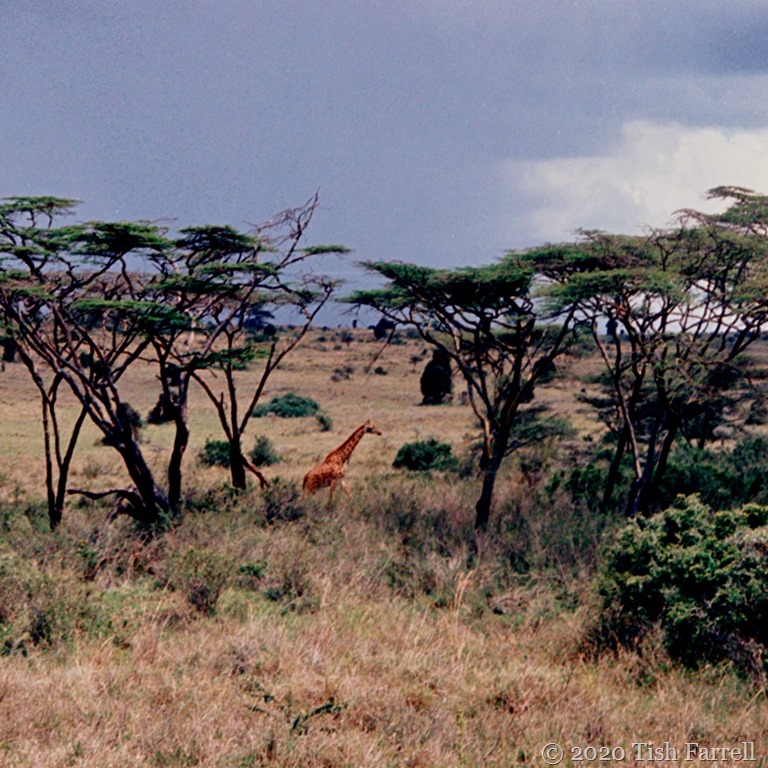
The Flat Top Acacia or umbrella thorn is characteristic of Kenya’s wooded grasslands, especially in gullies. It tolerates drought and degraded landscapes and in traditional communities has long served in all manner of useful ways. It provides wood for fuel and charcoal making, and poles for house-building; the frondy branches make good goat fodder; the tiny puffball flowers feed bees; the bark produces edible gum; the roots are nitrogen-fixing; and the tree has medicinal qualities. My Kenyan tree book however tells me that, though quick growing and wonderfully shade providing, it is not a good idea to plant this acacia around your homestead since its branches tend to fall off.
This photo was taken in Nairobi National Park on the edge of the city centre.

Interesting scene
🙂 a storm brewing.
😊
I saw somewhere that it was studying the acacia and the giraffes eating its leaves that scientists first discovered how the acacia protects itself and one of the ways trees communicate with each other.
The tree releases deadly substances into leaves once the giraffes have begun to eat their leaves. They also release scent. Neighbouring trees ‘sense’ the scent and release the same poison to its own leaves. Giraffes eat upwind of trees for this reason and not downwind.
Did you see this too?
Sarah
Yes, I think I’ve heard that too. It’s fascinating stuff the way trees ‘communicate’. I’m also remembering that thorn trees have their biggest thorns when they are small and most vulnerable to grazers.
Duly warned about planting it too close!
Falling branches? True?
The reference is in a book produced by ICRAF (Internat. Centre for Research in Agroforestry) ‘A Selection of useful trees and shrubs for Kenya’ so I’m assuming it is accurate since it’s designed for agroforestry extension workers. I gather the wood itself is not long-lasting.
Growing acacia at home would be a recipe for disaster. Pricks every time.
You sure have a wealth of pics from days gone by
7 years worth, and all before digital over-the-top snap-happy shooting mode. I often wonder how many more images I would’ve ended up if digital had been invented then.
That’s many photos. I don’t take as much pictures. Usually I prefer to keep them to photographic memory
I think you are wise. You can be so busy taking photos, you miss the reality.
That’s beautiful. Around where I lived it used to be all prairie with oak savannah’s. I bet it looked kind of like that, minus the giraffe.
So many tree-scapes have been lost – on both sides of the Atlantic. I often wonder what things looked like before we got our axes out.
Indeed. We actually have more trees here than we did before. The natives used to burn the prairie, and the only things that survived were grass and oaks. Now anything that’s not corn is a scrubby kind of woods.
I remember seeing some Victorian photos of rural scenes in my home county of Shropshire. What amazed me was the enormous size of the trees back then – height and girth of oaks being felled. And then when we were on vacation in Canada, we went to London, Ontario, to a historic pioneer village, and one of the guides there talked of all the tall trees that the settlers felled. All of which makes me feel we have missed a lot, not ever encountering such trees, and most of us not even knowing of their loss.
Wow! With so many uses I’m surprised there are any of these trees left.
I think we might find most of our trees have all sorts of properties that we’ve never discovered. We could do with nurturing them a bit more.
For sure. When I was a kid I lived near Seattle, and played on giant stumps that were several feet across.
They’re interesting looking trees. Isn’t it odd about them releasing deadly substances when the giraffes eat their leaves? A suitable alternative to running away, I guess 🙂 🙂
Clever trees!
😉😉
This shot reminds me so much of camping in Kenya, and having giraffe wander by. It’s like something from another planet – the whole experience. And what I remember most about the acacia is the thorns. One time we used branches to build a barricade around our tents.
Alison
Indeed. Very thorny, Alison. Excellent for making ramparts. When was this camping event?
I did a four-month overland expedition from Johannesburg to London in 1980, camping almost all the way and living from a 4WD truck. There were 12 of us. We were camped near Bagamoyo I think it was and the first night we had people trying to raid our tents while we slept. Thankfully I was not asleep and was immediately aware of someone unzipping my tent. My screaming for the others in the group did the trick and whoever it was ran away. So the next night we put out tents in a semi-circle with the truck closing the circle and the tents surrounded by acacia branches. They still tried again that night. I don’t think they were dangerous, they just wanted some of what we had.
Exciting stuff, Alison. Graham did an overland trip from London to Victoria Falls, and I have to say I do envy him that trip, though I can pretend I’ve been looking at his photos.
Ah. The Nairobi Park. 😉I read, then saw a picture that they ran a train in the park? I hope I am wrong?
It’s up on very tall concrete stilts, so I imagine it’s rather good for game viewing. The city was encroaching quite noticeably when we were there, but a fellow blogger (had also lived in East Africa in the past) was there a year or so ago and said it was still a great place to visit.
Seen a few posts from bloggers that confirm what you say. The encroachment is a shame. Don’t they realize that this is their most precious resource? Tsss. (Not to mention the Tanzania highway project to cross Serengeti and the great migration path…
I agree with you to a huge extent, but then the benefit of maintaining wildlife domains relies on foreign tourism, and that can be v. fickle. Also in Kenya (and I assume elsewhere in Africa) most of the tourist infrastructure is foreign owned, so the only in-country revenue is earned from what tourists spend while they are there. All the booking revenue will be in foreign banks. The other thing that’s happening round the world is wildlife reserves are being created by apparently philanthropic corporate entities – wildlife has been monetized and it’s already big business as an investment instrument. The downside of these ‘protected areas’ is that indigenous peoples are often excluded, and often by security measures that are not at all pleasant.
Wow. I didn’t know about that. I always assumed Kilaguni Lodge and the likes were locally owned. I mean when we were there many people, including my father’s cousin, lost their job to Africanisation… There must have been a lot of palm greasing afterwards… Sigh. And of course, of the “locals” are not included, why should they bother… re-sigh
Some of the lodges and Nairobi hotels are owned by locals, but the big players are international hotel chains. The lovely small, low key, low impact Delamere’s camp at Elmenteita has been replaced by this over-the-top production: https://www.serenahotels.com/serenaelmenteita/en/default.html
A very fancy resort. Nicely put-up. Though I can think of other places that get you into the spirit of africa without so much a-do. Thanks for the link.
And I can imagine the big hotel chains buying place after place. Must all be deserted now… This will wreak havoc on the local people’s source of living. The Askaris, the rangers, the waiters, cooks… This will hit them hard.
Indeed it will hit people v. hard.