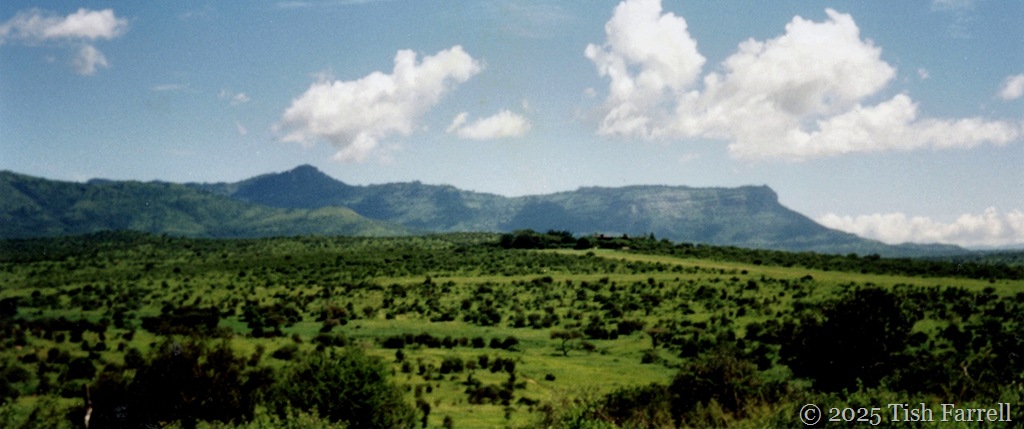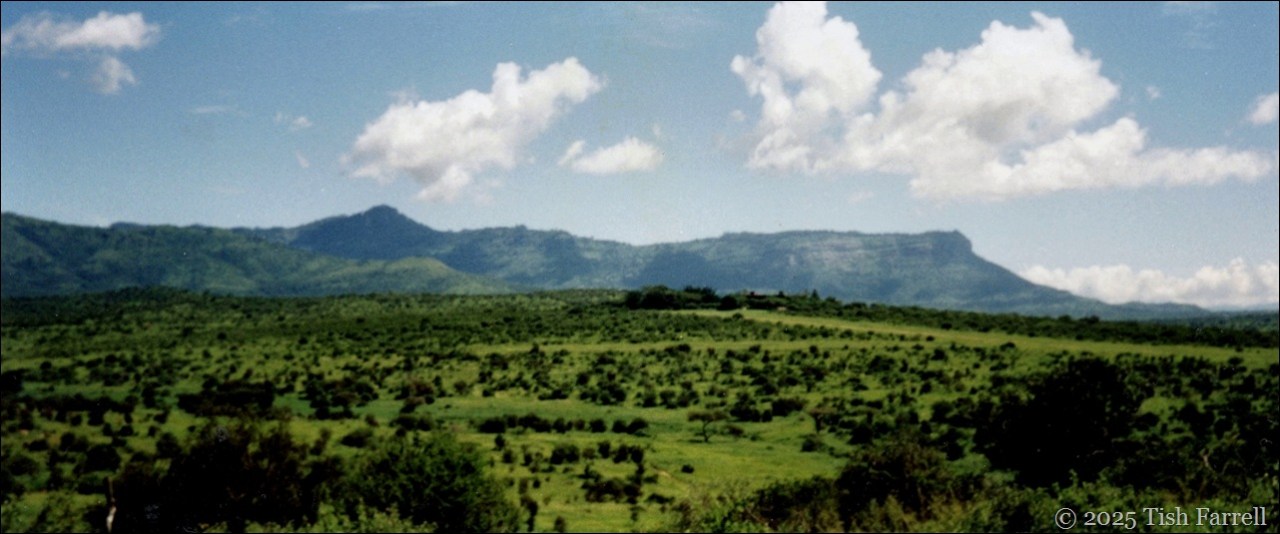
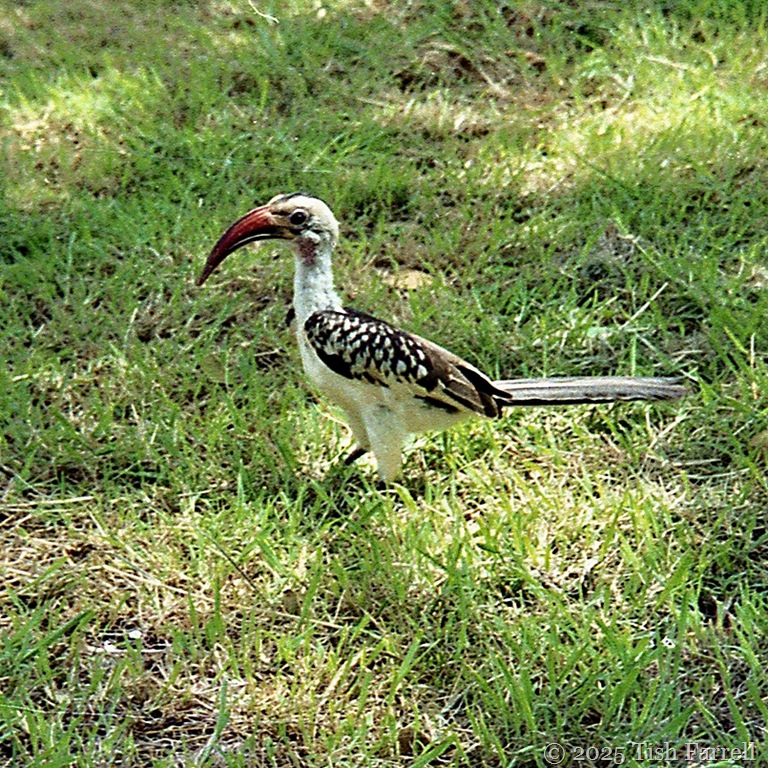
The hornbill in the photo is not the one I’m going to talk about – for reasons that will shortly become clear.
*
It was a quiet afternoon at the Taita Hills Hilton. The lunch-time safari vans had come and gone. I’d been writing letters, sitting in the shade by the teardrop pool (see previous post). Its heavenly blue, the shimmer of it, was mesmerizing, as were Robert’s passes with the pool net. The lack of guests meant he could take his time sifting out the tiny acacia leaves and assorted bugs. He moved quietly and with ease. My attention drifted.
And then Robert was at my side. Would madam like to see something very interesting. I must have looked doubtful because he assured me I did not need to go far. I then noticed he was holding a moth between thumb and forefinger. It looked dead. But this wasn’t it. He led me to the largest of the poolside flame trees, had me stand directly in front of the trunk. Look, he said, holding the moth towards the tree. In a trice it was gone. Something had moved, but I could not see what.
Robert pointed to a slit in the bark. I leaned forward and saw that behind the slit was a hollow. A very dark hollow. Except for two bright, beady eyes looking straight back at me. It was a very odd experience – to be watched from inside a tree. It was then I noticed how close my nose was to a shadowy scimitar bill. I stepped back.
Robert found another bug and held it near the slit. Another twitch of the air. And that’s when he told me about the remarkable nesting habits of the hornbill family. The mating pair find a suitably hollow tree, he said. The female then allows herself to be imprisoned, the male building up a mud and dung walled nest around her. A small opening is left so he can deliver food. And there the female stays until the eggs are laid and hatched. When all becomes too crowded in the nest, the female breaks out, and the parents then rebuild the mud wall and continue to feed the chicks through the slit until they are ready to fledge.
Well!
Robert then alerted me to the fact that the male was hovering nearby, waiting with the food delivery. We quietly withdrew. And then my new wildlife guide wanted to know what I was doing in Kenya. I told him how Graham was working on a project to control the Larger Grain Borer (LGB), an imported pest of grain stores, and that there were plans to introduce a predator beetle to reduce its numbers. Robert then said he hoped the predator would not cause harm to Taita’s butterflies. I assured him that it had been meticulously screened to have no impact on anything but LGB.
It was some eighteen months later when I talked to him again. In the interim Graham and I had been in Zambia, and when we returned to Taita Hills I found that the hornbill tree had been felled, was nothing but a stump. I was so surprised I remarked on it to the pool attendant, at which point we recognised each other. Robert then recounted all I had told him about the LGB project in the Taita Hills. I was very touched. It was as if he had thought often about our one previous conversation, as day in and day out he gracefully sieved bugs and leaves from the teardrop pool that shimmered like a mirage.
*
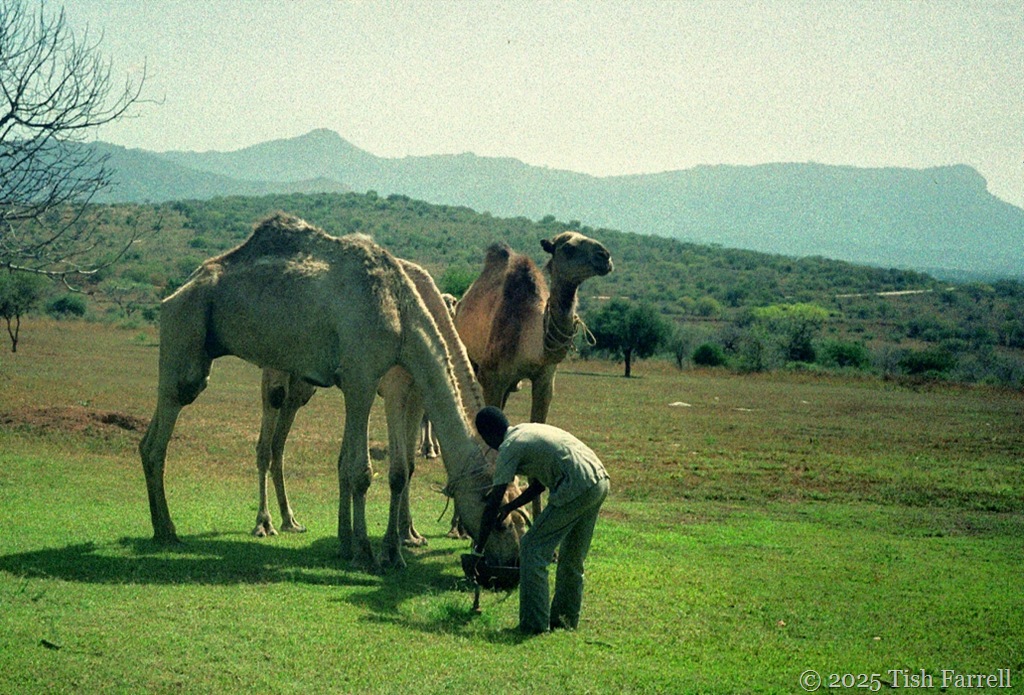
P.S. On later visits we found Robert had been promoted to camel handler; at least one assumes it was a promotion. The camels in question were ever surly creatures. Here he is in the hotel garden; the Taita Hills during the short rains.
*