

…life goes on
*
WordPress Photo Challenge: dialogue – go here for more photo conversations


First light on the Mara plains, and the Marsh Pride lionesses have eaten well. In the night they have killed a giraffe and are resting up near the remains of the carcase. The peace doesn’t last though. And it isn’t us who are bothering them.

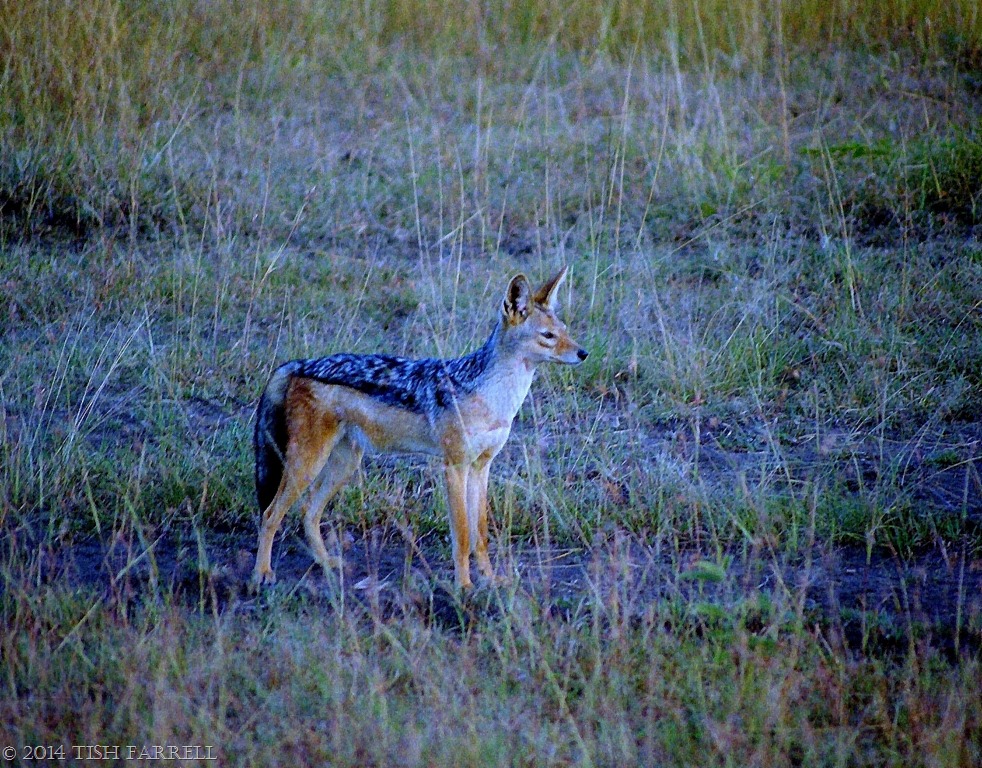
Other predators are moving in on the leftovers. First a black-backed jackal comes trotting by, watches hopefully from the side-lines. Her chances are looking slim…
…already the heavy mob are moving in – a pack of spotted hyenas.
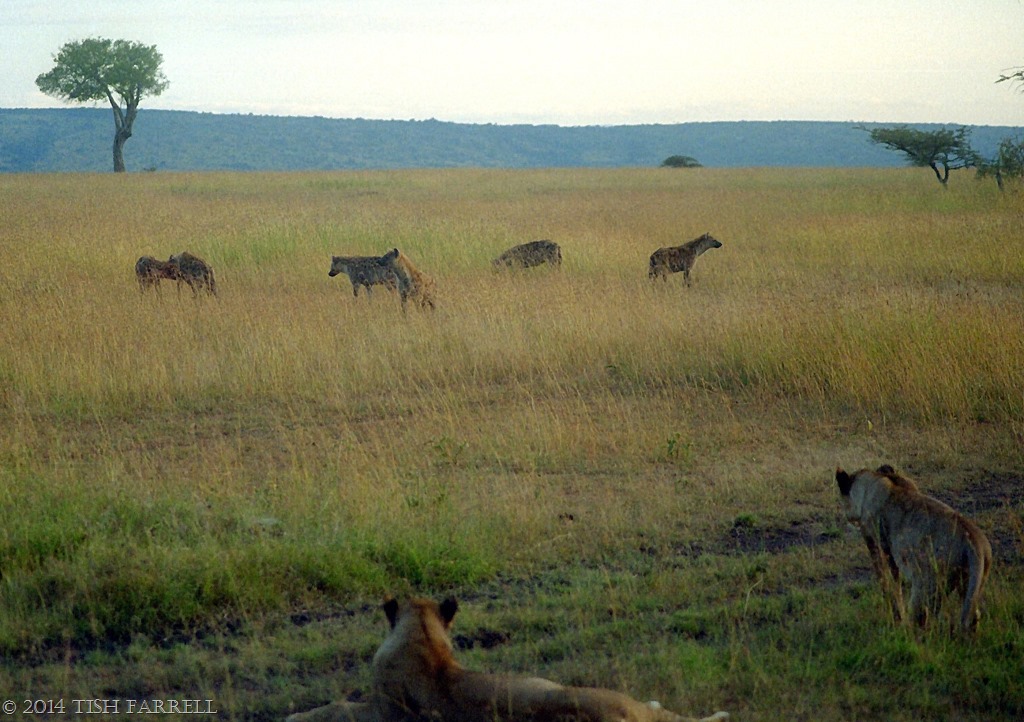
As I said in an earlier post, hyenas do not only scavenge, they are powerful hunters with jaws like demolition-crushers. And despite their lop-sided gait, their feet with blunt, non-retractable claws, are well adapted for the long-distance chase. They can take down a wildebeest and eat and digest the lot (apart from horns and rumen) within 24 hours. They will also eat anything, including the faces of sleeping humans caught out without sufficient night-time protection. This was a commonly reported horror while we lived in Kenya. In consequence they are East Africa’s most successful large predator, apart from politicians, that is.
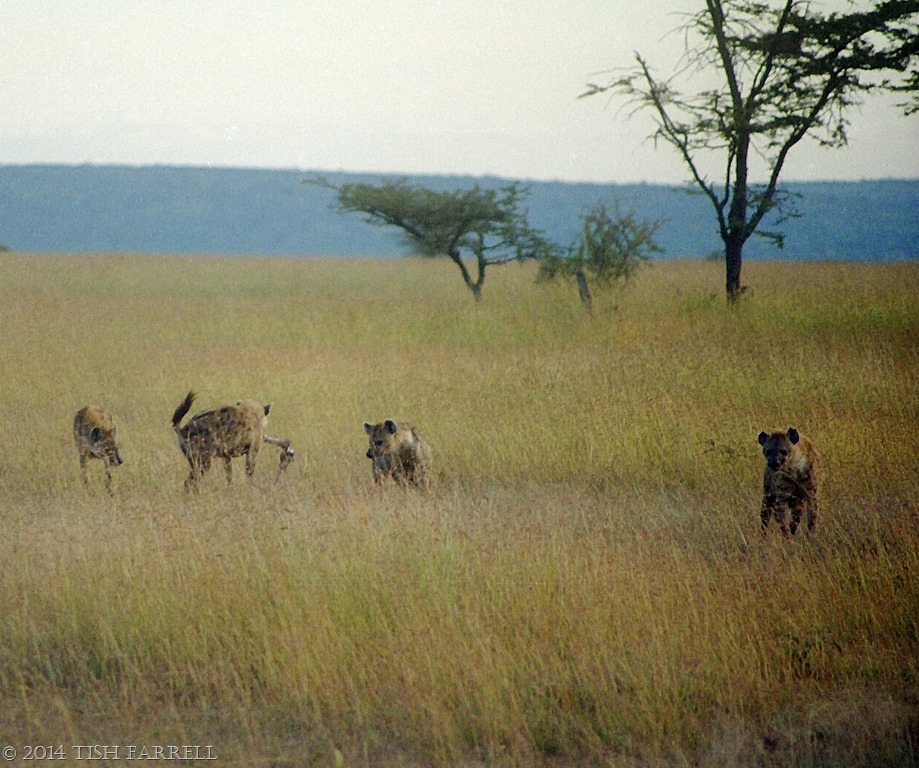
Here, one of the pack has made a rush on the kill and escaped with some leg bones, but it doesn’t look as if sharing is on the hyenas’ menu.


The lionesses go on watching, alert in that laid-back kind of way that cats do so well. The remnants are not worth fighting over. When the time comes, and bellies are empty, they will make another kill.
FLICKR COMMENTS ‘H’ WORDS for more bloggers’ stories
copyright 2014 Tish Farrell
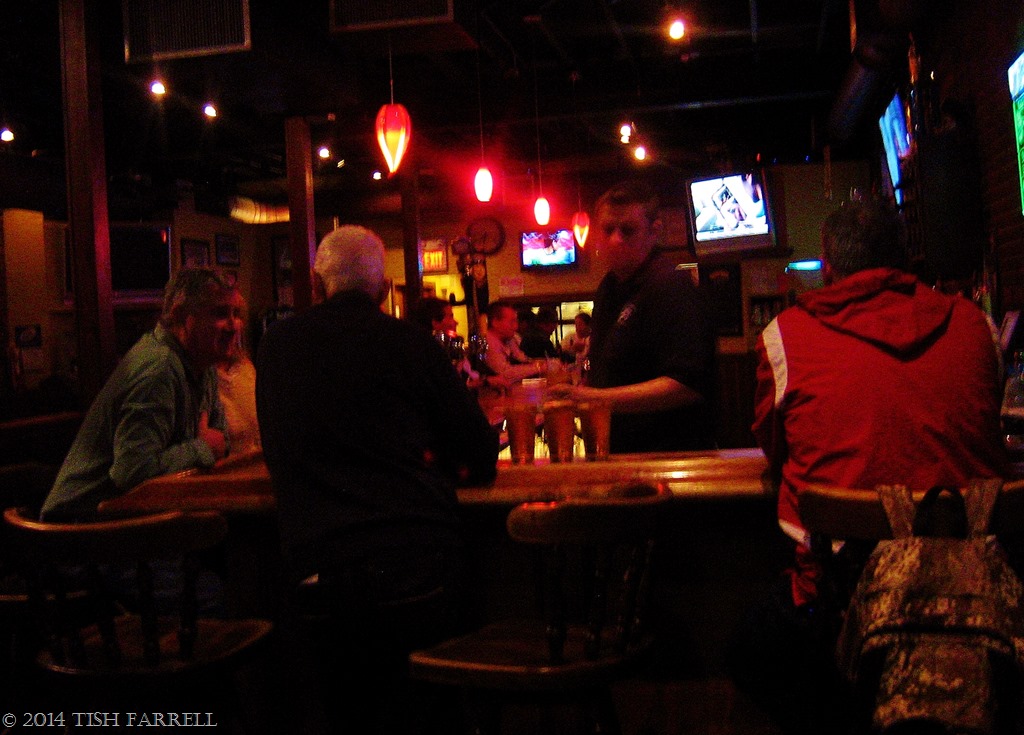
We had left Maine in late September sunshine, heading for Boston on the last leg of our journey before returning to the UK. We arrived mid-afternoon after mooching around Portsmouth. The sun lasted long enough for a fine view of Jamaica Pond, and then the rain moved in. By supper time it was cold and dreary and we did not feel like walking far from our B & B. We wandered a couple of blocks up and down Centre Street, looking for somewhere to eat. Nowhere beckoned, but at least the red glow of Costello’s sports bar looked welcoming. And it was welcoming. A query about the best brew on offer very quickly led to this:

DA-DAAH! A round of applause for Shipyard Pumpkinhead Ale.
I have to tell you that this was a whole-body experience. The rim of the glass came coated in caramel, sugar and cinnamon, which then proceeded to dribble down the sides. And all over our hands, which then required clean-up trips to the rest-room. But never mind. The ale was delicious, and required further sampling, and more de-sticking, and finger-licking. To hell with it. Who needs supper.
I now discover that this ale was created first in 2002, and that the Shipyard Brewing Company had its beginnings in Kennebunkport Harbor ME. In 1992 entrepreneur Fred Forsley joined forces with English master brewer, Alan Pugsley and started Federal Jack’s Restaurant & Brew Pub. This was the birthplace of Shipyard ales, but so popular were their English and seasonal ales, they soon had to move production to bigger premises in Portland ME.
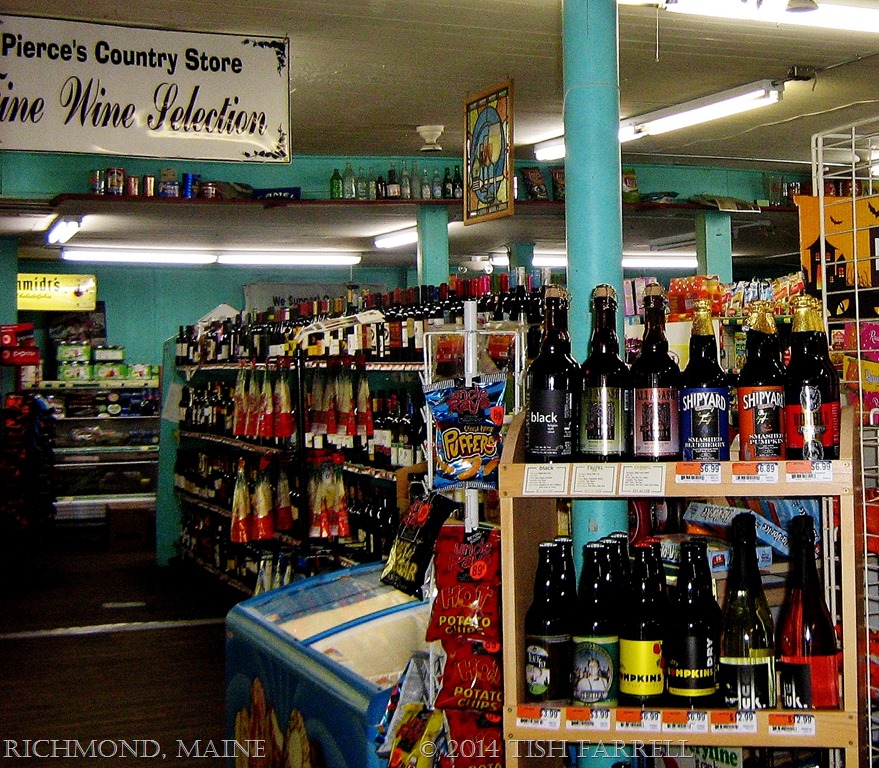
The other thing you need to know is that Pumpkinhead Ale is strictly seasonal, and only available between August and November. So get yours now. It is described as “a crisp and refreshing wheat ale with delightful aromatics and subtle spiced flavor”.
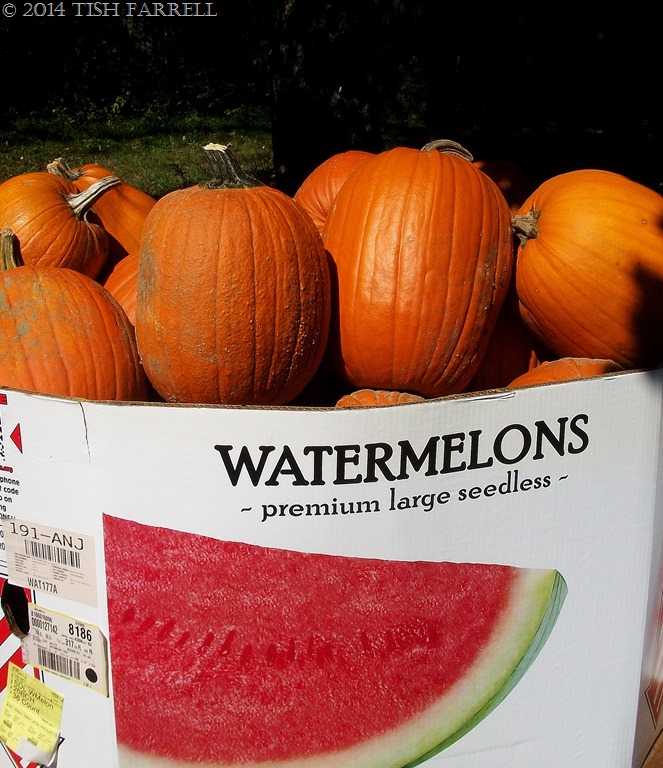
I’ll second that, or even third it. But just to finish off, and continue in the seasonal vein (since autumn has definitely come to England a month early), this last photo was taken at a farm shop just outside Kennebunkport. It’s the sort of quite understandable confusion that might arise after a beer or two. Chin-chin!
copyright 2014 Tish Farrell

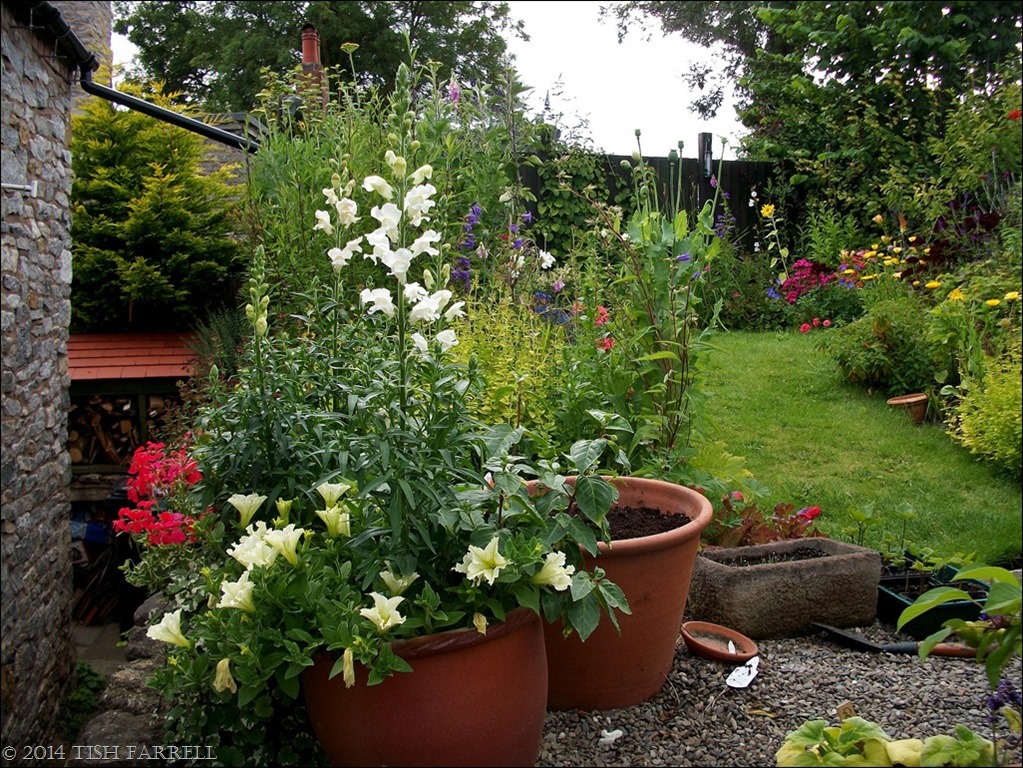
There’s a rainstorm brewing along Wenlock Edge, and the garden has taken on an autumnal air. All afternoon I’ve been watching this harvester ply the wheat field. At close quarters the cutting blades are of a scale more suited to the Canadian prairies than to a small Shropshire field. I feel the soil compact beneath the giant machinery, and it strikes me that industrial farming does not care much for the welfare of the earth, or ultimately for the nutritional quality of the crops produced. I have this image of starvation in the face of plenty, and think how skewed have our rich-world values have become. But before I make everyone feel too dreary, here’s a brighter shot of my garden earlier in the summer.
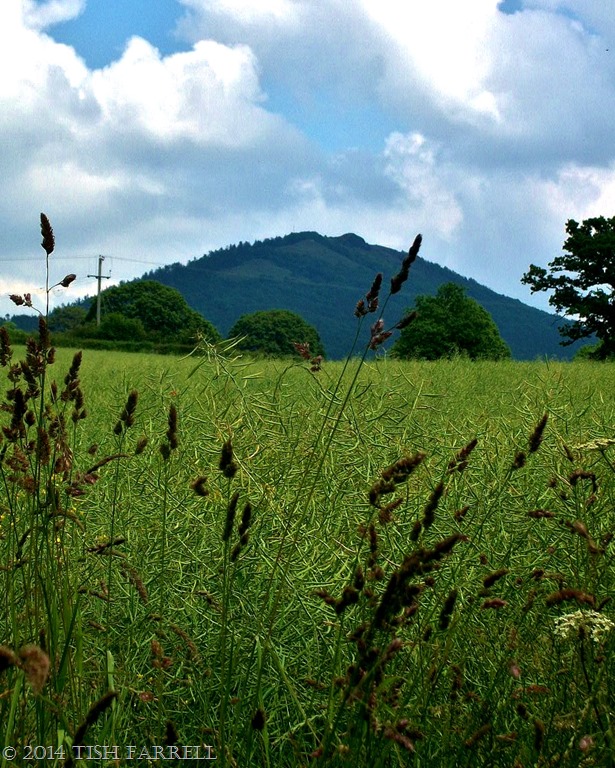
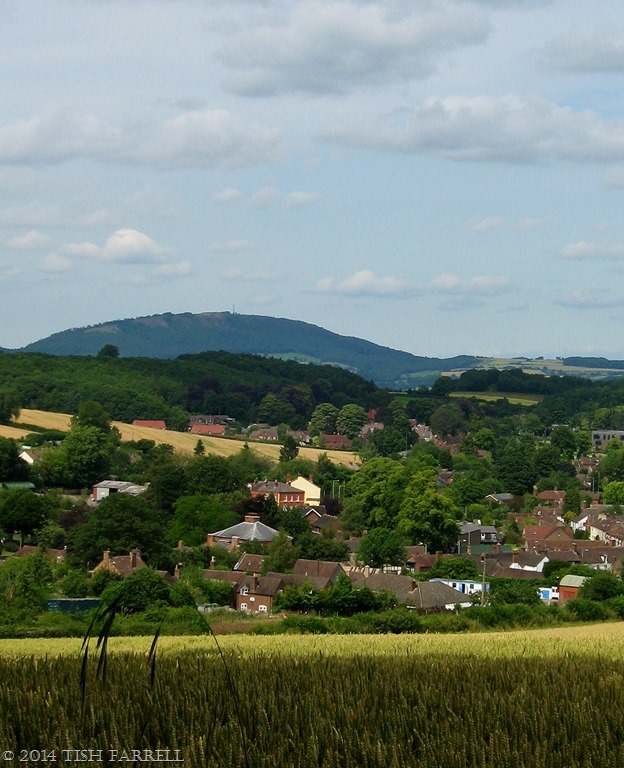
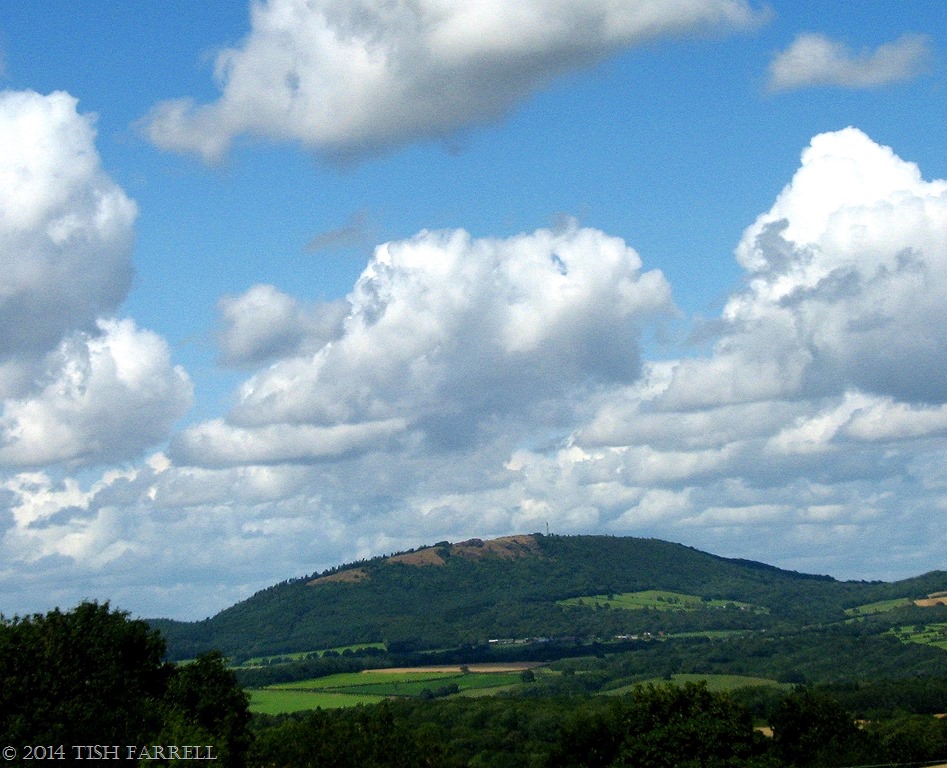
As hills go, The Wrekin (pronounced REE-kin) in my home county of Shropshire is not very high – just over 400 metres (1300 feet) . But then, as estate agents say, location is all, and this is the only big hill for miles around. It rises over a county of farm fields and the flatness of the Shropshire Plain beyond, and thus is a useful landmark when navigating the county’s ancient network of sunken rural roads. It has also long loomed large in local imagination. As with significant natural features the world over, it gives people something to think by, prompting many a tale and joke.
For instance, we have a saying whose usage extends into neighbouring counties. To go all round The Wrekin means to ramble on for hours before arriving at the point. Hopefully not exemplified in this post. Because yes, I will get around to Giant Gwendol before too much longer. But first some geology. Please don’t groan. I’ll make it snappy.
Looking at the photograph above, the first thing that strikes you is that the hill looks like an old volcano, and I seem to remember being told that it was in year 3 geography at secondary school. This apparently is not the case, although it is composed of volcanic rock. The vent that spewed it out is no longer around or visible. This is perhaps worrying. One has to put faith in notions of volcanic dormancy and, since the spewing forth of rhyolites, tuffs and agglomerates took place in the Precambrian some 680 million years ago, we can perhaps rest easy in our beds: Shropshire has had long enough to get over its hot phase.
This is also good because as you can see from the second photo, the place where I live, Much Wenlock, is rather close to The Wrekin. The yellow wheat field in the middle ground is behind my house.
But now for the Gwendol story.
There once was a Welsh giant called Gwendol. For reasons unknown he had conceived a grudge against the mayor and townsfolk of Shrewsbury, in the neighbouring county of Shropshire. Since the town lay within a nearly closed loop of the River Severn, Gwendol came up with a dastardly plan. He would dam the river and so drown the town and all who lived there.
He set off from Wales with a great spadeful of earth to do the deed, and headed for Shrewsbury. He tramped for mile after mile, but somehow lost his way, ending up instead near the town of Wellington. Weary with the search, and from carrying a heavy load, he sat down to rest.
After a time, an itinerant cobbler came walking by. He had walked from Shrewsbury and was heading for Wellington. Over his shoulder he carried a big sack of used shoes for mending.
Gwendol stopped the man and asked for directions. He even told the cobbler his plan to fill in the River Severn and so drown Shrewsbury and all who lived there.
The cobbler was horrified, and especially appalled at the prospect of losing so much trade.
He thought fast.
“Oh dear me,” he told the giant, “that town is so far away. Many days’ walk.” Then he opened his sack of old shoes. “See,” he said. “I have worn out all these shoes and boots walking from Shrewsbury.”
At this, the giant groaned. “I am too tired,” he said, “to carry my load of dirt that far. I had better leave it here.” And so he emptied it out there and then and, as a parting shot, before setting off back to Wales, he cleaned the mud from his own boots, and so left behind little Ercall, the small hill that stands nearby.
And so now you have the true story of how The Wrekin was born. In fact, for a not very bright giant, I think Gwendol did a pretty good job, landscaping-wise. Also the damming plan would never have worked. Old Shrewsbury town may sit inside the loop of the River Severn, but it is also on a very steep hill. Just as well, though, that Giant Gwendol trudged back into Wales and was never heard of more in Shropshire.
copyright 2014 Tish Farrell
SOURCE: This tale appears in Charlotte Burne’s Shropshire Folklore 1883. In other versions the Devil is the hill-builder.
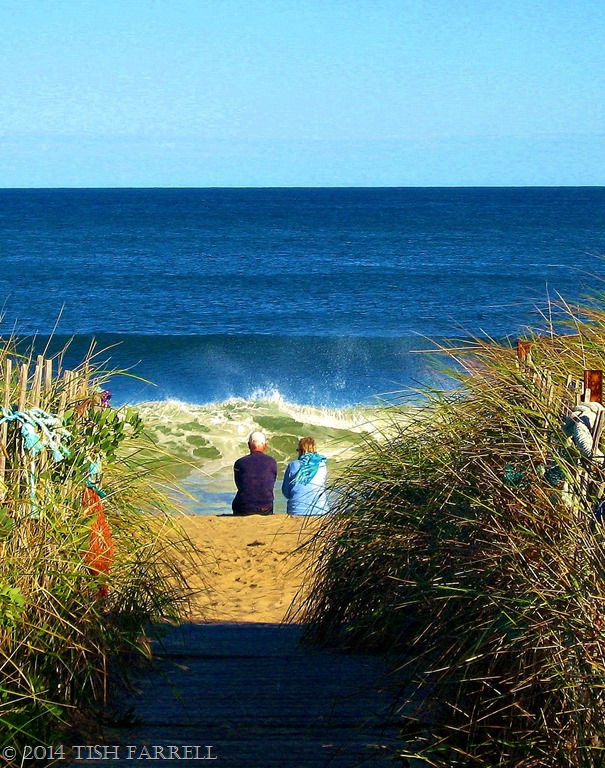
A late September afternoon on Old Orchard Beach, Southern Maine.
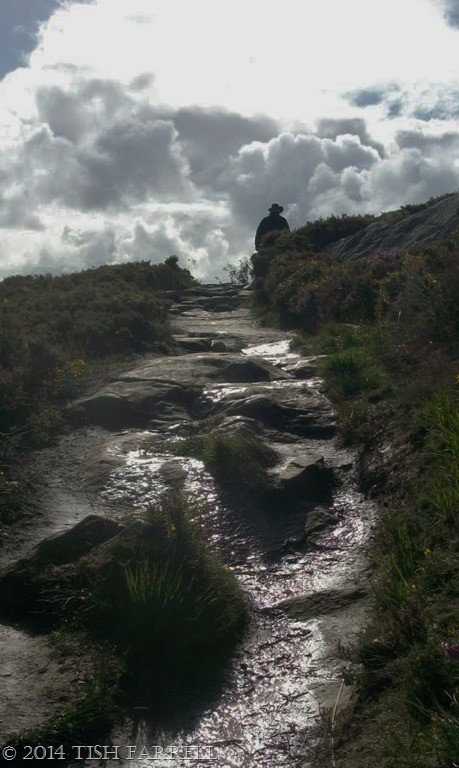
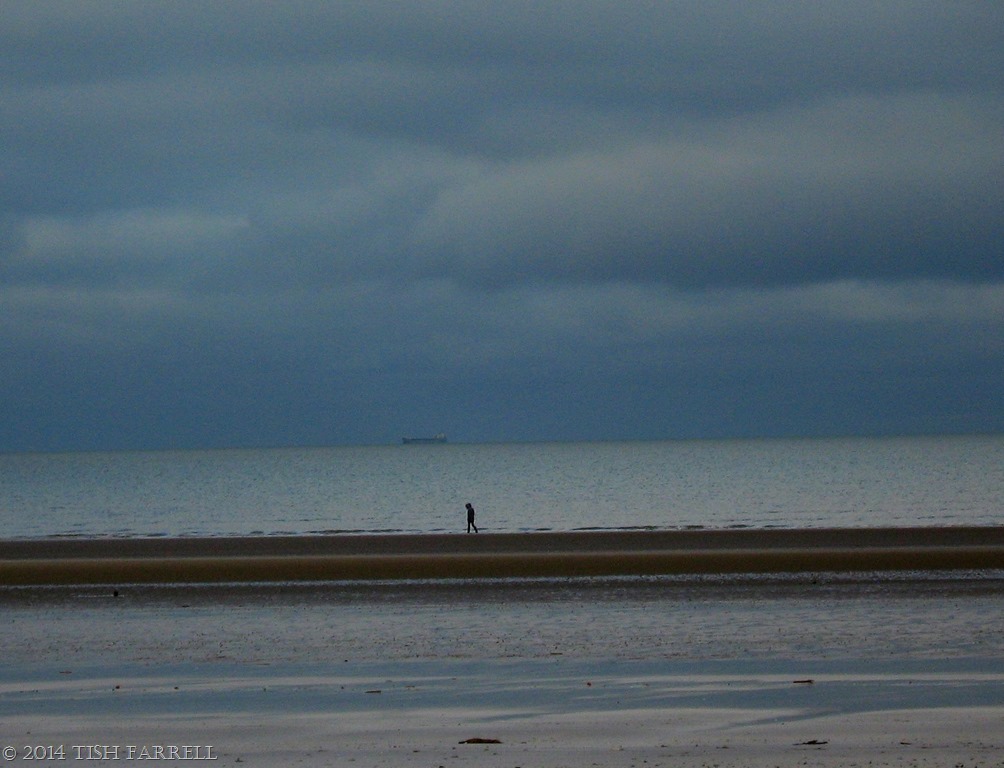
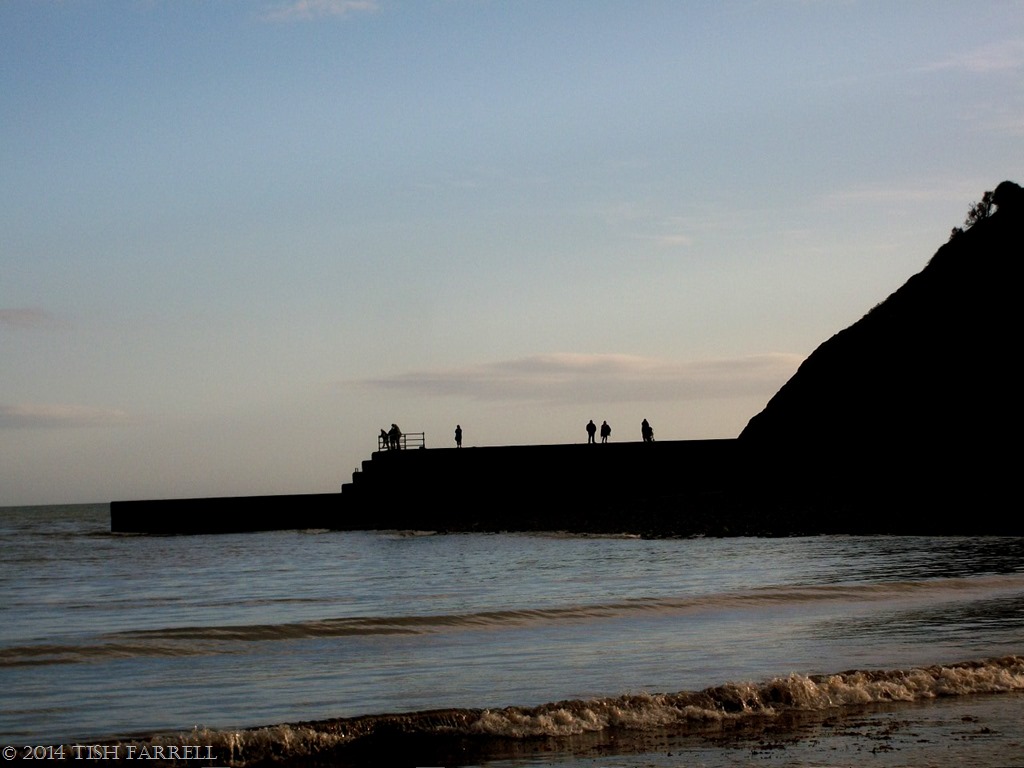
I love the stark expanse of landscape in all these shots, the inconsequence of humanity; and also a certain sense of mystery…
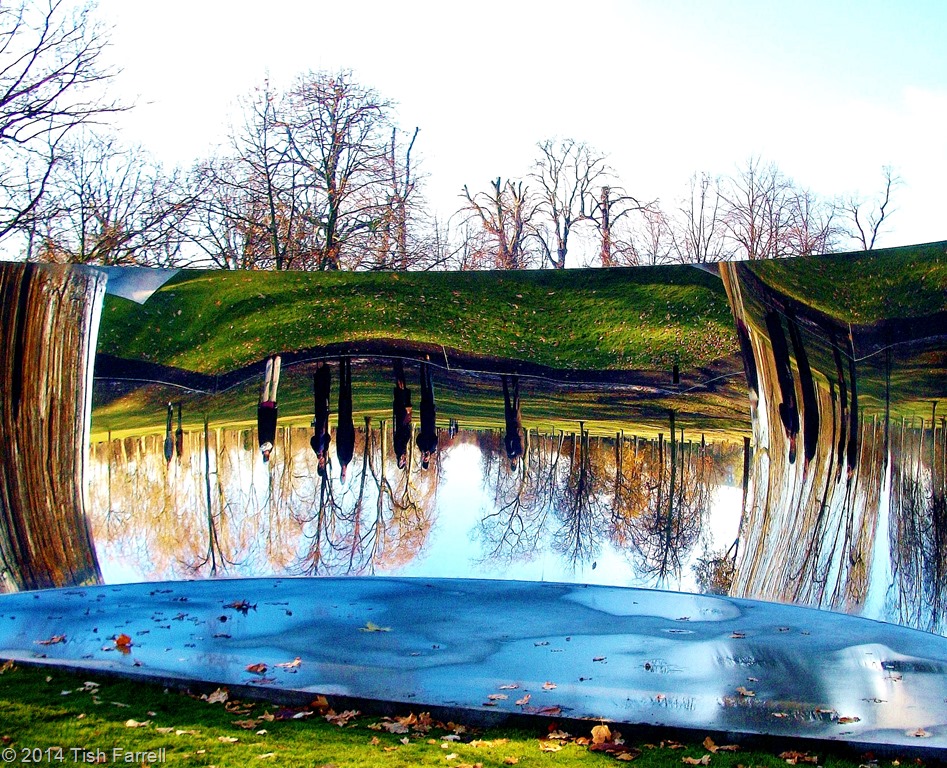

These photos of the C-Curve by Indian sculptor, Anish Kapoor, were taken on freezing cold winter’s morning in London’s Kensington Park. The marvellous stainless steel creation was one of four Kapoor pieces sited across the park for the Seeing the World Upside Down exhibition hosted by the Serpentine Gallery and Royal Parks in 2010-2011.
Some of you will have seen these shots in earlier posts, but I thought they were perfect for Cee’s challenge for all sorts of reasons. For one thing, the stark silhouettes of trees say ‘winter’, but the bright sunlight also says that life goes on; and the trees themselves, though dormant, are still full of life. I also like the reflections of the couple and the trees in the puddles on the plinth, and the reflections of the puddles in the sculpture. It is all so playful, yet reflective too – and in every sense.
Cee’s Fun Foto Challenge: water or the season of winter Go here to see more bloggers’ takes on this challenge
![Makokos-Floating-School-NLE-2[1]](https://tishfarrell.com/wp-content/uploads/2014/08/makokos-floating-school-nle-21.jpg "Makokos-Floating-School-NLE-2[1]")
Photos © 2014 NLÉ
![Makoko_approach-960x550[1]](https://tishfarrell.com/wp-content/uploads/2014/08/makoko_approach-960x5501.jpg "Makoko_approach-960x550[1]")
And what is this extraordinary structure?
Why, a floating school of course. It is also a prototype building created by Nigerian-born architect, Kunle Adeyemi and his Amsterdam-based company NLÉ. Adeyemi has more plans too, ones that will relieve the dire conditions for the 100,000 people who currently live in this, Nigeria’s Makoko slum. The fishing settlement in Lagos Lagoon has been there since the 18th century. To cope with changing tidal levels, the shanties are built on stilts, rising from the lagoon mud; the main way to get around is by boat. There is zero sanitation, and consequently much disease. Life expectancy is reckoned to be less than 40 years.
For the past two centuries Makoko slum dwellers have adapted to tidal changes, but now climate change, with rising sea levels and increasingly extreme weather events, is putting them at grave risk.
Recently the Nigerian authorities have addressed their plight by demolishing many of the stilt-built dwellings, making the inhabitants homeless. There will be re-development naturally – not for the poor who have long lived there, but to replace their community with flashy lagoon-view high rises. Makoko as it stands is deemed a blot that must be erased. It is an interesting approach to social deprivation: to make it worse.
![_61618156_a1zaixbb[1]](https://tishfarrell.com/wp-content/uploads/2014/08/61618156_a1zaixbb1.jpg "_61618156_a1zaixbb[1]")
*
See instead Adeyemi’s vision:
![NLEs-floating-school-casts-anchor-in-Lagos-Lagoon_dezeen_14[1]](https://tishfarrell.com/wp-content/uploads/2014/08/nles-floating-school-casts-anchor-in-lagos-lagoon_dezeen_141.jpg "NLEs-floating-school-casts-anchor-in-Lagos-Lagoon_dezeen_14[1]")
Now doesn’t this make your heart sing? Homes to live for.
And here is where it begins:
![ml_schoolatSea_Makoko_d2_600[1]](https://tishfarrell.com/wp-content/uploads/2014/08/ml_schoolatsea_makoko_d2_6001.png "ml_schoolatSea_Makoko_d2_600[1]")
Diagram courtesy of NLÉ.
Makoko floating school, then, is literally the flagship of NLÉ’s proposed waterborne city. The structure was designed and built in collaboration with the Makoko Waterfront Community and with input from Dutch naval architect, Erik Wassen. It is movable, and capable of dealing with storm surges and flooding. The triangular frame which is mounted on 256 floating plastic barrels makes it very stable and with a capacity to keep 100 people safe in storm conditions. PV cells on the apex generate solar power, and there are facilities to recycle organic waste and harvest rainwater. Most importantly of all, it was built using the techniques and skills of local craftspeople. It is a building that fits with people’s view of themselves. And it is beautiful.
![Makoko-Floating-School-5-606x400[1]](https://tishfarrell.com/wp-content/uploads/2014/08/makoko-floating-school-5-606x4001.jpg "Makoko-Floating-School-5-606x400[1]")
Photo © 2014 NLÉ
The school has three levels with a capacity for 60 -100 pupils. The 1st level is an open play area for breaks and assembly. Out of school hours this space may be used by the community. Level 2 is an enclosed space for 2-4 classrooms, and Level 3 has a partially enclosed workshop space.
The only fly in the ointment of NLÉ’s scheme for Makoko’s regeneration is the fact that Nigerian authorities say the floating school is an illegal structure, and should not be there. NLÉ are currently in negotiation with Lagos state government and are said to be optimistic that no immediate action will be taken.
I for one hope that this African solution to an African problem will be seen for what it is – an amazingly wonderful, life-giving, life-enhancing scheme of which Nigeria should be heartily proud. The floating school addresses both present need and future uncertainty, and in ways that its community can reproduce and embrace. It has inherent sustainability. It is a pattern to build on, adapt, develop, replicate, but on an individual human scale that everyone can understand. And as time goes on, we may all have need to tap into some of NLÉ’s ingenuity if we wish to continue living well and safely on our home planet. Town Planning that gladdens my heart and gives me hope, and believe me, that does not often happen.
text copyright 2014 Tish Farrell
Further info:
![Kunlé-Adeyemi_1c_Photo-by-Reze-Bonna-293x400[1]](https://tishfarrell.com/wp-content/uploads/2014/08/kunl-adeyemi_1c_photo-by-reze-bonna-293x4001.jpg "Kunlé-Adeyemi_1c_Photo-by-Reze-Bonna-293x400[1]")
The Architectural Review Jan 2014
http://www.nleworks.com/case/makoko-floating-school/

Today, 10 August 2014, is World Lion Day, and I’m posting this photo of a rather threadbare old lion. He might look world-weary lying here in the Mara oat grass, but he still conveys a sense of the powerful creature he once was. Of course in these days when humanity and wildlife increasingly compete for territory, it is wishful thinking to hope that all lions might live out their natural life span in the wilderness they have left to them.
DP weekly photo challenge: texture
