Ancestral spaces

P1080417cr

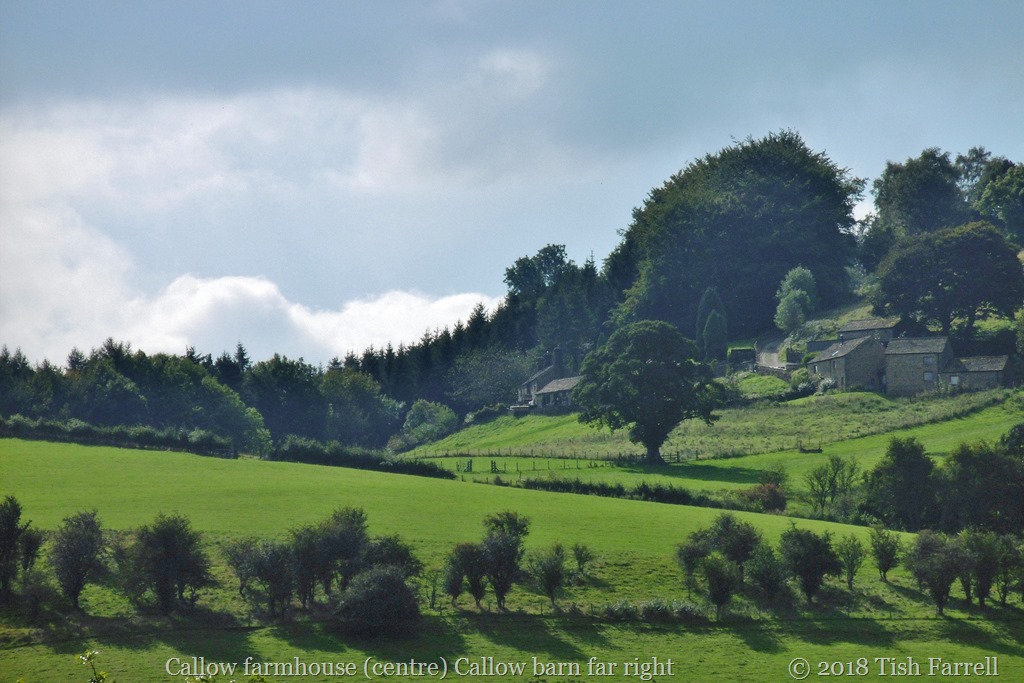
Offerton Moor viewed from Callow Farm, Highlow, Derbyshire

*

I’ve been posting views of South Shropshire lately, the green and wooded hill country of my home county. It is a terrain that, on the whole, seems more amiable than rugged, although in bad winter weather the tops of Stiperstones and Long Mynd  will ever prove challenging.

But today, on another hoar-frosted day in Bishops Castle, I’m thinking of the Derbyshire Peak District where my maternal Fox family ancestors farmed over many generations. What a tough life they must have led, running sheep on the high moors, struggling to raise essential oat crops in more sheltered enclaves, raising a few cattle to provide milk to make cheese and butter: the cheese a staple with ale and oatcakes, the butter to sell at market.

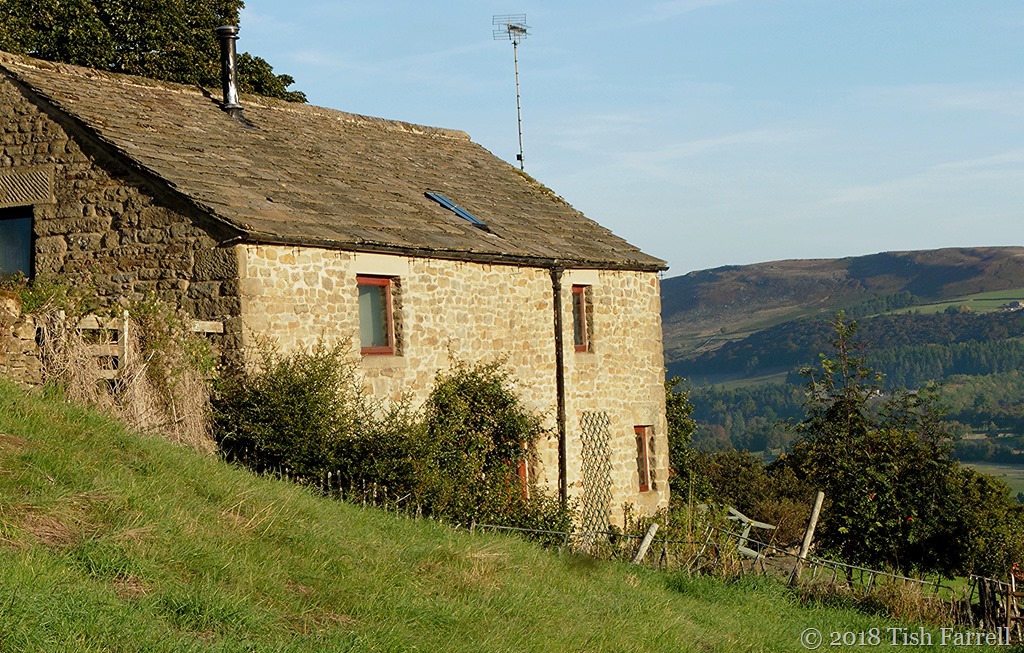
The header photo is the view from the former farmyard of Callow Farm, last occupied by 3x great grandfather George Brayley Fox in 1892.

Most of the High Peak farmers (even if they were yeomen owning some land and property) were also tenants of large estate owners – the Dukes of Rutland and Devonshire as well as lesser lords of manors. The farms provided food and shelter, but Derbyshire farmers were opportunists too. For centuries they mixed farming with other trades, butchery, hat making, grindstone making for milling and the Sheffield cutlery trade, weaving, haulage, and most dangerously of all, but potentially lucrative, lead mining; this last usually carried out in winter months when there was little farm work.

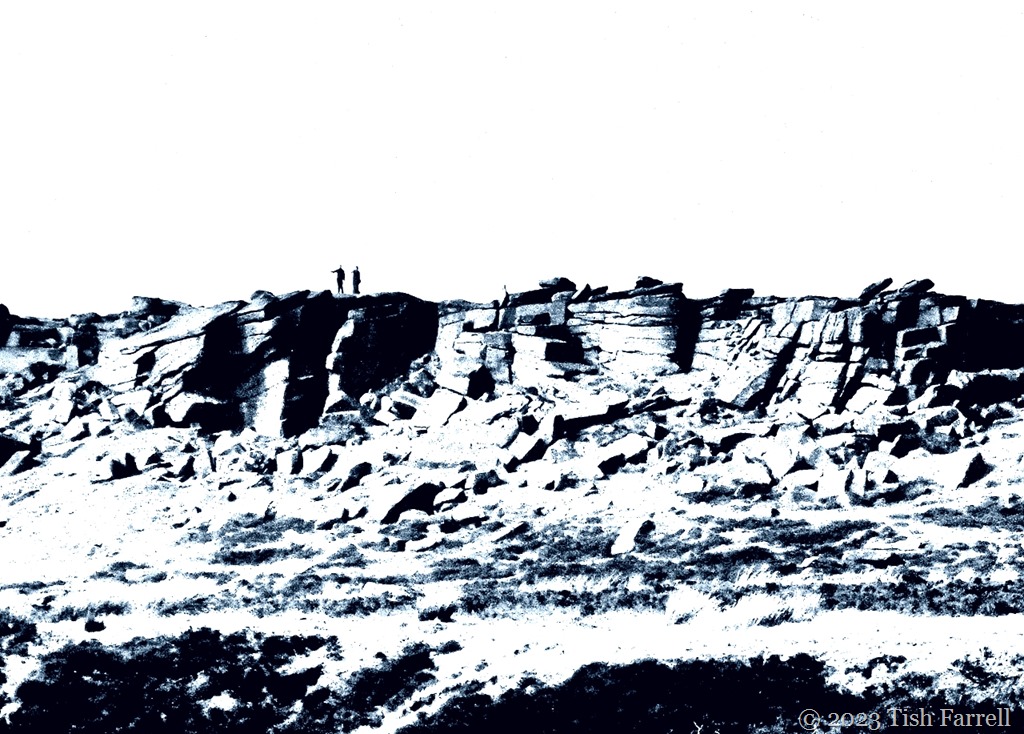
These next views are of Stanage Edge. This gritstone escarpment lies across the valley from Callow Farm. This is where millstones were once cut and hauled to nearby Sheffield. I know there were farmer Foxes who went in for this arduous trade, but none, as far as I know, in my immediate family tree.
P1000999ed

*

P1080864ed

*

This next photo is of Scraper Low Farm also known as Scraper Low Hall. It stands above Hathersage, and for a short time was the home of my 2x great aunt, Sophia Lister nee Fox who married Mr. Lister the silversmith while still attached to hill farmer, John Brocklehurst who himself had bigamously married a young next-door widow. You can read the story at the link.

When we first came upon Scraper Low, I was astonished that the Listers would choose to move to such a lonely place after living in a Sheffield city centre flat, to say nothing of taking on a farm in their sixties. But then when I walked up the long approach lane, I realised that whenever Sophia walked this way from her extraordinary castellated porch house, she would have been able to scan across the Derwent Valley and spot Callow Farm where she was born in 1814, the place where her brothers George and William still lived.

But then was she engaging in family feeling, or cocking a snook at the relatives now that she could pretend she’d finally made something of herself?

P1080976ed

*

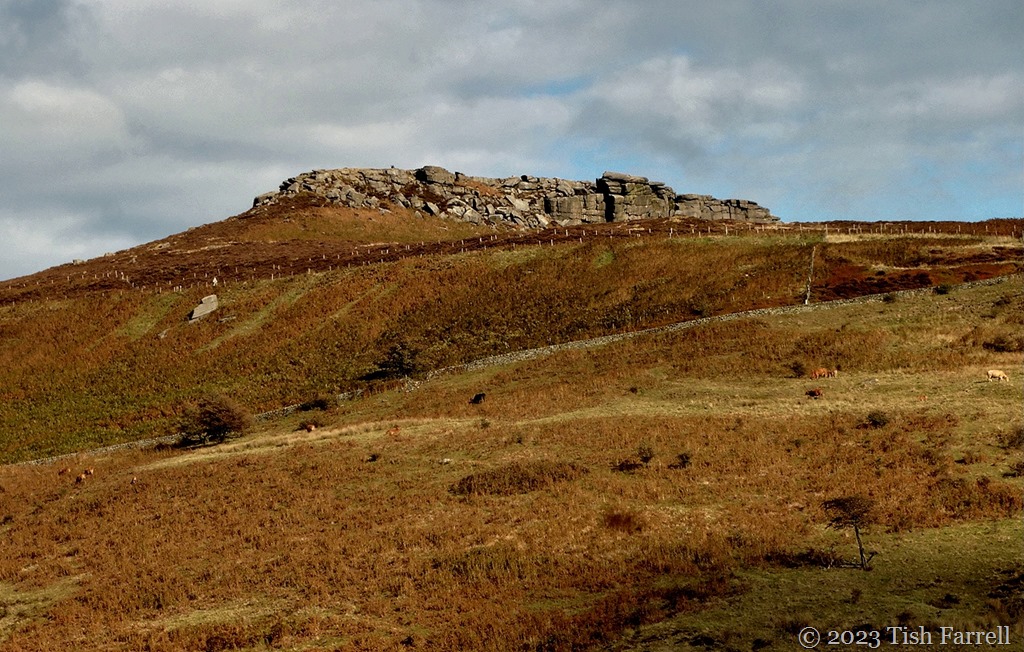
This is the view from Scraper Low: Hathersage Moor – Higger Tor, Carl Wark hillfort and Burbage Rocks. It’s a landscape that already looks bleak in September. Imagine it in winter:
P1090030ed

P1080997ed

*

And finally back to Callow Farm, a more benign scene of the fields below the house, once worked by four generations of Foxes: George, Robert, George and William.

P1080325ed

*

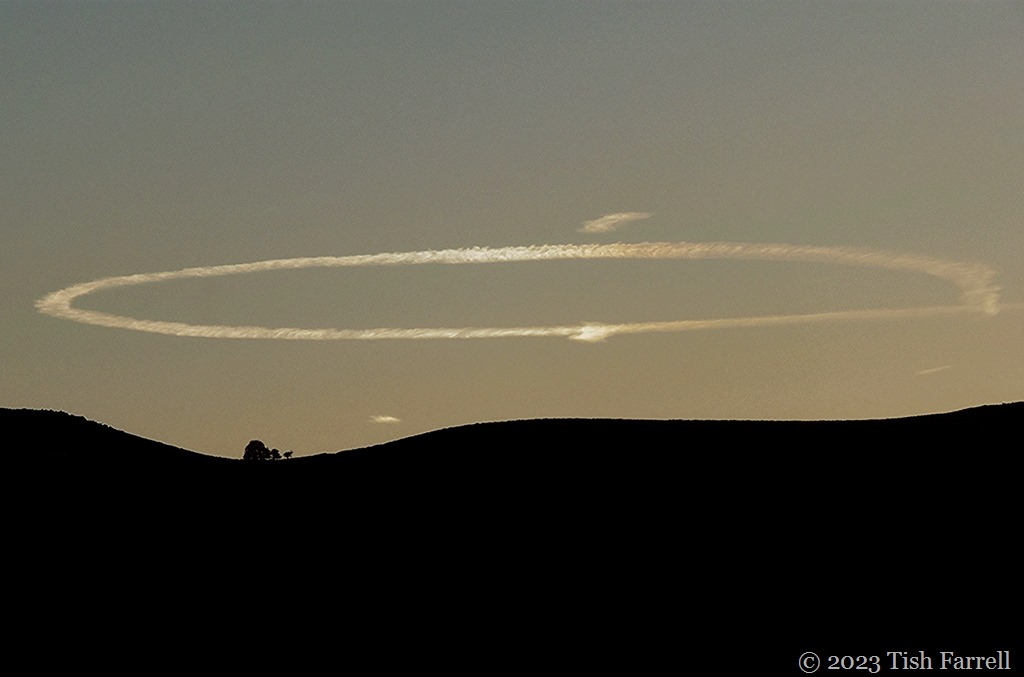
And an early morning flight trail across the valley. Not the sort of phenomenon the ancestors would have spotted, nor dreamed of seeing.
P1080444ed

Lens-Artists: Empty Spaces  Over this past week Patti has asked to show her empty spaces, however we chose to interpret the theme.
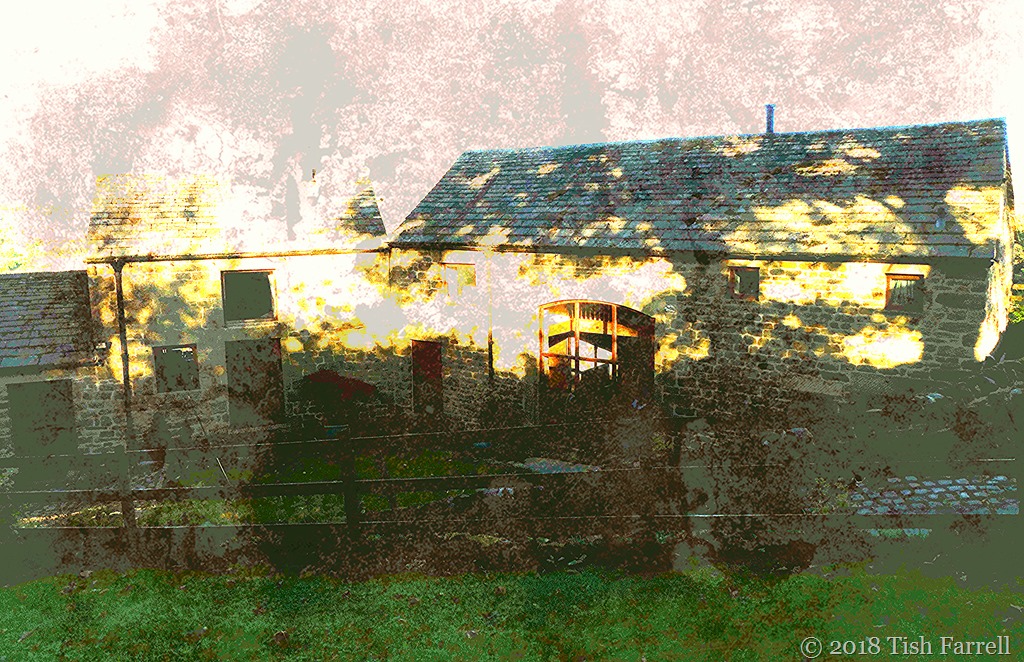
So What Did Great Great Grandfather George Brayley Fox Keep In His Barns In 1892?

P1080297ed

Here we were then staying in the ancestral Callow barns and in the greatest comfort, each day looking out on the fields farmed by four generations of our Fox family, and wondering what it must have been like to have lived a life in these remote uplands above the Hope Valley, to have worked this land in all weathers.

The name Callow perhaps says it all – deemed to mean cold or bare hill in Old English. A hard life then, and especially for the women who mostly died in their forties and fifties after giving birth over and over. By contrast the Fox men tended to be long lived 2x, 4x and 5x-great-grandfathers all lasted into their eighties, and George Brayley’s grandfather, George, was 93 when he died. Tough old birds the lot of them, and some of them prone to a bit of competitive fist fighting, a pursuit that was illegal but much favoured and therefore well supported by the gentry.

In the last post I said that many of Derbyshire’s yeomen farmers were also much involved in lead mining and processing. This dangerous trade could make your fortune or kill you. The Barmote Court that regulated the industry’s practices was an ancient institution going back to 1288 when 115 square miles of Derbyshire’s High and Low Peak was established as the King’s Field, a free mining area. Surprisingly the construct pertains today, the last surviving Barmote Court still meeting at Wirksworth once a year.

According to Peak District Online the rules of the King’s Field were as follows:

Anybody was allowed to set up as a miner and work by very liberal rules permitting them to search for lead ore anywhere but in churchyards, gardens, orchards and highways. The miners had right of access, water and space to mine and dump their waste without regard. They did however have to pay a royalty on all ore mined, of one thirteenth to the Crown( known as a lot ) and one tenth or tithe to the Church.
The Barmote Court was established to deal with disputes and claims arising from lead mining and to collect the royalties due.

In other words, the lead miners were likely to be tough, free-booting individuals and, although answerable to the Barmote Court in the staking and working of their claims, their pursuit of lead gave them the chance to break free from feudal obligations as tenant farmers and manorial employees.  One 16th century yeoman, Arthur Mower, also bailiff to the Lord of the Manor of Barlow, became so rich from lead mining and exporting he soon outclassed his lordship in terms of wealth and property. Not so the Foxes, at least not the Callow clan. But then George Brayley Fox did have quarry tools in his barn. And many more things besides.

P1050618

The 1891 census shows that George is seventy years old and  a widower. He is living at Callow with his son George (22 years) and daughter Louisa (25 years). His 9 year old step-grandchild from Farnworth, Bolton in Manchester is also staying there at the time of the census, and this may be a clue as to the real reason why George B had announced his intention to sell up by the following year.

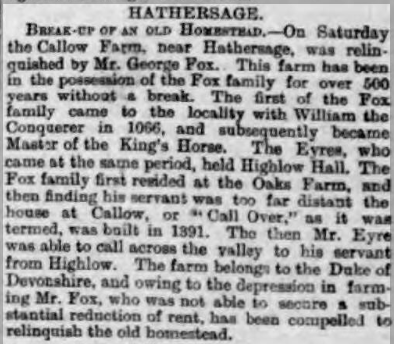
Giving up the tenancy of the farm where he was born must have been a wrench. It was certainly newsworthy, and reports of the Fox family finally leaving Callow were published in regional newspapers as far away as Leeds. The reports made much of the family’s connection with Callow’s environs since Norman Conquest days, a claim that was part of the Fox family narrative, much repeated down the generations, but so far lacking verifiable substance. The report below also says that the reason for selling up was due to the high rent, which was very much a common complaint of Derbyshire farmers at this time. But I still wonder if this was the chief reason, or the one meant for public consumption.

Derbyshire Courier 25 March 1893

Derbyshire Courier 25 March 1893

*

So back to facts.

On Saturday 29 October 1892 the Sheffield & Rotherham Independent newspaper listed items in the upcoming Callow Farm sale. It is a vivid snapshot of life on the farm, and the picture it gives is of a well-managed enterprise using up-to-date technology, not of a farm that is failing. Much of the equipment is stated to be new, and the livestock of good quality.

First there are the horses – a black mare in foal, and an ‘excellent worker’; a valuable six-year old brown horse with ‘splendid action’; a roan foal by Bedford. There are 23 cows including 5 strong bullocks, a cow in calf for 25th December, and 4 cows due to calf in April. Then there are ‘11 superior stock ewes, 6 fat sheep, one two-shear ram, 12 strong lambs’. Finally in the farmyard there are ‘two fine ducks and one fine drake’.

P1080344

And now for the barn contents.

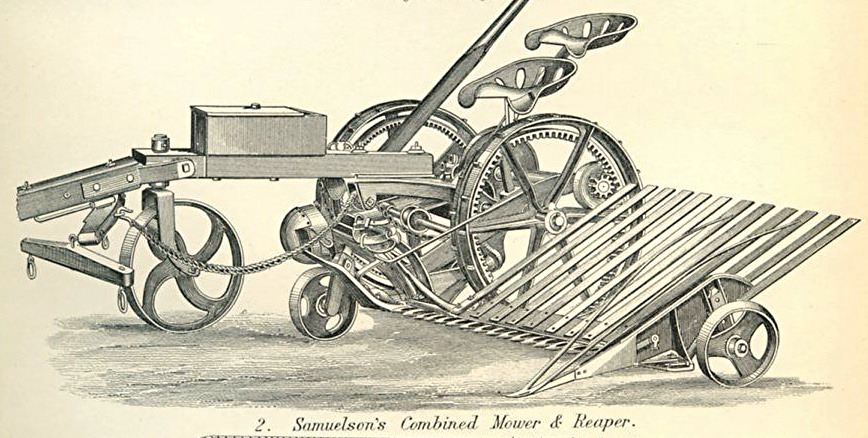
These included some pretty high-tech (not to say cutting edge) gear of the day, including a nearly new Samuelson 2-horse combined mower-reaper complete with spare shafts. This was the sort of pioneering equipment that was shown off at national trade exhibitions of the day, produced by the Britannia Works, Banbury.

Samuelson mower reaper

There was also a plough, several sets of harrows, a stone roller, a horse turnip hoe, 2 horse carts, a winnowing machine, a joiner’s bench and tools.

Then there are clues as to what the farm was producing. There is a stone cheese press, rack and boards (nearly new), five stacks of white oats, three stacks of wheat, two brewing tubs, a quantity of eating turnips – all of which reflect the standard staple diet of Derbyshire farming folk. For the animals there was one stack of ‘prime new hay’ and two stacks of black oats – probably horse fare.

The whole lot up for auction at 12 noon on the 3rd November 1892.

*

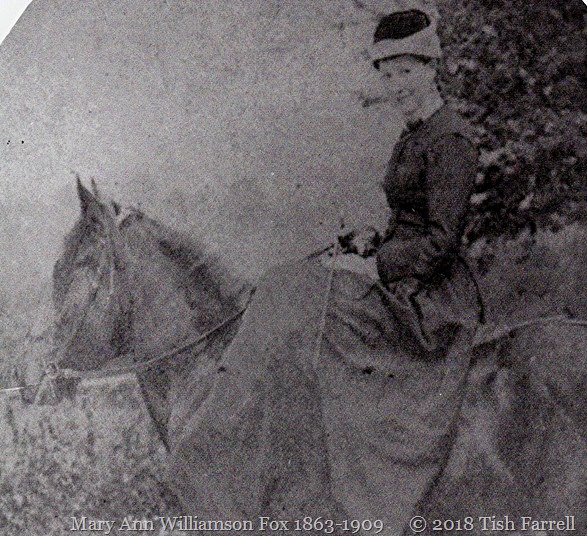
And the reason for the sale – well my big guess is that it has much more to do with his eldest daughter, my Great Grandmother, Mary Ann Williamson Fox. According to my aunt she was engaged to the Squire of Abney (just over the hill from Callow), but at the age of 22  she ran off and married a young widower, a shuttle and flyer manufacturer from Farnworth, Bolton. And not very long after that, it was all downhill for the last generation of Callow Foxes. But that story will have to wait for another time.

Mary Ann Fox

copyright 2018 Tish Farrell