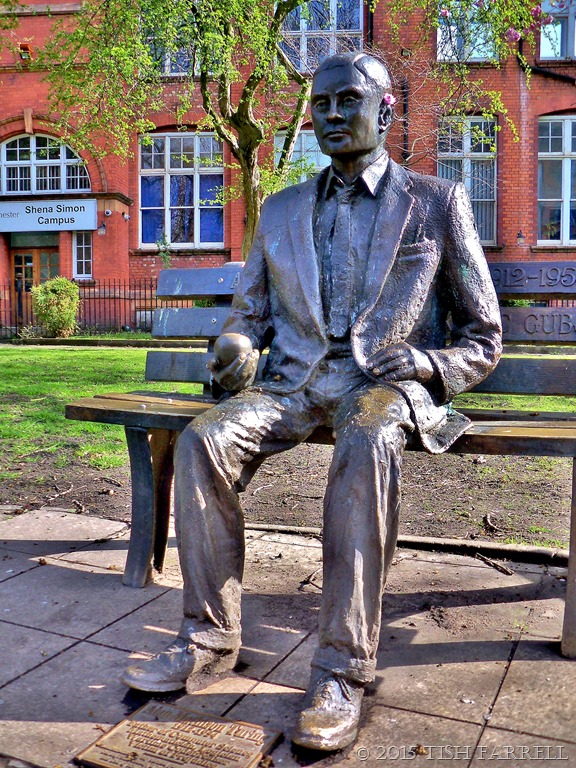
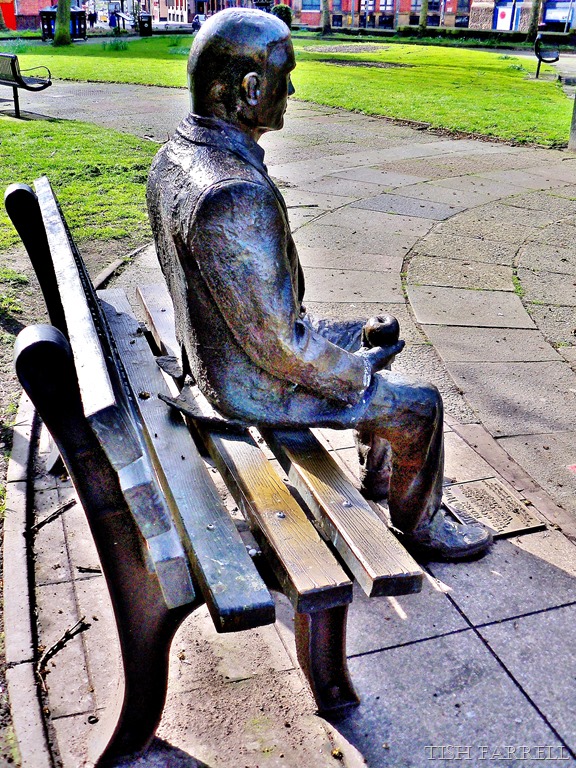
Alan Turing Memorial 1912-1954, Sackville Gardens, Manchester: sculptor Glyn Hughes
*
Over at Travel Words, Jude’s October Bench series calls for shots of benches with someone or something on them. This reminded me that I hadn’t posted these photographs of the Alan Turing Memorial, taken on a bright and early April morning in Manchester. I like the way someone has placed a cherry blossom behind his ear – symbolic perhaps, but affectionate too. I feel that if he had been alive now, living in world that is rather more enlightened about sexual mores, he would have enjoyed the gesture.
I have written a little about Turing’s life in an earlier post – An Intricate Mind. His is a mind we could have well done without losing before it had reached the natural conclusion of its great thought processes. And since no opportunity should be lost to counter any lurking bigotry, I’m repeating here what I said in that post:
Here is the statue of man whose decoding of German Enigma Code is credited with shortening World War 2 by two years, and so saving thousands of lives. After the war, working in Manchester, he played a key role in developing ‘Baby’, the first digital computer. He had the brilliance of intellect and foresight that should have been considered a national treasure. Yet in 1952 he was charged with engaging in homosexual acts, tried and convicted of gross indecency. The penalty was prison or chemical castration through the administration of oestrogen. He chose the latter. But because homosexuals were considered security risks, he forfeited his security clearance. In 1954 he was found dead. At the inquest the coroner concluded he had committed suicide by taking potassium cyanide. He was forty two.
There have various theories about his death: that he staged it to look like an accident; that it was in fact an accident; that he was assassinated. In any event we can only guess at the scale of his future contributions to the domains of science, mathematics, and computer technology had he lived. In 1950, concluding his article in the journal Mind, Computing Machinery and Intelligence, he himself said:
We can see only a short distance ahead, but we can see plenty there that needs to be done.
In 2013 Turing was granted a royal pardon, and British Prime Minister, Gordon Brown, expressed his regret at the way the eminent mathematician had been treated. Today, Turing’s great-niece, Rachel Barnes is lending her support to the campaign Turing’s Law that wishes to see 49,000 others given posthumous pardons. She says that while the Turing family was delighted by Alan Turning’s pardon, they felt it unfair that it was not extended to others similarly convicted.
Turing relative demands pardons for gay men convicted under outdated laws
And all I can say is: see where bigotry takes us. And if you want to see what kind of funny, humane man Alan Turing was, and discover something of his intricate thinking, then read the article Computing Machinery and Intelligence at the link above. It begins with the words:
I propose to consider the question, “Can machines think?”

copyright 2015 Tish Farrell