Traces Of The Past ~ The 330-Year-Old Hedge

P1040963

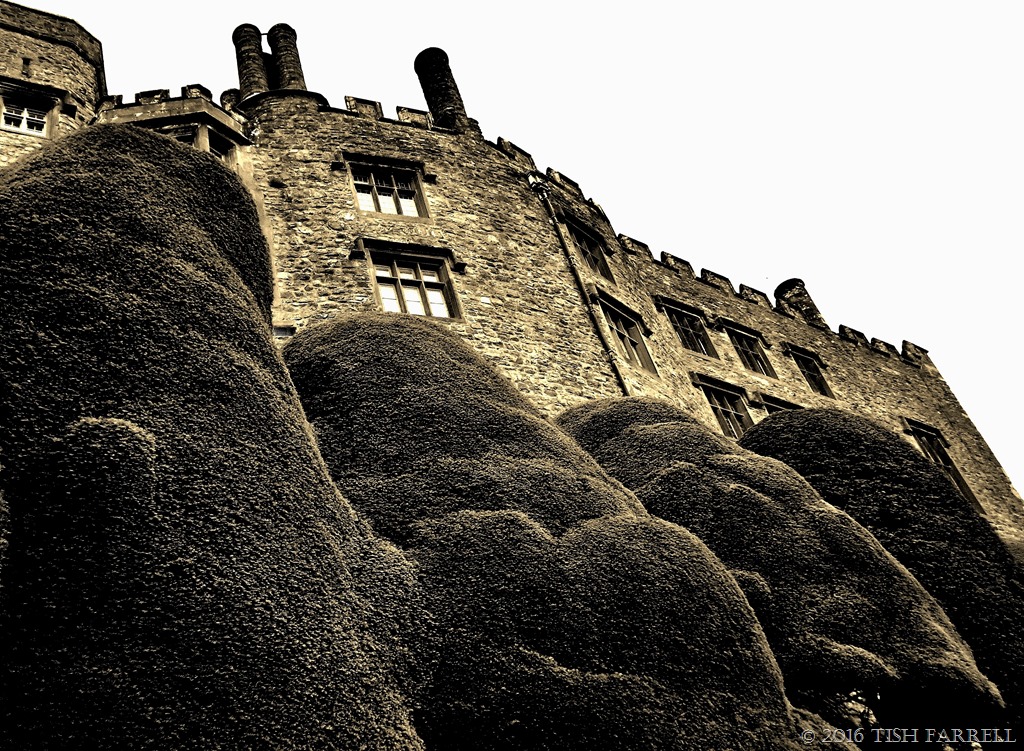
It’s hard to imagine that this gigantic bastion of ancient yew trees began three centuries ago as a formal terrace row, each tree cut into a neat, small cone or obelisk. Back then in the 1680s, when these trees were first planted, the taste in grand garden design was for the linear and geometric, following the French notion of strict plant control.

A hundred years later it was all change.  In keeping with the new romantic landscape style of English gardening, the yews were allowed to grow as they pleased. The aim was to create vistas of idealized nature.

But this more liberal attitude did not last either. Around the time of the yews’ two-hundredth birthdays, Victorian garden men armed with sickles and step ladders intervened, and began creating this  arboreal rampart of free-form topiary. Both fascinating and overbearing, I feel. The gardeners apparently hung onto to their ladders with one hand, while pruning and shaping with the other.

Today, the effect is still maintained by National Trust gardeners, now using electric hedge trimmers. Every year four of them start work in late August, and keep on trimming until mid-November – three months’ toil.

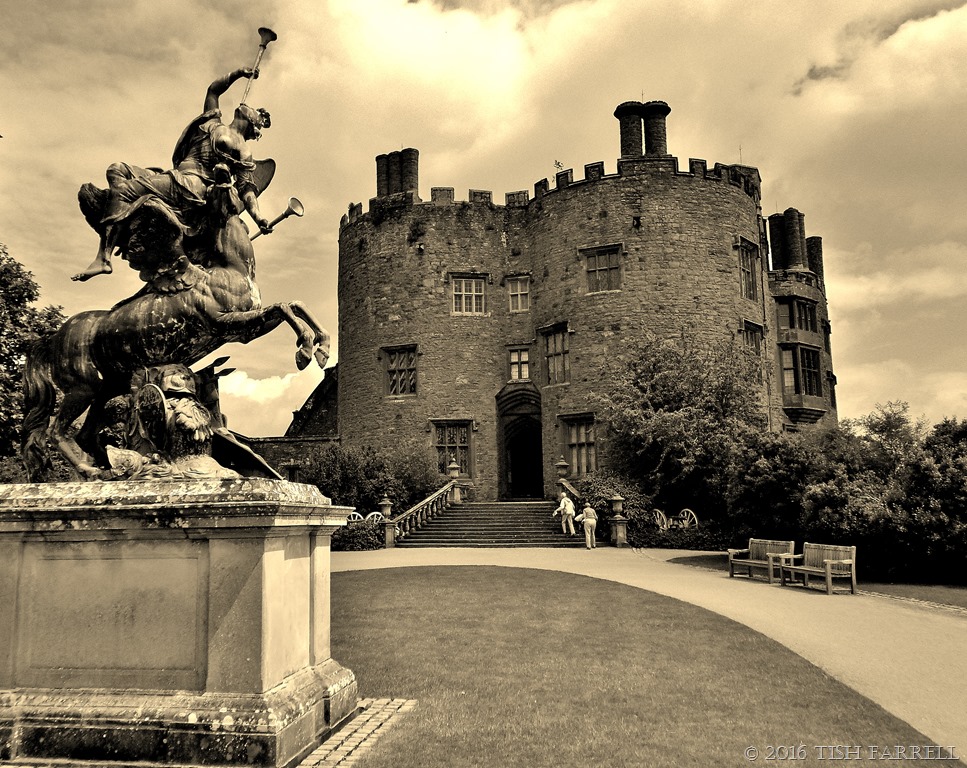
The yews are to be seen at one of the National Trust’s outstanding properties – Powis Castle, near Welshpool in Powys, just over the border from Shropshire. We called in there on our way home from our recent stay on the Mawddach Estuary in mid Wales. I’m afraid that on this occasion it was more for a good cup of coffee than for culture.

P1040976

P1040932

The castle dates from around 1200 when it was the stronghold of the last Welsh princes of Powys. In the sixteenth century ownership passed to the English Herbert family who acquired the title Earl of Powis. Indeed, they appeared to have acquired it on three separate occasions through history until the title eventually stuck fast to the family.

One of the Herbert daughters married the son of Clive of India (Robert Clive 1725-1774) – he who plundered the subcontinent under the auspices of the British East India Company. The Clive fortune paid for repair and development of the castle, and Robert Clive’s collection of valuable arts works gathered during his India days are on display there. You can tell I have very mixed feelings about this. But scruples aside, the house is well worth seeing and it contains many treasures.

The garden, though, is the best part. The setting is magnificent, with stunning views of the Welsh borderland. A whole day (and indeed several days at different seasons) could be spent exploring the many layered terraces, the lawns and woodland walks. The planting is on an epic scale with many unusual herbaceous varieties deployed. Specialist garden history talks are also available, and when energy flags (and as intimated earlier) there’s a good restaurant-tea room for re-charging purposes. Although to be on the safe, take your own picnic as well. It’s a long way from the grand lawn to the courtyard refreshment station.

copyright 2016 Tish Farrell

Please visit Paula at Lost in Translation for more traces of the past. This theme is going to be regular every-other-month challenge on her blog, which is good news. Thank you, Paula. I have lots more traces in my archive.

Going Behind The Scenes In Wenlock Abbey

IMG_1979

We followed in the footsteps of long-gone celebrities on our recent, and I have to say, nigglingly exclusive visit to Wenlock Abbey. It was the first chance we have had to visit there, and it was done under the auspices of our Civic Society.

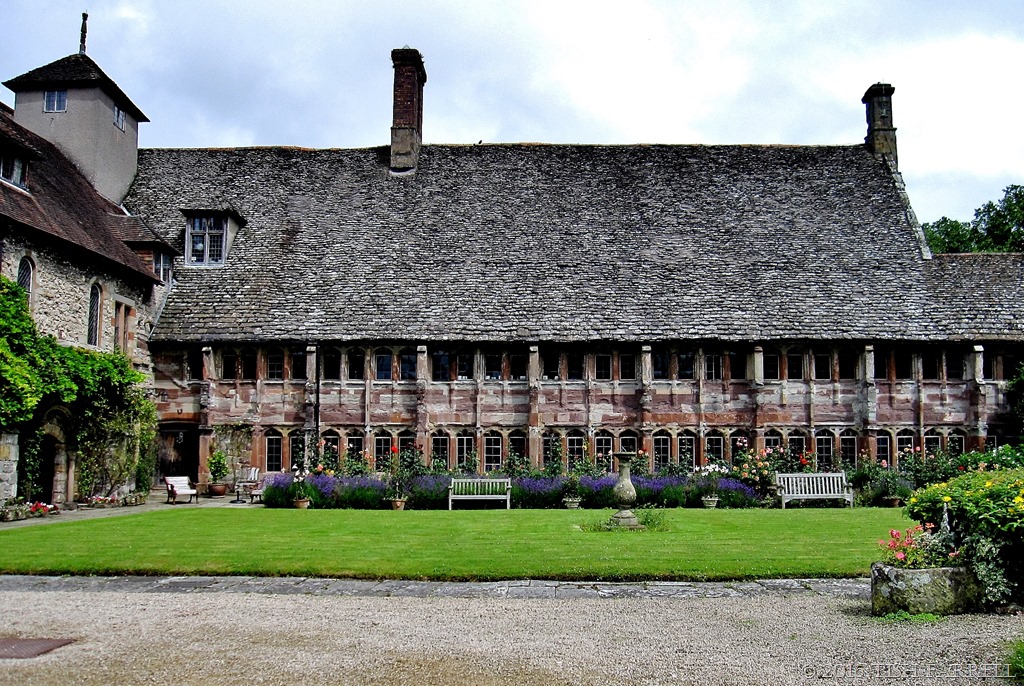
Without doubt this building is the architectural jewel of Much Wenlock. It lies at the heart of the town, but is usually only visible if you scramble around at the back of the church yard, and peek over the wall. It housed the erstwhile domestic quarters of the priors of Wenlock Priory and, since the Dissolution in 1540, has remained in private ownership. The adjoining priory ruins, however, belong to English Heritage, and are the town’s main tourist attraction. Somewhat confusingly the house has long been called The Abbey, although the priory from Norman times was always a priory, not an abbey. The Saxon religious house that preceded it, however, was an abbey of both monks and nuns and ruled over by an abbess.

The range seen in the first photos is the most recent part of the house, built in the early 1400s. The limestone wing, just visible on the left, comprised both the monks’ infirmary and the original prior’s chambers, and are considerably older.

The present owners have spent the last three decades restoring the house, and creating interior settings that to many might seem outlandish and controversial. There will be more about this in a moment.

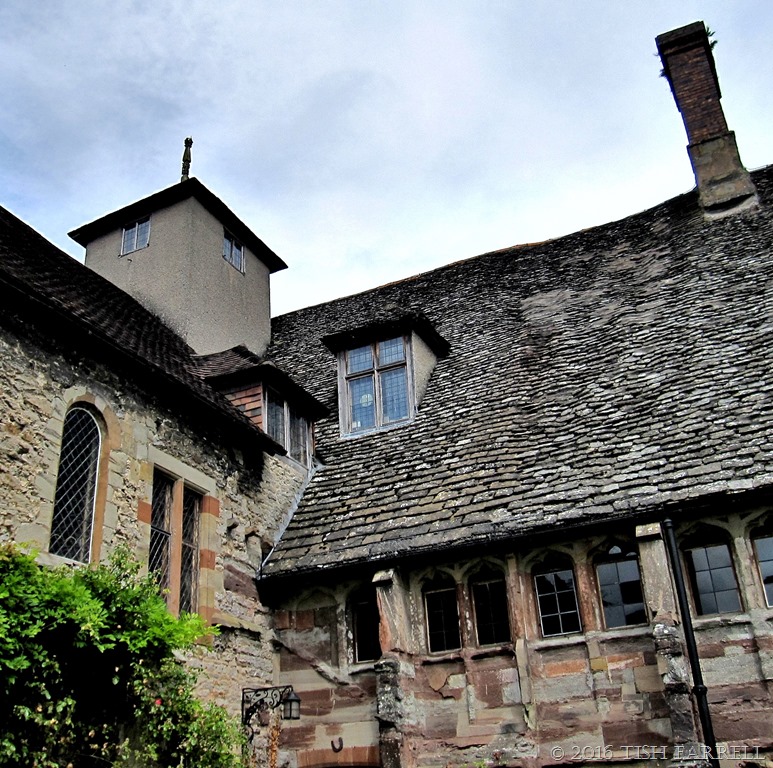
But first those celebrities of times past. I’ve written about his visits before, but one of the returning house guests in the days of the Milnes Gaskells’ ownership was Henry James. He came in 1877, 1878 and 1883 – and apparently drew much inspiration from the house and grounds when he was writing The Turn Of The Screw.  The little roof-top tower certainly puts in an appearance in the text.

At the time of James’ first visit, his hosts, Charles and the young Lady Catherine Milnes Gaskell, had not long been married and were expecting their first child.  The invitation had been secured through ‘lobbying’ by a mutual friend, Henry Adams, the American historian. He and Charles Gaskell had met as undergraduates at Cambridge, and before Charles’ marriage he had also been a frequent guest at The Abbey. Adams thought Charles, by then a prominent barrister, and Henry James had many interests in common and would get on well; and so it proved.

Charles’ father, James Milnes Gaskell, had been the Conservative MP for the Borough of Wenlock and had bought The Abbey (priory ruins included) in a derelict state from his wife’s cousin. The Gaskells senior appear to have held rather rustic and unconventional house parties there. (They naturally had other smarter homes elsewhere). Adams describes a visit in the autumn of 1864:

God only knows how old the Abbot’s House is, in which they (the Gaskells) are as it were picnic-ing before going to their Yorkshire place for the winter. Such a curious edifice I never saw, and the winds of Heaven permeated freely the roof, not to speak of the leaden windows. We three, Mrs. Gaskell, Gask (Charles) and I, dined in a room where the Abbot or Prior used to feast his guests; a hall on whose timber roof, and great oak rafters, the wood fire threw a red shadow forty feet above our heads. (1.)

One of the more unusual pursuits on such visits included the archaeological excavation of the Priory ruins.

IMG_1976

Adams describes his own contributions to the general exploration:

Whenever we stepped out of the house, we were at once among the ruins of the Abbey. We dug in the cloister and we hammered in the cellars. We excavated tiles bearing coats of arms five hundred years old, and we laid bare the passages and floors that had been three centuries under ground. (1.)

When Charles Gaskell took over The Abbey from his father, he and Lady Catherine set about restoring the property and making it a family home where they might energetically entertain notables from the world of arts and literature. Emphasis was on mind-improving activity, and an appreciation of the aesthetic in all its forms.  Visitors would be treated to extensive walks, drives and railway journeys to view all the surrounding great houses, and visit Shropshire’s many ancient churches and castles.  A trip to Wenlock Edge to take in the vistas was also obligatory.

Henry James documents his own many outings with Charles Gaskell in Portraits of Places.
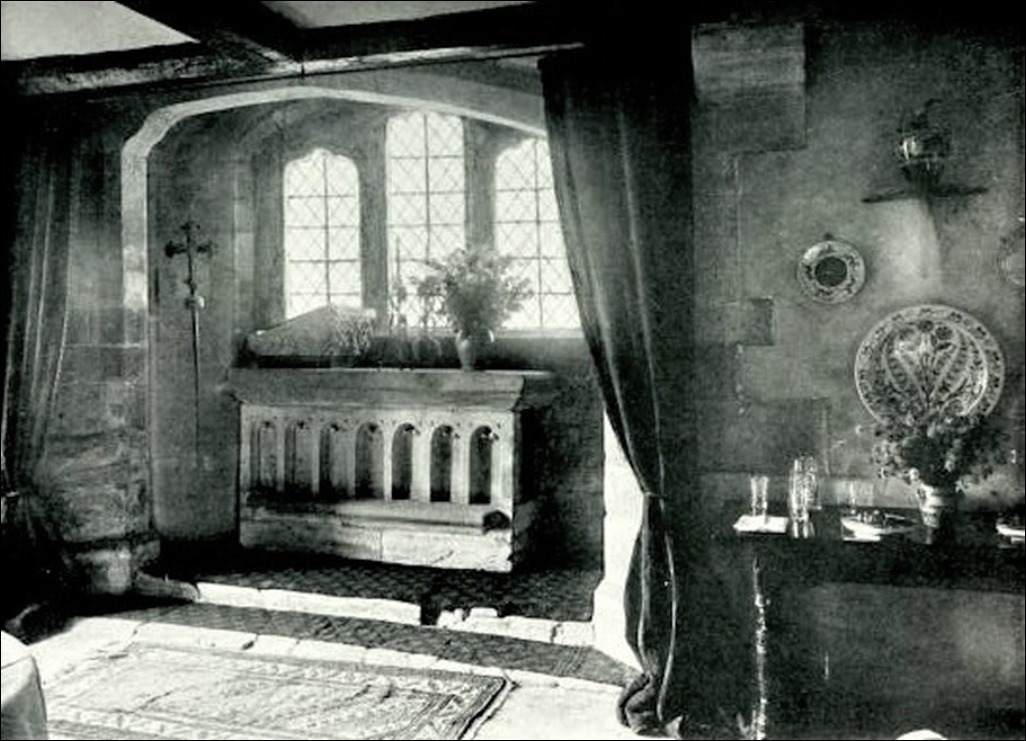
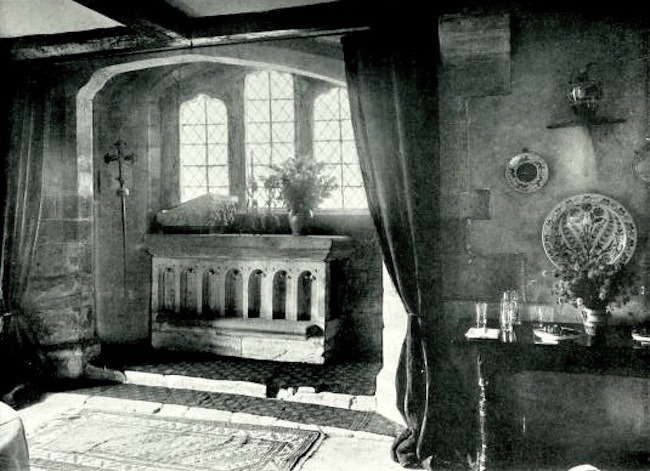
Chapel Wenlock Abbey

The Prior’s Chapel during the time of Lady Catherine Milnes Gaskell from her book Spring in a Shropshire Abbey  1904 (available to download on Gutenberg Press).

*

The Gaskells’ other guests included In Darkest Africa explorer, Henry Morton Stanley, architect, Philip Webb, Architect and Pioneer of the Arts & Crafts Movement, and Thomas Hardy and his wife. Hardy was apparently surprised to find himself lodged in the oldest part of the house, and declared that “he felt quite mouldy at sleeping within walls of such high antiquity” (2.)

The Hardys were also taken around the county, visiting Stokesay Castle and Shrewsbury. Florence Emily Hardy recounts how one Sunday Hardy and Lady C walked until they were tired, when

“they sat down on the edge of a lonely sandpit and talked of suicide, pessimism, whether life was worth living, and kindred dismal subjects, till we were quite miserable.”(2.)

The room wherein Hardy felt so mouldy was in the infirmary wing and is indeed very old, dating from the 1100s CE.  The original prior’s chambers were built adjoining the infirmary around a hundred years later, the scale of them doubtless dictated by the need to accommodate a series of royal visits. The deeply devout King Henry III, along with his own prestigious guests, was a frequent guest between 1231 and 1241.

100_5971

This photo shows the rear view of the infirmary and original prior’s lodgings, (the limestone range on the right) together with the side elevation of the upscaled prior’s lodgings that were added in the early 1400s (multi-coloured stonework to the left).

The king, as monarchs did, would arrive with a large retinue of servants, clerks, cooks, musicians and blacksmiths, all of whom had to be housed. There must have been some pretty good parties too, since a permanently appointed keeper of the king’s wine was required to manage the contents of the priory wine cellar in readiness for any royal visit. Supplies were  brought in from Bristol ( a hundred miles away) by the Sherriff of Shropshire and a record relating to the delivery of four barrels in 1245 states that the wine was to be placed ‘safely in the cellars there against the king’s arrival as he proposes shortly to come to those parts, God willing.’ (4.)
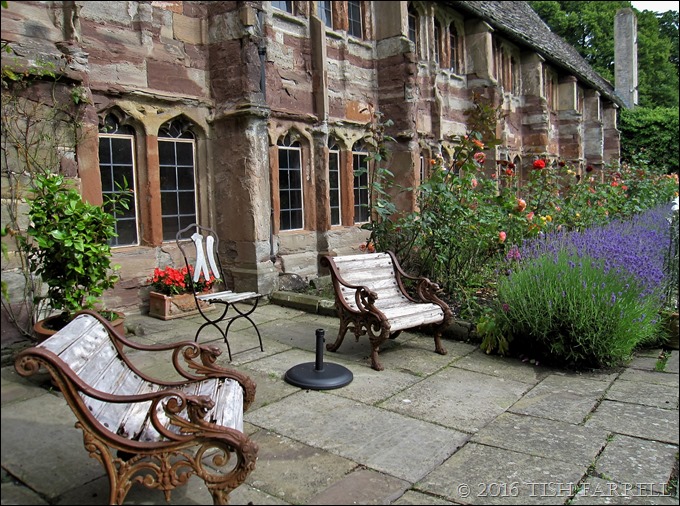
IMG_1996

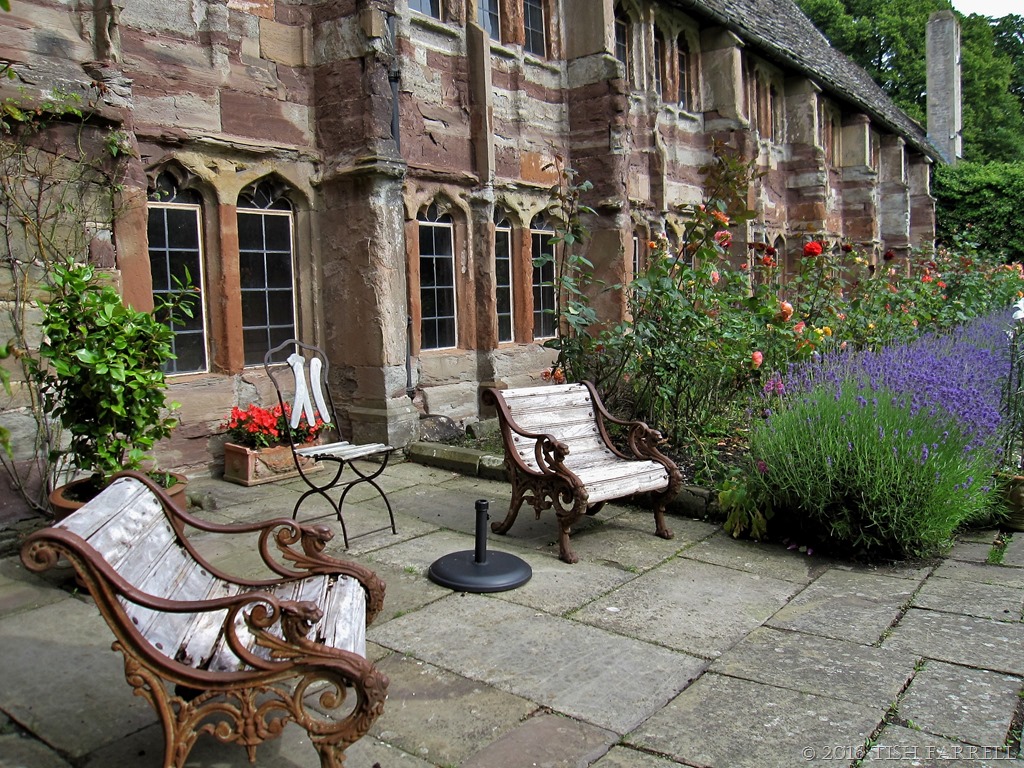
The galleried facade of the more recent fifteenth century lodgings,originally unglazed, was constructed from stone from four different quarries.
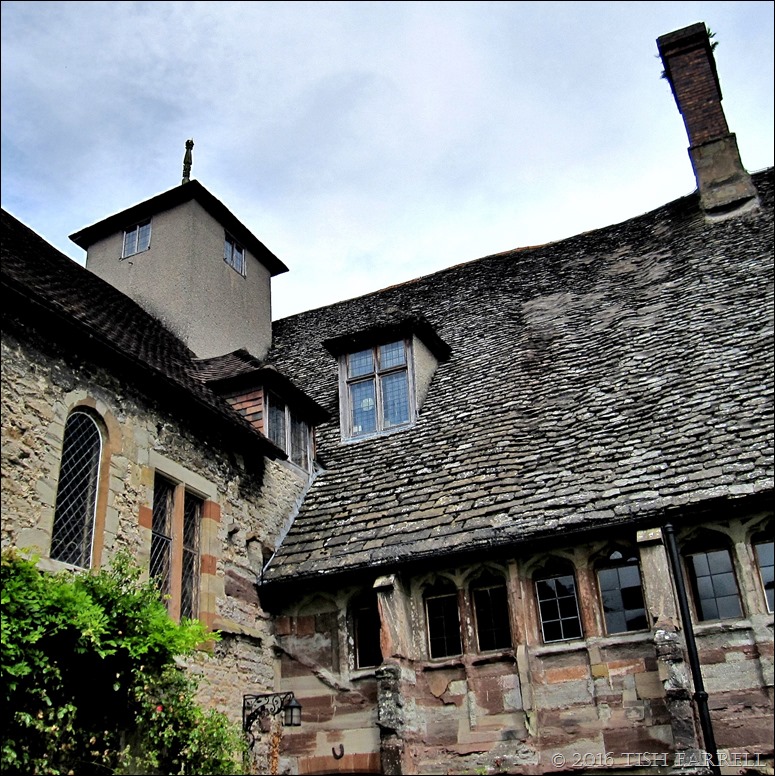
IMG_1991

The catslide roof is tiled with stone flags.

Inside, on the ground floor, is the prior’s private chapel, while upstairs is the Great Hall with its great stone fireplace and high beamed ceiling mentioned by Adams, and next to it, though scarcely less grand, the Lesser Hall. Timbers in the Great Hall roof have been dendro-dated to 1425.

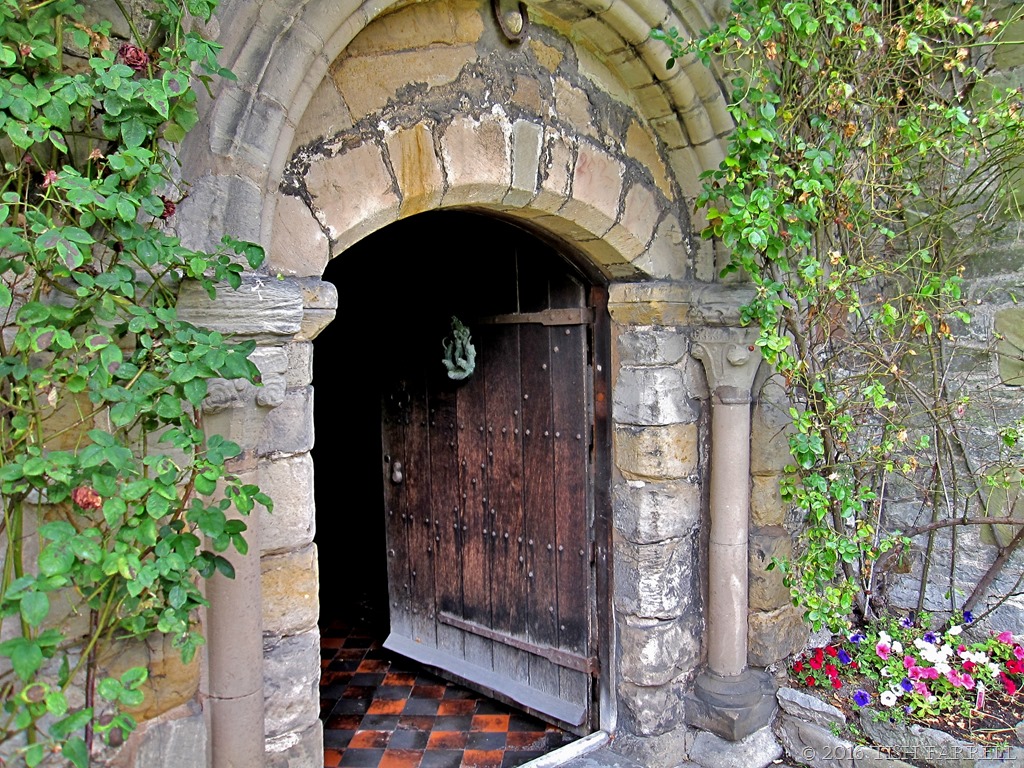
The front door to the left of this range, though, is considerably older, with its characteristic Norman arch. James describes it in his travelogue Portraits of Places (3):

IMG_1997

I returned to the habitation of my companion (Charles Milnes Gaskell)…through an old Norman portal, massively arched and quaintly sculptured, across whose hollowed threshold the eye of fancy might see the ghosts of monks and the shadows of abbots pass noiselessly to and fro…for every step you take in such a house confronts you in one way or another with the remote past. You feast upon the pictorial, you inhale the historic.

It was through this doorway we also went a few  Saturdays ago. As I said, this was a private tour, and our first such visit. Since 1983 the house has been the home of Gabriella and Louis de Wet. De Wet is an artist of some renown and Gabriella is better known to the wider world as theatre and television actor Gabrielle Drake. For the last 33 years, driven by Louis de Wet’s extraordinary artistic vision,  they have been restoring the house – carrying the building’s story on into the 21st century while revealing its ancient monastic roots in strikingly original ways. The project has been an epic labour of love, and involved the dedication of consummate craftsmen, working very much in the mediaeval guildsmen tradition.

I did not take photos. So if you want to see what lies behind this door, please follow this next link. It will take you to a 2 minute trailer of a very excellent film made by Gavin Bush in 2011: In The Gaze Of Medusa . I leave you to make up your own minds about the merit of the De Wets’ prodigious and unique enterprise. It is not straight forward by any means.

For now, here’s the one photo I did take – of the library, and still a work in progress. It gives a taste of the quality of the craftsmanship involved in the restoration-creation work, the newly made shelves that will house a life-time’s collection of books on art, philosophy and history. Also niggles apart, we did appreciate the gracious hospitality of Mrs. de Wet who showed us around with such enthusiasm, and then treated our party to tea and some very delicious cakes in the Venetian Room. So very English!

IMG_1994

copyright 2016 Tish Farrell

1. Ernest Samuels Henry Adams: Selected Letters  1992 p 69

2. Florence Emily Hardy The Later Years of  Thomas Hardy  1930

3. Henry James Portrait of Places

4. Vivien Bellamy A History of Much Wenlock  2001

Lady Catherine Milnes Gaskell Spring In A Shropshire Abbey  1904

Partners In Steam On The Talyllyn Railway: WOO-HOOOOOO

P1040776

Take two steam enthusiasts

*

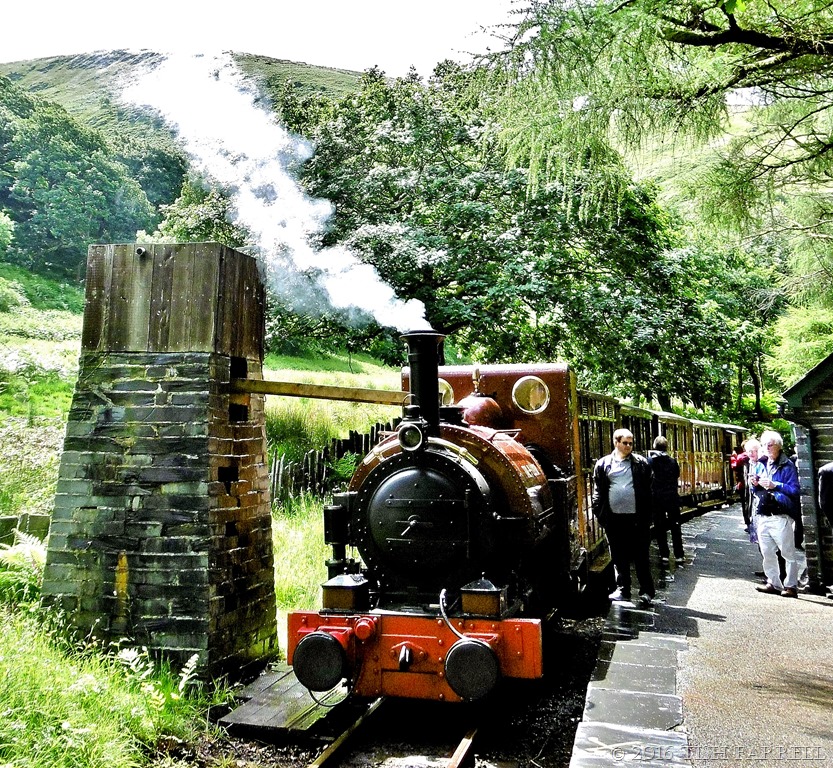
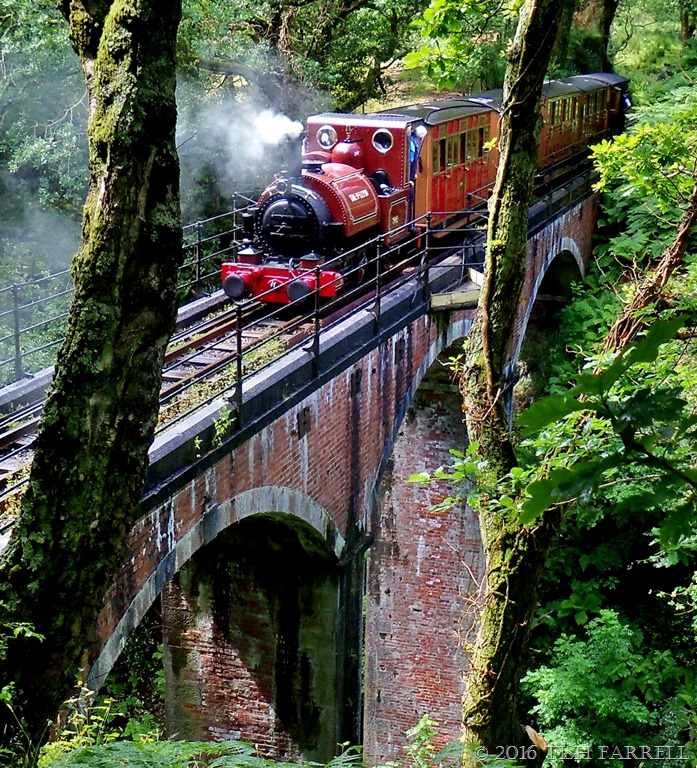
It has to be the best day out in Wales – a trip on the historic narrow gauge Talyllyn* Railway, setting out from Tywyn on the west coast and meandering up the hills to Nant Gwernol. The line was built in 1864 when the McConnell brothers of Manchester decided to branch out from cotton spinning into slate mining. The railway brought in supplies for the miners, and later carried a few passengers between the various valley communities. But mostly it delivered slate wagons which, from the railhead in Nant Gwernol, were winched on cables up mind-boggling inclines to the the heights of the slate quarry, and thence returned laden with slate for export from the port of Aberdovey.

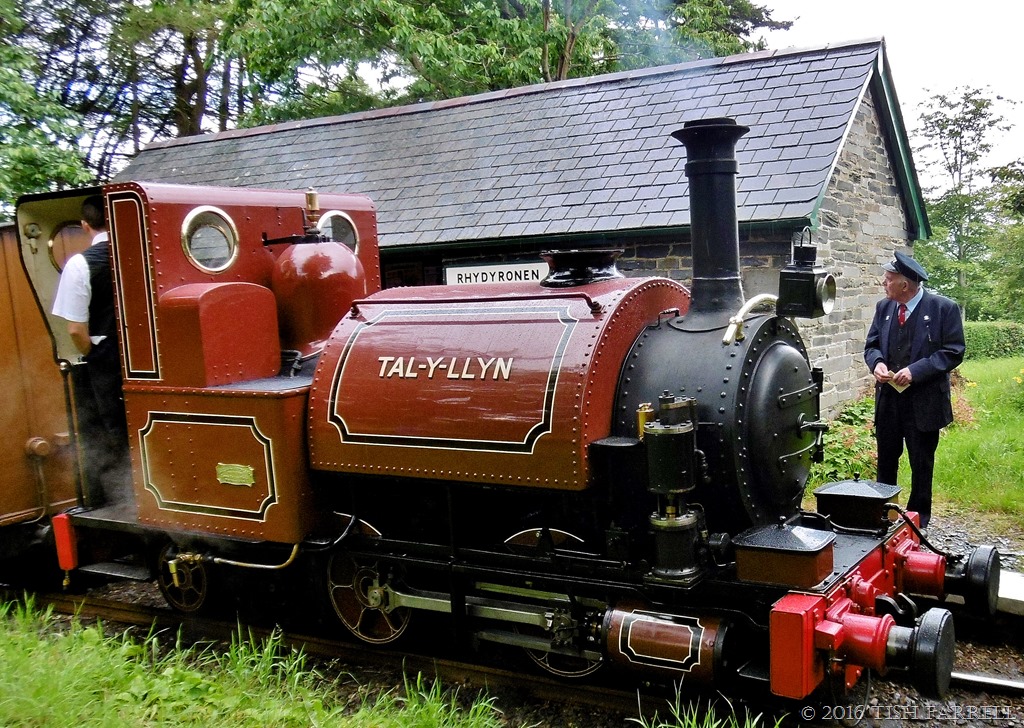
As a preserved line, Talyllyn is the world pioneer. The Preservation Society was set up in 1951, and ever since has run with the help of passionate volunteers who have supported the small corps of paid staff. One of the early volunteers was the Reverend W V Awdry who wrote the Thomas the Tank Engine books, still much loved by children big and small. But Thomas apart who cannot fail to fall in love with a locomotive that looks like this? It’s an original Victorian  engine too.

P1040771

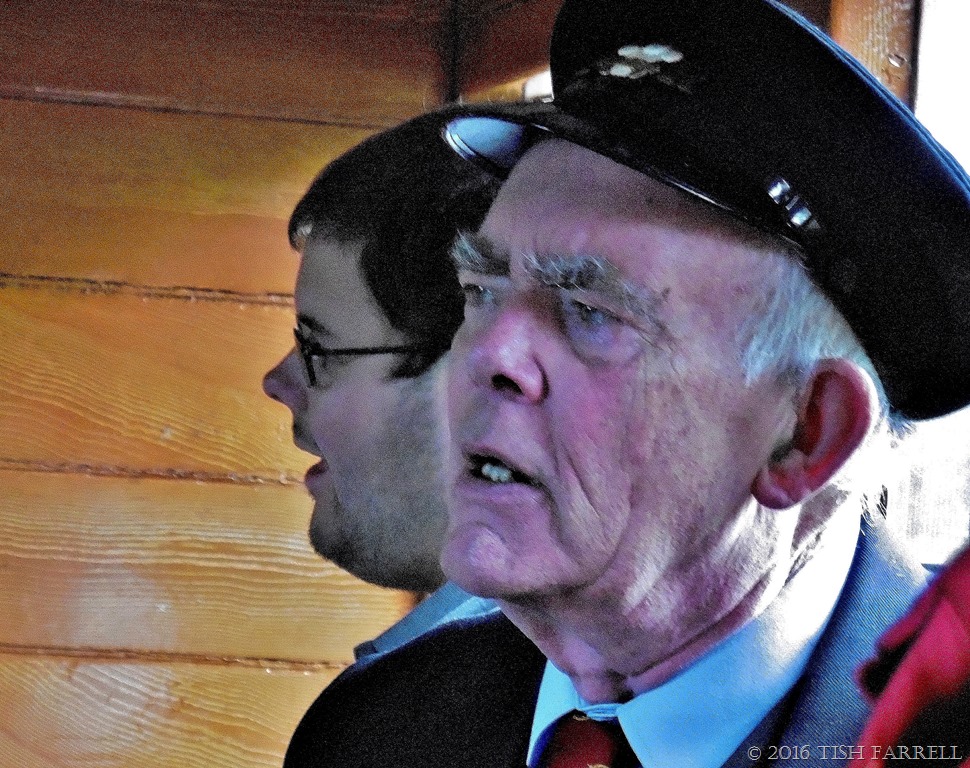
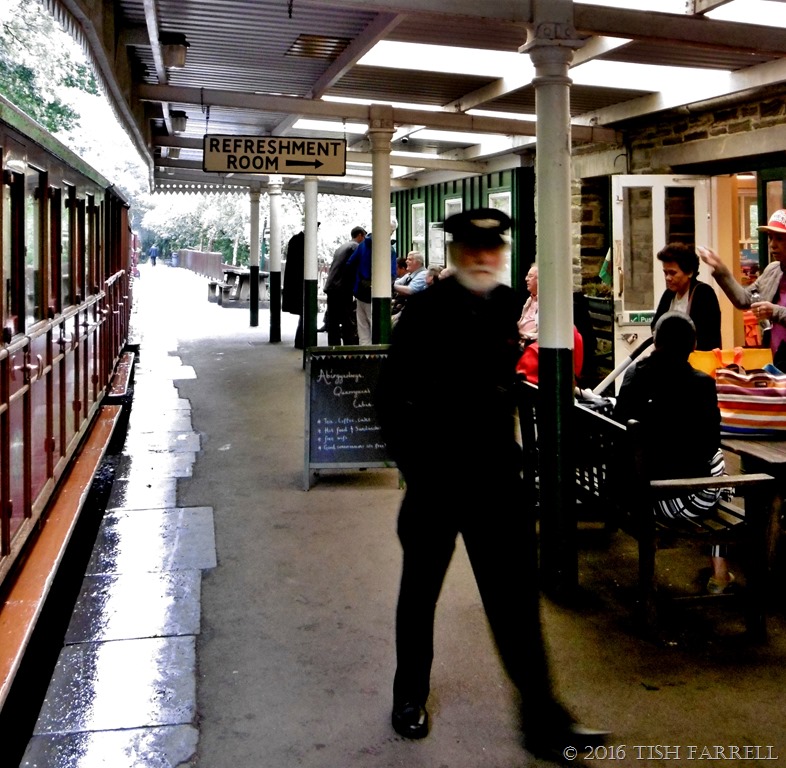
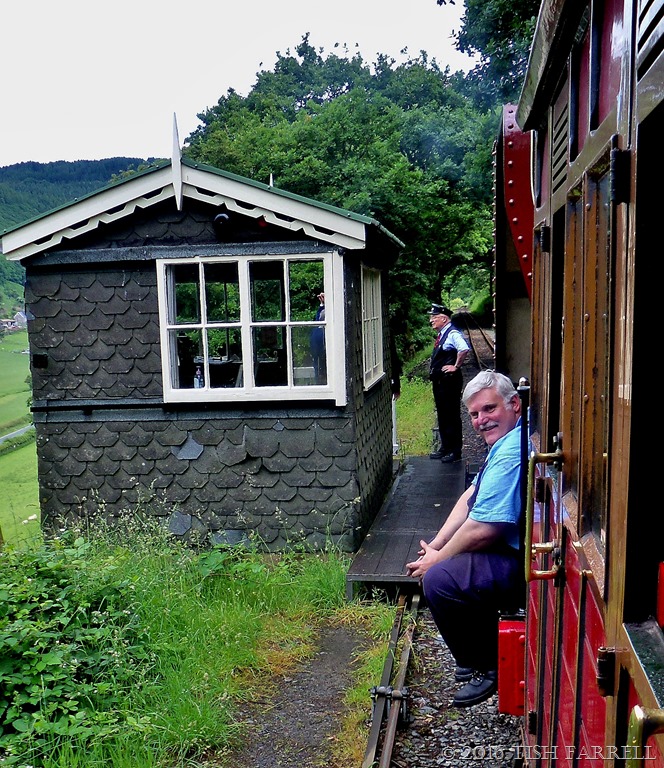
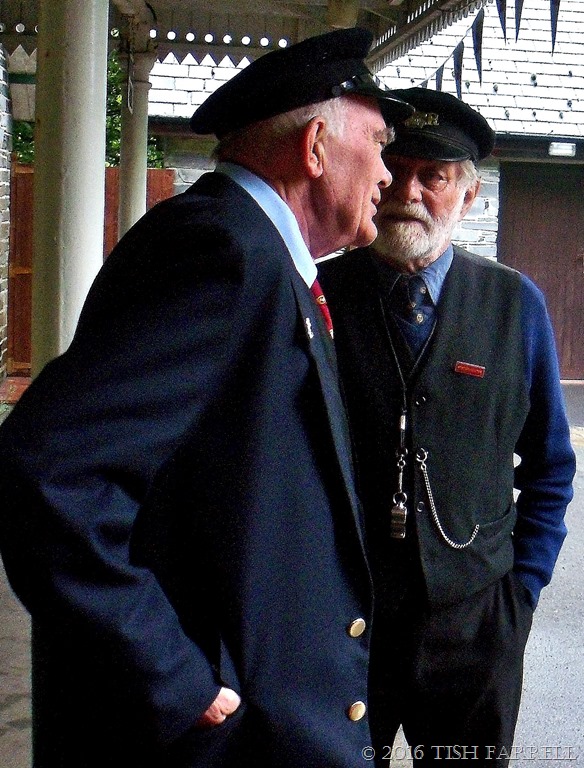
For our first trip on the line we had booked to go on the special Victorian Train Experience, a four-hour potter on an original period train which departed Tywyn Wharf at 11.15 am and aimed to return around 3.20 pm in time for a cream tea in the station restaurant. Our guide, David Leech (seen here in his guard’s uniform) informed us that we would spend that time “wombling around” on the line, fitting in between scheduled services which we would have to give way to at various points. He also explained that the train would stop in several scenic locations so we could get out and photograph it. This also included having the train reverse a mile or so back down the track so we could position ourselves on, or above bridges and catch it on the return, steaming at us for all it was worth.

It was all extremely silly, but thus enormous fun. And we didn’t even mind that it kept pouring with rain. We shared our carriage with a retired British Rail signal man and his wife, and a young extant signal man with his mate. For the first leg of the trip David Leech sat with us telling us daft anecdotes – Tales of the Talyllyn Railway. He had once been the railway’s traffic manager as well as being a life-long volunteer.

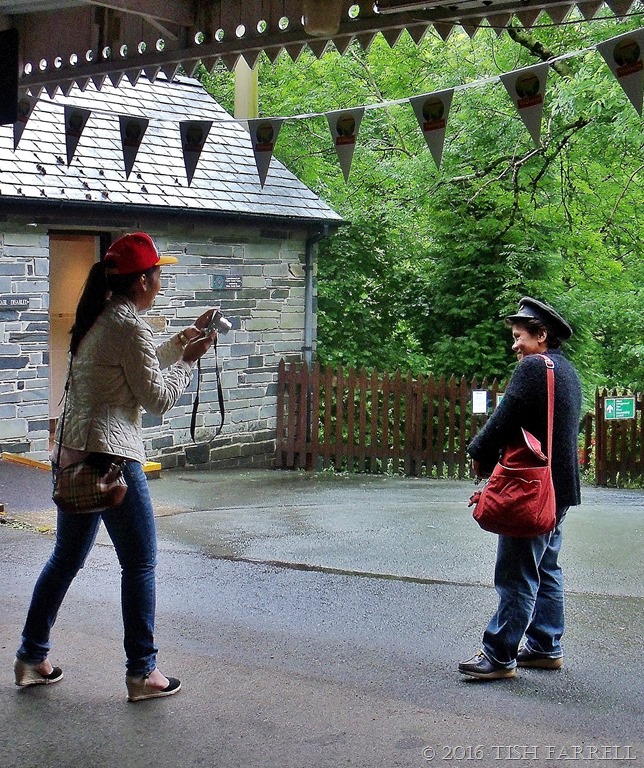
The entire Talyllyn enterprise is infused with the most enormous goodwill, humour and enthusiasm. It embraced us from the moment of our departure, and went on hugging round us as we rattled up into the hills to Dolgoch Falls and beyond. At Abergynolwyn we stopped for lunch in the Quarryman’s Tea Rooms where we were warmly welcomed by the serving staff who were dressed in Victorian costume while managing to not look naff.

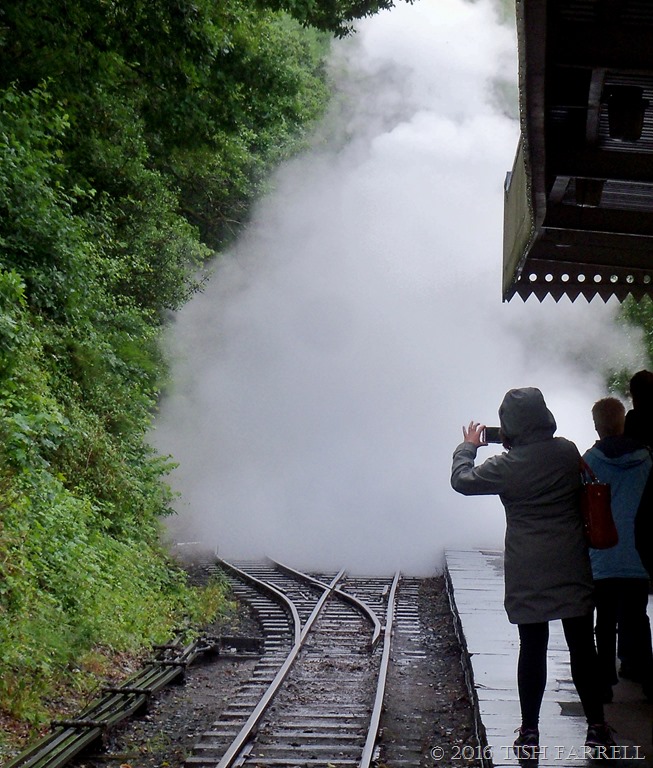
After lunch we had to wait on Abergynolwyn Station while another train came through so the platform was crowded with waiting passengers just like a main-line railway – the difference being the palpable excitement was all for the train ride itself rather than the destination. While we waited, and rain pummelled the platform roof, the Station Master told us jokes.

All this and the beautiful Welsh landscapes.  A steaming good day all round.

P1040793

Taking on water at Dolgoch Falls

*

P1040857

101_0154

P1040830

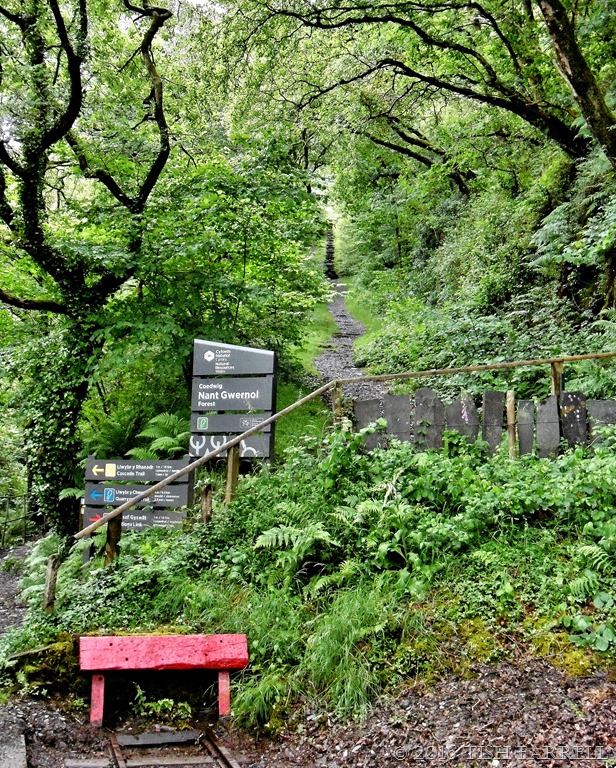
End of the line at Nant Gwernol and the incline ahead; the slate trucks were winched up and down here to and from the Bryn Eglwys quarry. Sometimes the winch cable broke.

*

101_0140

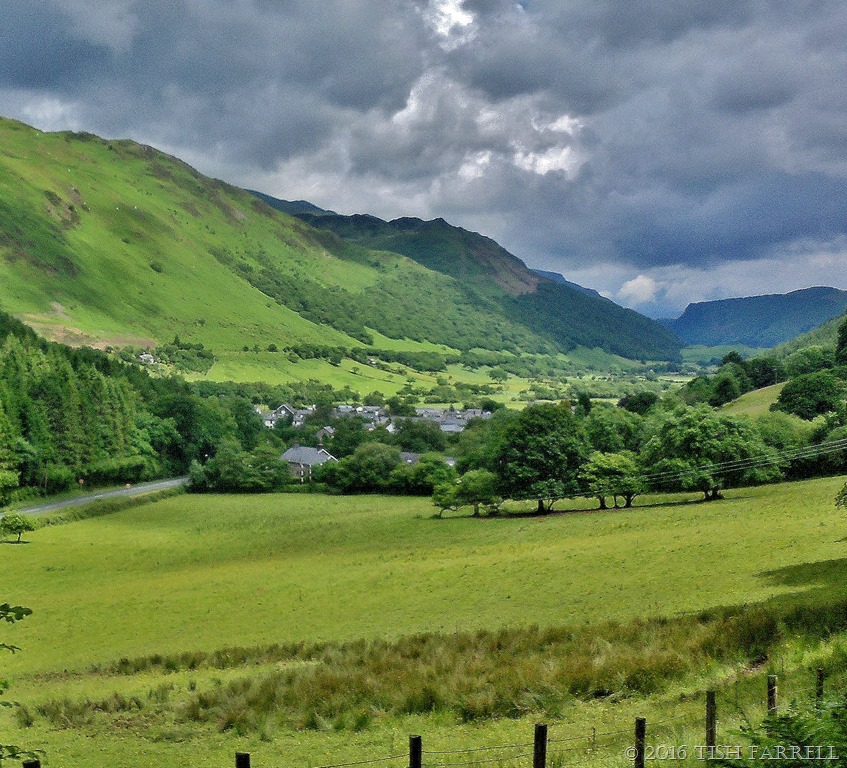
Looking down on Abergynolwyn village from the train. It began as a slate miners’ community in the 1860s.

*

101_0128

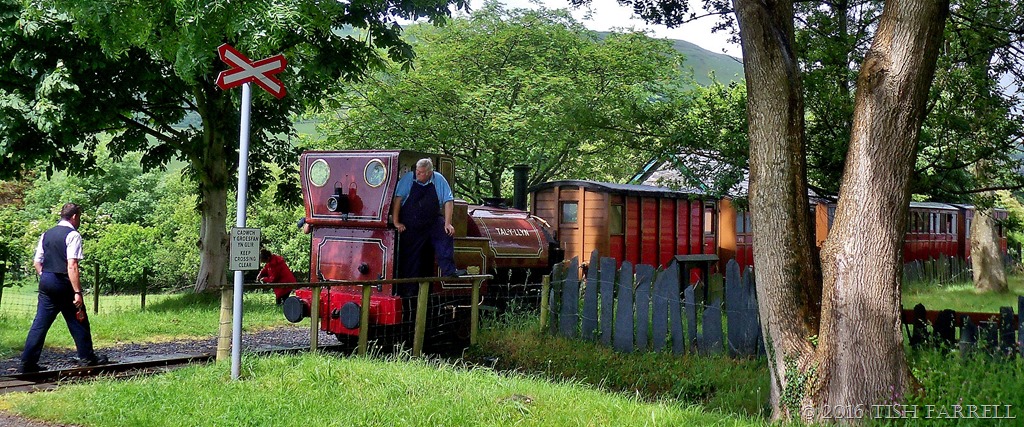
Our driver taking a break while we wait for another train to pass on the line.

*

101_0209

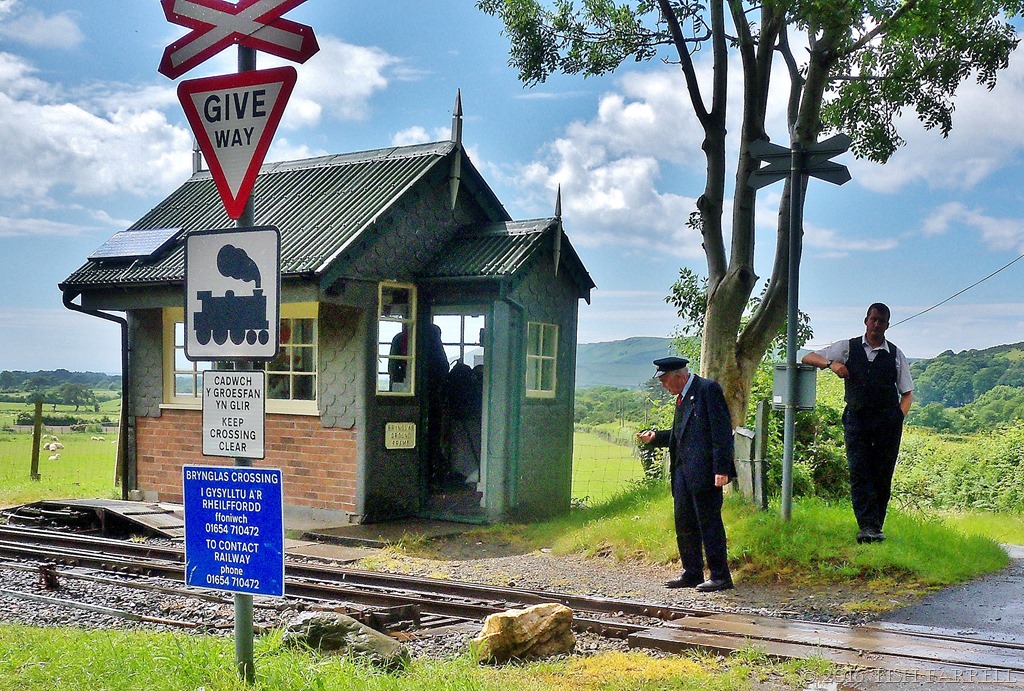
Heading back to Tywyn. The Brynglas crossing.

*

101_0204

At Brynglas Station, and behind the slate fence, is the Talyllyn Railway’s Memorial Garden. The ashes of supporters may be interred here. Those attending the funeral service get go there by train. What a send off.

*

101_0162

101_0119

101_0186

* ‘ll’ in Welsh is roughly pronounced ‘cl’

copyright 2016 Tish Farrell


Daily Post Challenge: Partners

#RheilforddTalyllynRailway

A Five Hundred-Year-Old C.V. ~ And All Kinds Of Timeless Connections…

P1030901

THIS TOMB

IS TO THE MEMORY OF

SIR RICHARD CROFT . KNT .

SHERIFF OF HEREFORDSHIRE

1471-72-77-86

FOUGHT AT MORTIMER’S CROSS 1461

TEWKSBURY 1471

M.P. FOR HEREFORDSHIRE 1477

GOVERNOR OF LUDLOW CASTLE

CREATED KNIGHT-BANNERET

AFTER THE BATTLE OF STOKE 1487

DIED JULY 29 1509

ALSO OF ELEANOR HIS WIFE

DAUGHTER OF SIR EDMUND CORNWALL BARON

OF BURFORD SALOP

WIDOW OF SIR HUGH MORTIMER OF KYRE

P1030883

Sir Richard Croft (born 1429) lord of the manor of Croft Castle in Hereforshire was advisor to Edward Duke of York during the Battle of Mortimer’s Cross in 1461. The Duke was eighteen years old and had recently succeeded his father, Richard third Duke of York, to the title. Richard had been killed in the previous year at the Battle of Wakefield. Lady Eleanor Croft’s first husband had also also killed in that battle. These were Wars of the Roses times wherein the Houses of York and Lancaster vied bloodily for the British crown. The Battle of Mortimer’s Cross was fought on Croft land not far from the castle (and in the English Midlands nowhere near either York or Lancaster) and was a turning point in the conflict for reasons I’ll get to in a moment.

First I should say that this week’s theme at Paula’s Black & White Sunday is TIMELESS. And the reason I’ve chosen these photos is because there is quite another timeless connection – i.e. the words of William Shakespeare whose 400th memorial anniversary is being celebrated this year. In Henry VI pt 3  Act II scene i,  he makes reference to a strange meteorological event that occurred before the Battle of Mortimer’s Cross, although the actual battle does not feature in the play.

This is Shakespeare’s version of what was seen, expressed in an exchange between brothers, Edward 4th Duke of York the soon-to-be Edward IV, and Richard, Duke of Gloucester, the future Richard III:

Edward: Dazzle mine eyes, or do I see three suns?

Richard: Three glorious suns, each one a perfect sun; Not separated with the racking clouds/But severed in a pale clear-shining sky. /See, see: they join, embrace, and seem to kiss,  /As if they vowed some league inviolable./Now are they but one lamp, one light, one sun.  /In this the heaven figures some event.

*
The phenomenon described here was a parhelion or sun dog, a refraction of the sun’s rays through ice that created the impression of three separate suns rising simultaneously. According to historical accounts Edward decided that this extraordinary vision was a great portent promising victory, while his opponents were filled with terror. Thus inspired with holy certainty, Edward’s army won the day. A few weeks later Edward was crowned king. The sun thereafter featured as part of his personal emblem.
I’m afraid I have only one sun in my photo of Croft Castle and the chapel where Sir Richard and Lady Eleanor have their magnificent tomb, but then there are other interesting signs in the sky. Incidentally, Sir Richard served in his various official capacities (quoted in the memorial plaque above) under four successive monarchs, including Richard III.

Also to coincide with this year’s Shakespeare celebrations, the BBC is currently airing its own ‘Game of Thrones’ version of Shakespeare’s War of the Roses history plays, The Hollow Crown; proof of the timeless quality of good yarns, even if a few liberties have been taken with the playwright’s text. But then ‘the bard’ was nothing if not a past master at recycling other people’s tales and historical accounts, and giving them his own particular gloss; even during his own time players of his works apparently changed the words. It was ever thus with the art of good storytelling…

copyright 2016 Tish Farrell

The Tale Of A Hidden House That Once Hid A King

100_9663

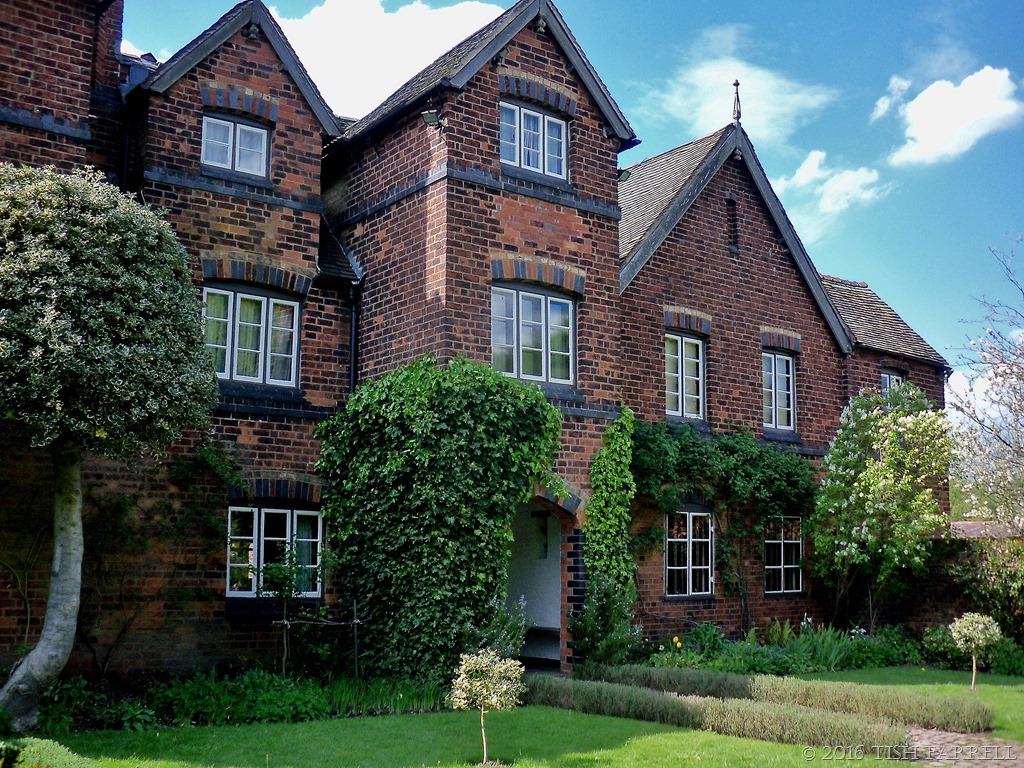
It’s something of a puzzle. When you first encounter Moseley Old Hall with its Staffordshire brickwork you feel sure you are looking at a Victorian building. And what’s more, rather than saying historic country manor, its looks suggest something urban and industrial, as if this might have been the home of some nineteenth century mill or mine owner.

Take another look from a different angle:

P1030952

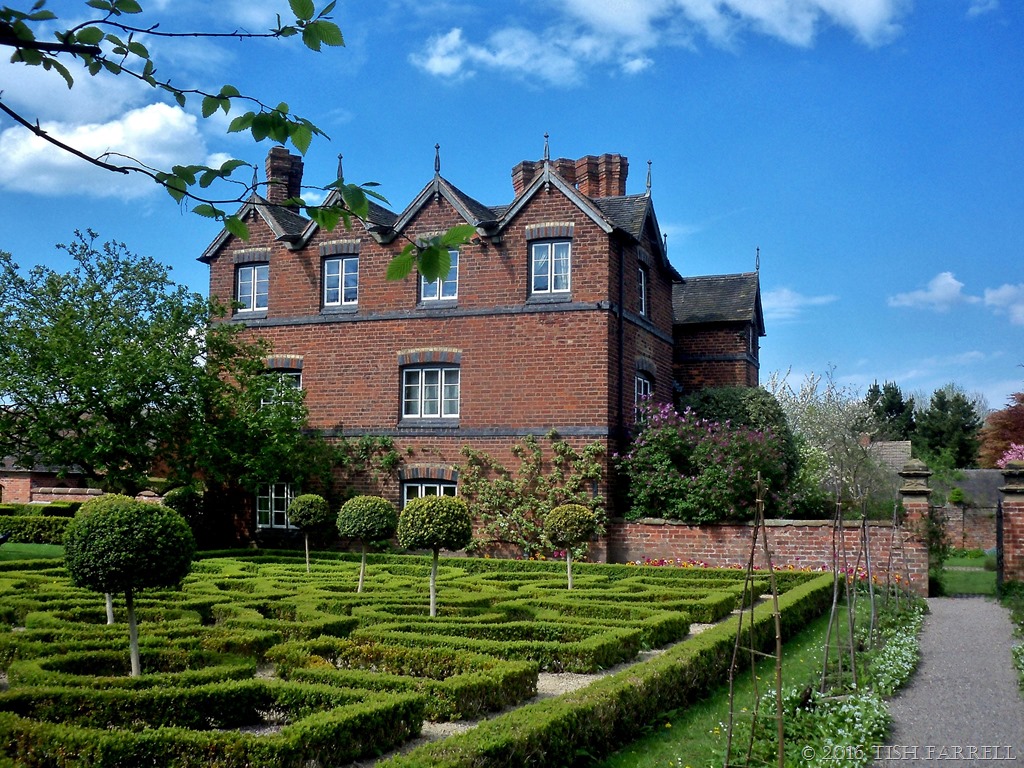
Now consider the side elevation coming up next. There’s an important clue here that all is not what it seems (a bit like Peter Greenaway’s film The Draughtsman’s Contract):

100_9677

Yes, here beside the house we have a restored knot garden of the 1600s. So what’s going on?

Time to put on the reading specs, and study the next three images:

http://www.historywebsite.co.uk/articles/oldhouses/oldhouses2.htm

Fig. 1

Source: Allan Fea Secret Chambers and Hiding Places

Now look at the photos again, and you have it. Moseley Old Hall, a timbered building of 1600 has been encased in a brick skin. This apparently happened in the 1860s, presumably as the easiest means of preserving the building. These drawings date from around 1850 before the cladding operation. Even though I have stared at the evidence, I still find it hard to accept that these are the same building. It’s like a variation on a ‘spot the differences’ puzzle. But just look at the placement of windows, eaves and bays. They are all pretty much the same whether in brick or half-timbering.

And now for the hiding of a king – and the year of 1651 when the house in timbered form played its part in British history, and sheltered Charles II after his disastrous defeat at the Battle of Worcester on September 3rd.

You can download the whole story in a free book at the following  link: Allan Fea The Flight of the King 1908  But the gist of the tale is this.

Moseley Old Hall is on the outskirts of Wolverhampton in the English West Midlands, and around 30 miles north of Worcester. After his army was crushed, Charles fled with a group of officers, and was guided to the Boscobel estate, not far from Moseley, by Colonel Charles Gifford who owned Boscobel. His properties there were in the care of servants, the five Penderel brothers.  This area on the Shropshire-Staffordshire border was a Catholic stronghold, and therefore most families were supporters of the king, although not necessarily brave enough to help a fugitive monarch. The stakes were far too high. Death being the likeliest outcome.

The cavalier officers who had been accompanying Charles left him in hiding at White Ladies Priory on the Boscobel estate, and carried on to Newport in Shropshire. It was thought the king would be safer travelling alone, and it was left to the Penderel brothers to effect the monarch’s disguise and scout out an escape route. The king wanted to get to London, but the roads east out of Boscobel were blocked and Cromwell’s militias were everywhere. He decided instead to head west into Wales where he had strong support.

Being over six feet tall, way above average height at the time, Charles was something of a challenge when it came to disguises. The Penderels cut his hair short, gave him coarse labourer’s gear, patched stockings, and a ‘greasy’ tall hat to wear. The shoes had to be cut to fit the king’s feet. These last were to cause the monarch much agony and multiple lacerations. Finally, after some lessons in local dialect and labourer gait, he was mounted on a farm horse. This beast was also to cause him much grief, and almost did for him when it stumbled. After that Charles had to walk cross-country tortured by the ill-fitting shoes.

The attempt to cross the River Severn into Wales failed. The crossings were all guarded, and Charles was forced to return to White Ladies. This was extremely dangerous. There were soldiers searching the woods all round, and Charles had to spend one whole day hiding inside an oak tree (the now famous Boscobel Oak). Meanwhile the Penderels were out searching the district for safer quarters.

So it was that Moseley Old Hall came to provide a safe haven. At the time it was lived in by Thomas Whitgreave and his widowed mother. Thomas was a Royalist but had not fought at Worcester due to ill health. Other occupants of the house were Father John Huddleston, a Benedictine priest, and his three pupils, who included two of Whitgreave’s nephews. The hall also had a priest hole, a relic of the earlier Catholic persecutions.

Charles was brought exhausted, and with bleeding feet to the hall where Father Huddleston set about tending to the king, and giving him fresh clothing and sustenance before showing him to a  comfortable bed. Meanwhile everyone else in the house was charged to keep a look out for the militias. (Can’t you see glimpses of those fearful faces peeping from every window around the hall?)

Thomas Whitgreave describes what happened next:

“In the afternoon [the King] reposing himself on his bed in the parlour chamber and inclineing to sleep, as I was watching at the window, one of the neighbours I saw come running in, who told the maid soldiers were comeing to search, who thereupon presentlie came running to the staires head, and cried, ‘Soldiers, soldiers are coming,’ which his majestie hearing presentlie started out of his bedd and run to his privacie, where I secured him the best I could, and then leaving him, went forth into the street to meet the soldiers who were comeing to search, who as soon as they saw and knew who I was were readie to pull mee to pieces, and take me away with them, saying I was come from the Worcester fight; but after much dispute with them, and by the neighbours being informed of their false information that I was not there, being very ill a great while, they let mee goe; but till I saw them clearly all gone forth of the town I returned not; but as soon as they were, I returned to release him (the King) and did acquaint him with my stay, which hee thought long, and then hee began to bee very chearful again.

“In the interim, whilst I was disputing with the soldiers, one of them called Southall came in the ffould and asked a smith, as hee was shooing horses there, if he could tell where the King was, and he should have a thousand pounds for his payns… This Southall is a great priest-catcher.”

After this episode the king no longer felt safe at Moseley. Another refuge had to be found and the means to get him there safely. It was at midnight, one week after the defeat at Worcester, that Thomas Whitgreave led Charles into the orchard of Moseley Old Hall where it had been arranged that Colonel John Lane would meet him with horses, and thence escort him to his home of Bentley Hall near Walsall.

This next stage of the escape was safely accomplished. Over the following weeks, and using various stratagems and much subterfuge, Charles dodged his enemies. Many attempts to find a boat and passage to France proved fruitless as he moved through Devon and along the south coast. There were even days when he hid at Stonehenge. Finally, on the 15th October, after six weeks on the run, he set sail from Brighton for France. It would be another nine years before he returned to claim his throne.

Now for more views of Moseley Old Hall. Another visit will be required before I can show you the interior. When we went on Sunday the weather was far too glorious to go indoors. So please enjoy a stroll around the gardens while imagining a battle-weary king with very sore feet arriving here secretly one September night. Look out, too, for Cromwell’s militia!


I’m linking this to Jo’s Monday Walk


Blowing Big Bubbles In Bishop’s Castle ~ Thursday’s Special

100_7331

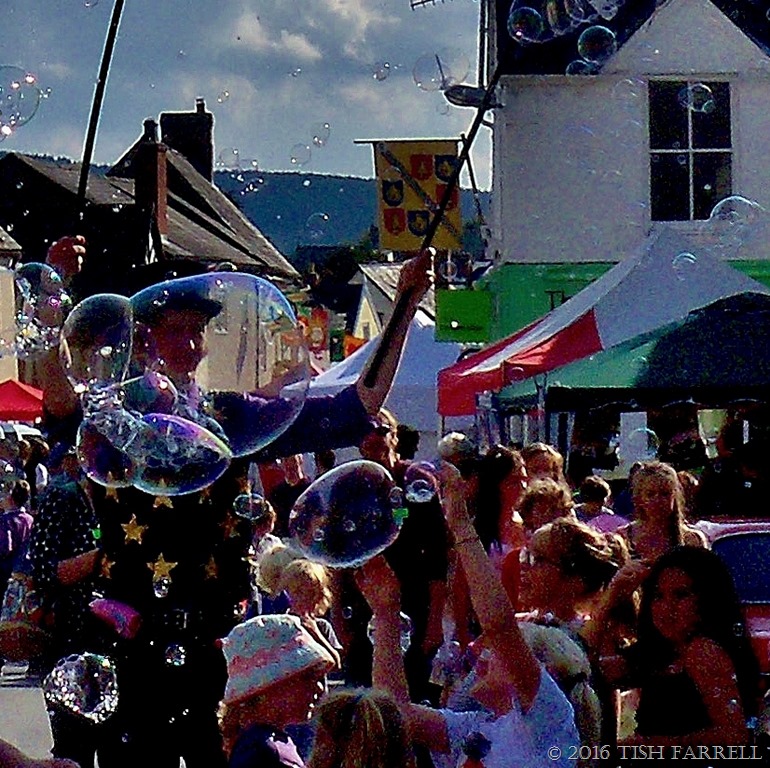
There screams of delight when Tall Will The World’s Tallest Bubbleologist began his magic. In fact it was rather like a bubble-version of the Pied Piper. As long as Tall Will was making bubbles the children were in hot pursuit. Everyone wanted to catch their own bubble. Of course I ran after him too. Never was more high-octane joy created than from Will’s bucket of agitated soap solution.

100_7323

These photos were taken at Bishop’s Castle’s Michaelmas Fair last September. There were all kinds of magic there: it’s that kind of place, with or without the fair. You can see more at Summer Came Back On Saturday And Took Us To The Fair.

*

Paula’s theme this Thursday is ‘inflated’. Please pay her a visit. You won’t be disappointed. Promise!

Not Any Old Bridge ~ But The World’s First Cast Iron Bridge Built By Abraham Darby in 1779

P1000831

For this week’s Thursday’s Special Paula is asking us to focus on traces of the past.  For those of you who have not seen my earlier posts on the Ironbridge Gorge, this bridge was the first to be made from cast iron, and in a single arch that spans the River Severn in Shropshire. It crosses the Severn Gorge just a few miles from my house, and is a World Heritage Site.

The height of the bridge was dictated by Quaker Ironmaster, Abraham Darby’s desire to show off – not only to prove the versatility and potential of cast iron, but also to build the first bridge on the the Severn that would allow the river’s big sailing barges (Severn trows) to pass under with out lowering their sail masts. One up on all the river’s stone bridges then! And what a sales (sails) pitch it was too, for people to see his bridge with a fully rigged sailing barge passing beneath it.

He also built the bridge in one of the most spectacular parts of the Gorge, and on the site of a treacherous ferry crossing. Before the bridge was built people had to cross between the two industrial settlements of Broseley and Coalbrookdale in a coracle, an ancient skin covered craft that was used by local poachers.

The bridge itself is a curious construction. If you look closely at the iron framework you can see that although Abraham Darby was breaking new ground (and in its day the Iron Bridge was definitely a world wonder), the building techniques include the kind of joints that people would expect to see in carpentry: mortise and tenon joints and dovetails.

It is hard to know if Darby was erring on the side of caution by sticking to tried and tested construction methods, or simply being innovative in ways that weren’t too innovative for people’s sensibilities. After all, one of the best ways to make people accept and welcome the new, is to start from something they already know and recognise. In such ways does the past follow us into the future.

P1000843

copyright 2016 Tish Farrell

Traces of the Past

A Mysterious Four-Thousand-Year-Old Circle

P1020777

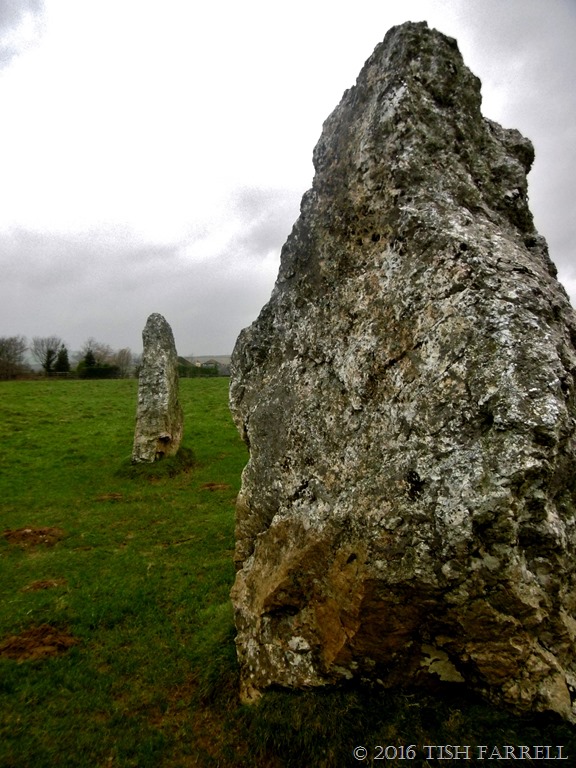
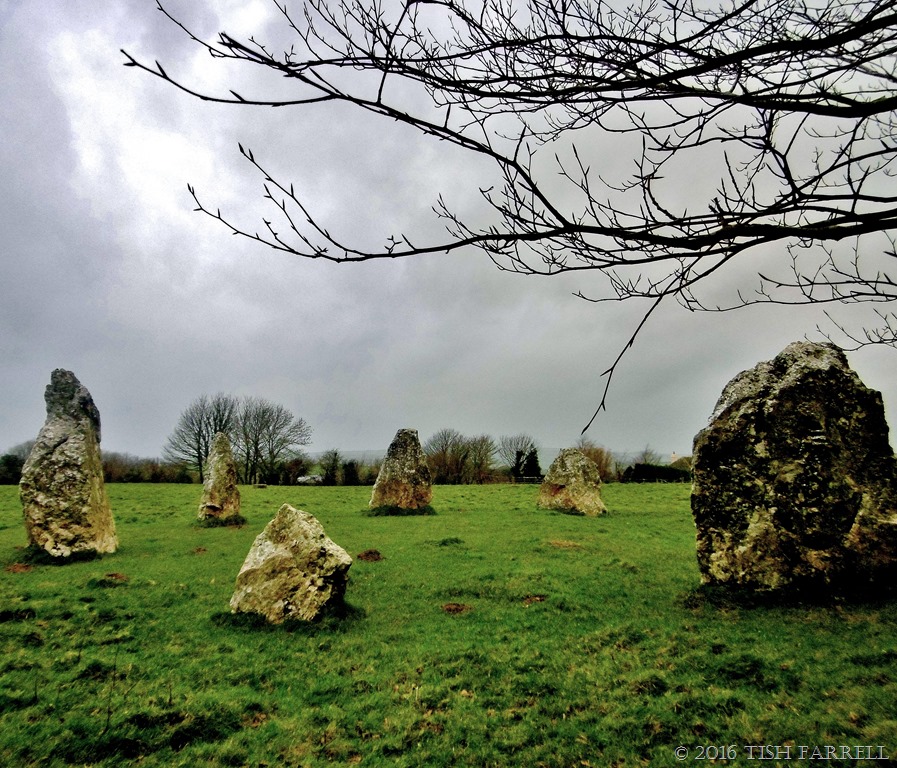
This is Cornwall’s smallest stone circle, captured here on a dreary December afternoon in the village of Duloe. It dates from around 2,000 B.C.  a relic of the British Bronze Age.

P1020774

In fact the 8 large stones that comprise the monument are set out in more of an ovoid than a circle, the diameter varying between 10 and 11 metres. But they are also roughly aligned with the compass points, which instantly has everyone thinking all sorts of things about the possible purpose of the structure.

The first historical, if indirect, reference to the circle, occurred in 1329 A.D. in a record that mentions the farm of Stonetown on whose land the stones stand. Its official antiquarian discovery, however, was in 1801, at which time the stones were prone, and the circle bisected by a hedge.

During restoration work in 1861, and the removal of the hedge, workmen stumbled on a Bronze Age funerary urn in the centre of the circle. Unfortunately the urn and the cremated human contents have since been lost, but it thus seems likely, given its small size, that the monument was intended only as an elaborate grave, rather than constructed for any other ritual purposes.

All the same, the enterprise involved some considerable labour. It’s been estimated that thirty or more people would have been needed to move stones up to 12 tons in weight. They are quartzite-rich with elements of ankerite, and the nearest source of such rock is at least a mile from the site.

100_8310

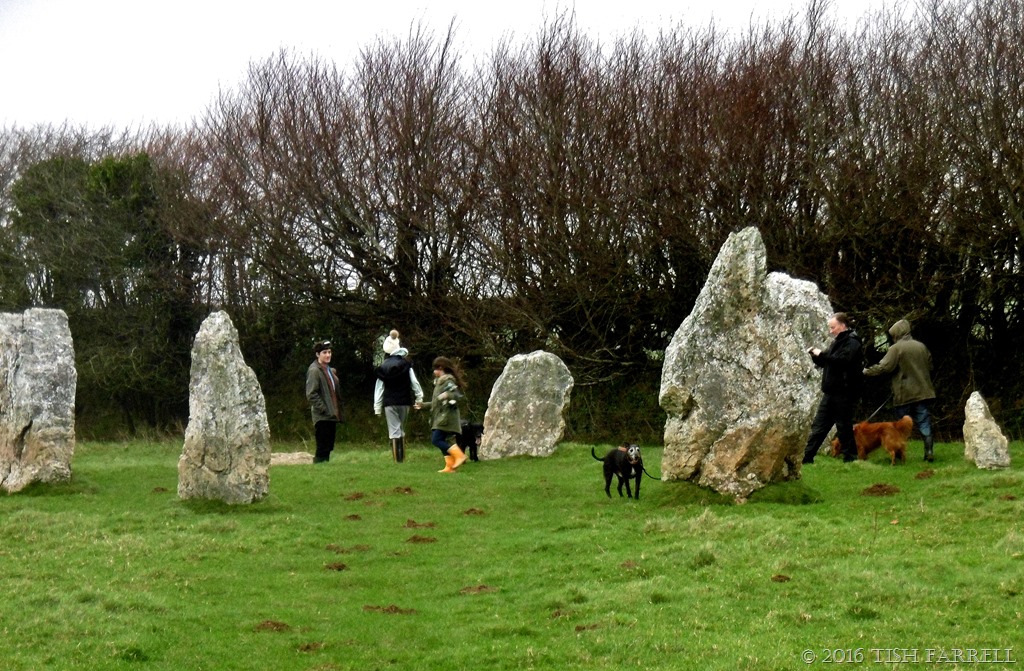
And so there it stands, a domestic-scale stone circle complete with neighbouring cottages, sheep and power lines. Families out with dogs and infants wander briefly round the stones before continuing their walk. They look bemused, as if expecting more. But the stones give nothing away. They have no stories to impart. They simply are.

P1020778

copyright 2016 Tish Farrell


Circle


The Cotehele Christmas Garland

P1020954

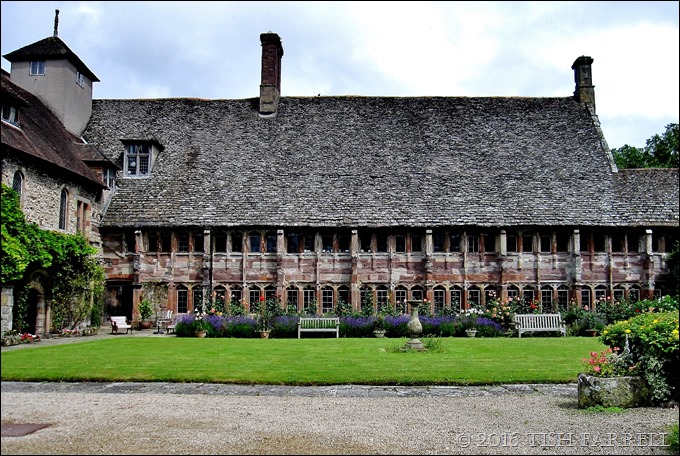
Even on the dreariest, dankest of days Cotehele is a magical place. For nearly 600 years this medieval-Tudor house was the home of the Edgecumbe family who aquired it through marriage in 1353. In 1947 it passed into the ownership of the National Trust in lieu of death duties.  Naturally, December is not the best time to visit, not if you wish to see the main house, or wander in the gardens. But from mid-November to 31st December Cotehele does have one very special attraction that makes it well worth the trip up winding, narrow lanes and into the mysterious Tamar River hinterland.

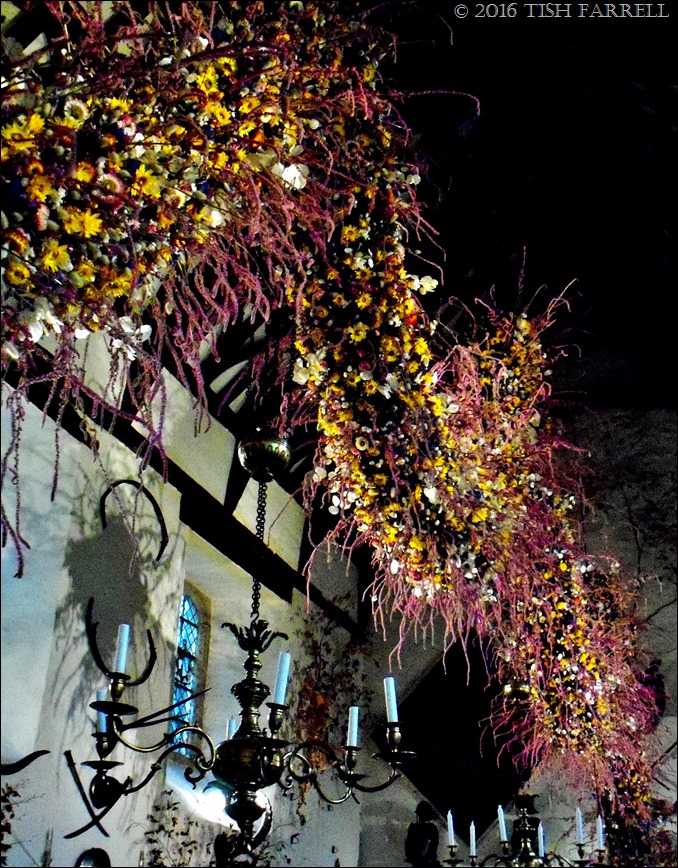
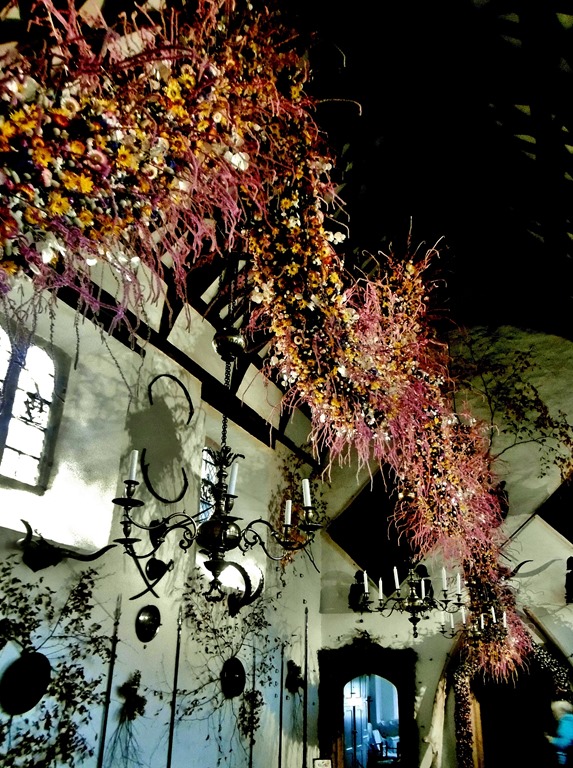
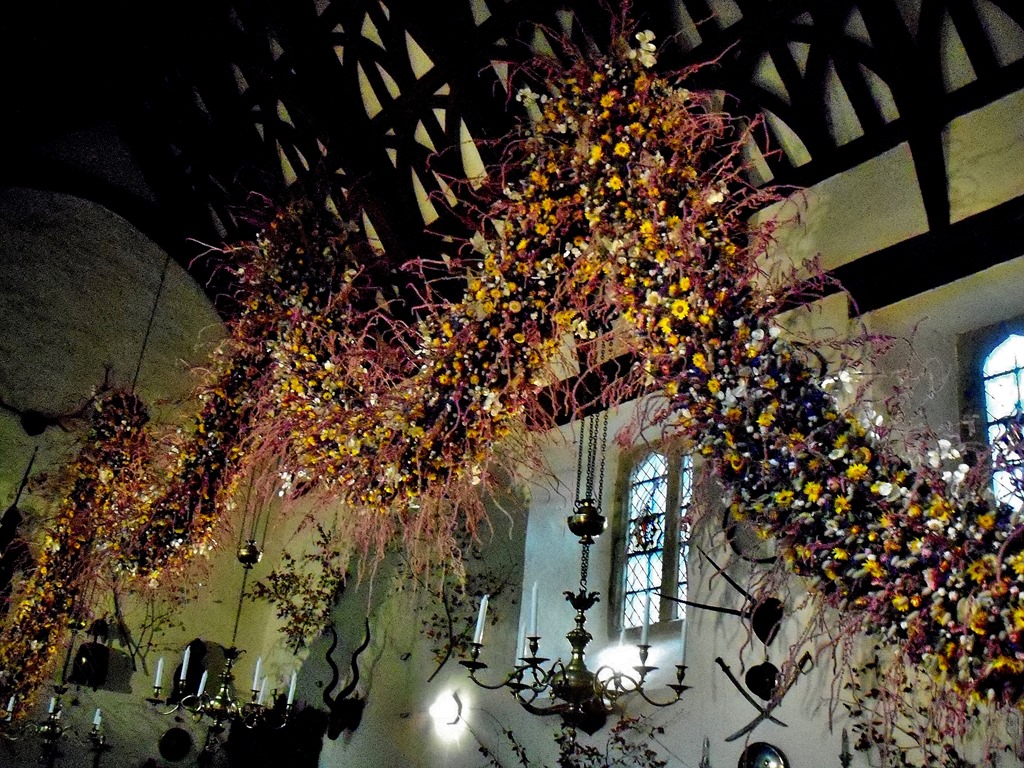
Every year in the Great Hall, and with a log fire flickering in the grate below, an epic swag of dried flowers is hung from the rafters to brighten the festive season.

The garland comprises one hundred feet of rope dressed with 46,000 dried flowers, all of which are grown on the Cotehele estate.  When you step into the Hall there is the faintest scent of summer hay, all of which puts one in mind of old English Hardy-esque midsummer relevry, and brings on a fit of nostalgia for the rustic yesteryear that probably never was.

But it does not matter. As invented traditions go (and the notion for it began in 1956), the garland is beautiful, and a darn sight more picturesque than that other English invention of similar vintage – the Ploughman’s Lunch that is still found lingering dolefully on most pub menus.

The garland takes staff and volunteers two weeks to construct. The base is made up of cuttings from 60 evergreen pittosporum trees. Added to these are statice, grasses, helichrysum, pink pokers, xerochrysum, acrolineum and helipterum. The whole creation lifts the spirits, and in the darkest days of the year, what more could one ask for, that and a delicious bowl of homemade soup in the National Trust tea room?

100_8667

100_8661

100_8686

Cotehele Great Hall

copyright 2016 Tish Farrell

Iron in the Soul ~ Warrior of Llyn

100_4526 - Copy

I have been a multitude of shapes
Before I assumed a consistent form.
I have been a sword, narrow, variegated,
I have been a tear in the air,
I have been in the dullest of stars.
I have been a word among letters,
I have been a book in the origin.
From a translation of the Welsh medieval text of The Book of Taliesin, a sixth century Welsh bard and courtly singer.

 *


It is said that the Iron Man of Mynydd Tir y Cwmwd sings in the wind. I can believe it too: bold laments of long ago battles, a proud Celtic warrior fending off invading Roman governors and power-hungry English kings. Sadly, the cause was lost on both fronts, although at least these days Cymru,* Wales, has its own Welsh Parliament, and Cymraeg, the Welsh language, is nurtured, learned in schools and spoken widely with great pride. And so it should be. It is one of the world’s wonderful languages, the words formed from the rush of sea on rocks, the wind whistling down from the heights of Yr Wyddfa** (Snowdon, Wales’ highest mountain). Under past times of English domination much was done to stamp out the Welsh culture altogether. It is what invaders do – belittle, ban, override  heartfelt expressions of a conquered people’s culture.

{*roughly pronounced Kumree and **Ur Oithva}

You can read the rest of this earlier post about the Iron Man of Llanbedrog at Warrior Wind-Singer of Llyn

copyright 2015 Tish Farrell

This Sunday at Lost in Translation, Paula’s ‘Black & White’ word is ‘winding’. Please follow the link to take part her challenge and see more winding renditions.