
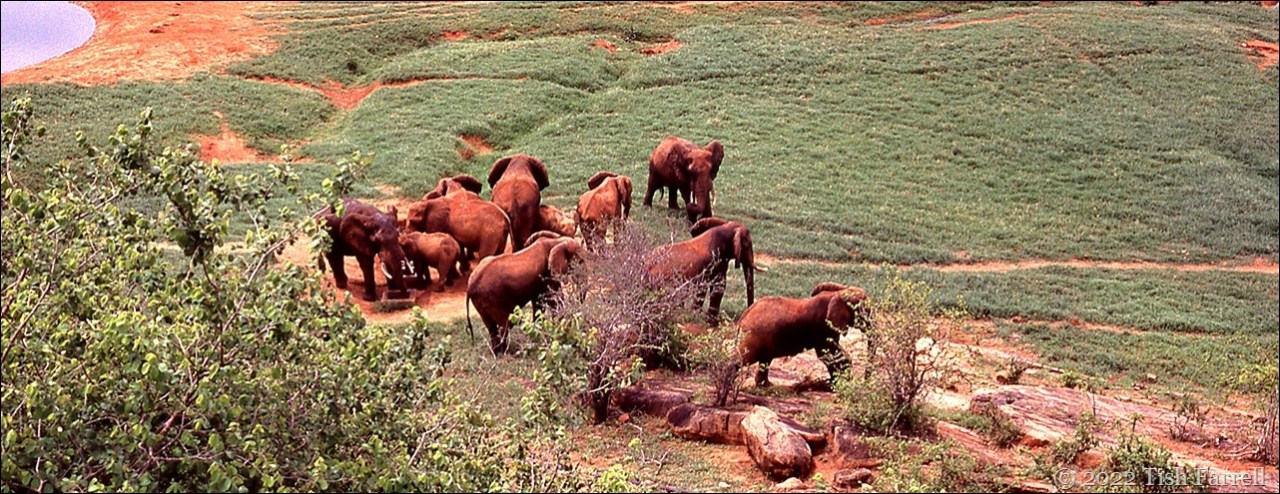
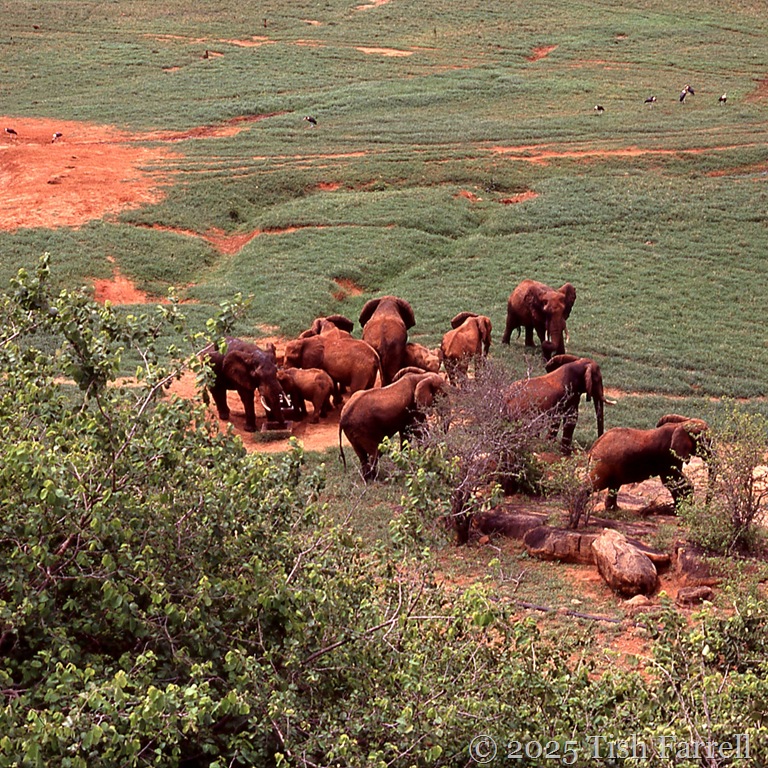
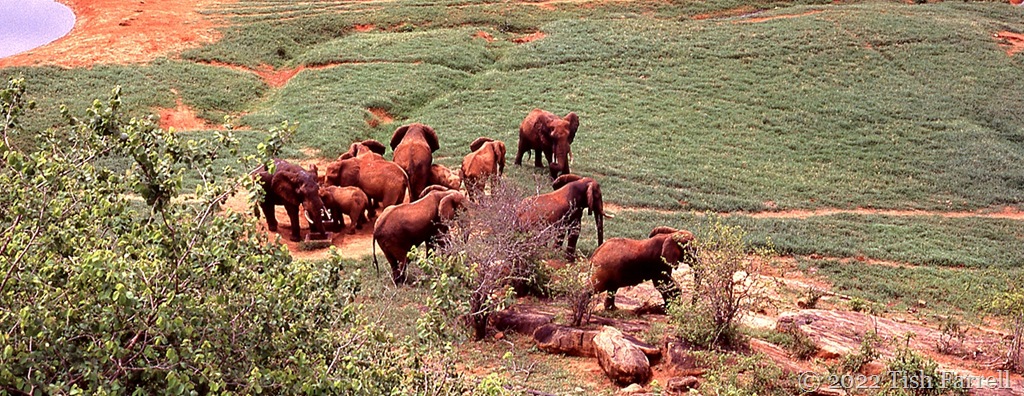
… so called because of their habit of dousing themselves with Tsavo’s iron-rich soil.
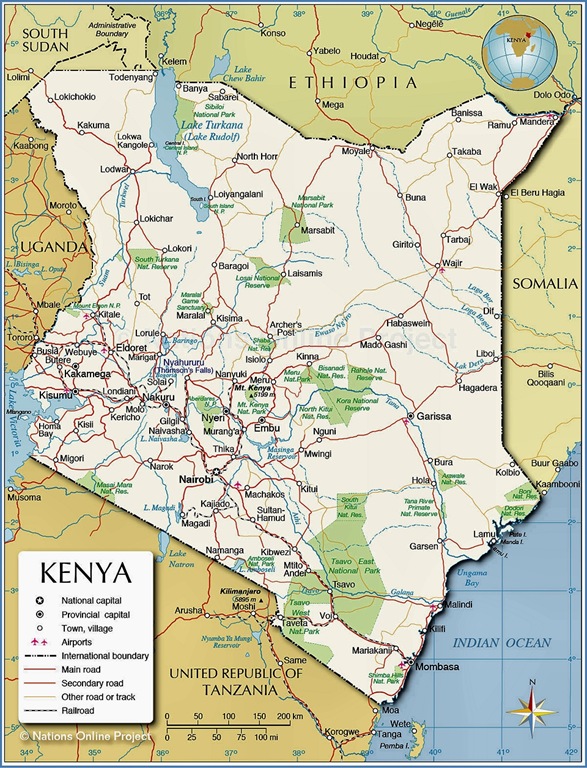
Tsavo East is one the largest parks in the world, covering 5,000 square miles. Together with its neighbour, Tsavo West, on the other side of the Nairobi-Mombasa highway, this adds up to nearly 9,000 square miles of designated wildlife reserve.
The map gives little clue of Tsavo East’s vast wilderness. The solid drawn lines of the designated parks suggest containment, but this is not the case. While areas near human settlement maybe fenced, elsewhere the boundaries are largely permeable. In 1994 the then director of Kenya Wildlife Service, Dr. David Western, famously stated that there was more wildlife outside the parks than in them. He also believed in protecting the free movement of animals, and especially in the one small park whose access was increasingly under threat from human settlement, i.e. Nairobi’s city park. This is still an ongoing issue, the one-time corridor from the southerly plains all but closed.
The business of maintaining wildlife areas is fraught with problems. Elephants may invade farms and destroy a season’s food crops in a few moments. In times of drought, starving farmers may resort to age-old habits of hunting game for food. It is also a fact that elephants can kill people if they feel threatened. Lions and buffalo and crocodiles kill people too. Then there is ivory poaching, small-scale and big-crime funded. The latter comes with highly armed gangs with automatic weapons. So it’s hats off to wildlife rangers who try to do their best by all concerned, and may risk their own lives in the process.
I don’t seem to have many photos from our stay in Tsavo East. I remember the weather was mostly gloomy and driving along dirt tracks for hours without seeing a thing. But the photos at this site are well worth a look.

Interesting- a lot I was unaware of
What an experience this would be. While I don’t expect at my age to ever make the trip..zi can enjoy yours..Thank you again for sharing .
The most visible difference between the elephants in Kenya and India was the colour of the mud they coat themselves with
But always a delight to spot however they come 🙂
A wonderful post that brings back sweet memories of driving through Tsavo in a little Fiat with my friend Pam in 1967. I was 19, off on a 4 day excursion from the S.S. Ryndam, where I was on a 4 month tour around the world on the “World Campus Afloat.” Kenya was the highlight for me and I couldn’t wait to graduate from college and head back to Africa, which I eventually did.
That is one fine memory, Judy. Kenya does have a ‘life-altering’ effect on one’s system. But a little Fiat in the bush, that must have been something.
We were so naive…had no idea where we were going but we did have an adventure.
I can believe it!
what an extraordinary sighting, and how wonderful you have some photos to accompany your memories
Yes, it was an amazing sight.
Great that you had at least this photo of the elephants. I know it’s a constant battle between animals and humans, but my sympathies lie with the animals as they were treading their routes long before man decided to turn the land into a farm.
Lots of thorny issues really, but I take your point about who was there first.
It seems that all countries have the same problems with progress. Amazing images of the red elephants. I am enjoying this series.
Thanks, Anne. One problem in Kenya is there is very little land that’s suitable for growing food, and most of it is in the highlands. It’s ever a problem of whose interests take precedence. The game parks of course are the draw for big tourism, bringing in essential income; lots of conflicts of interest.
That is a problem. People must be fed. Even with income you can’t import the necessary food stuffs.
They look beautiful bathed in red earth. Great capture.
They do glow so 🙂
Such amazing creatures!
I checked the site and yes some brilliant shots but I rather preferred yours Tish – much more WYSIWYG as western tourists ‘on safari’ make me cringe – I’d even rather see big game hunters despite rightful disapproval
Well thank you for preferring my version, Laura. I do know exactly what you mean about safari glitz. In the last few decades it’s grown ever more ‘glam’ and resource heavy.
Dousing. Refreshing? Cooling? Sexy? What’s the answer? Some interesting stuff here, not all of which I was aware of.
I think the dust and mud bathing protect the skin from insects. Also cooling.
Ah! Red deer stags here like to bathe in mud into which they have urinated. It has the same function, but more importantly, makes them impossibly alluring to females. Takes all sorts …
Thanks for sharing that, Margaret 😉
😉
Some lovely photos and interesting article in the link, but your elephants are far redder and a better photo. Maybe the dust soothed and gave some sun protection? I’m enjoying your memories Tish
I have a notion the dust is some protection from insects/ticks. Now I need to go and check 🙂
Mmmm I’d love to come with you 🤭🐘
🙂
Reminds me a bit of the discussion of reintroducing wolves in the western United States. People get very passionate both for and against and there are valid points on both sides.
Yes, it isn’t always easy to accommodate human interests alongside other creatures’ needs. I seem to think wolves have been successfully introduced in many eastern European wildlife reserves.
Of course, the problem is that they don’t stay in reserves and the ranchers in the west don’t appreciate their animals being killed by the wolves.
Our time here last year was very special, one photograph of Michaela’s, of a red elephant walking towards her, is one of my favourite of all of our travel shots. We also had a great safari guide who couldn’t stop giggling at the sight of the red elephants.
Thanks for that image 🙂
I’m always happy to see elephants and these look great with their dusting of red dust 🙂 The orphans we saw at the David Sheldrick centre looked much the same!
Funny you should mention the orphans, Sarah…
Because? Do you have a post planned?
Today’s 🙂
Got it!
An amazing experience, Tish. Love these photos.
It was an experience, Flavia. Though I still have to give myself a mental pinch – was I really there.
It must have been extraordinary – great memories.