
Our first stint in Kenya was meant to be for three months. It stretched to nine, a long time to be away from home when none of it had been planned. On our return to the UK in September ‘92 we weren’t sure what would happen next. But come November we were flying off to Lusaka, Zambia, on another short-term contract.
This time Graham was seconded to the EU Delegation to take charge of the Commission’s food aid distribution. Zambia had been suffering a prolonged drought, but as it happened, and fortunately too, our arrival coincided with a return of good planting rains; food aid was only needed to bridge the gap until harvest time. And so once again, like strange migrating birds, we left Africa in September. And once again, two months later, we were heading back again, to Kenya on yet another short-term contract, this time to close down the Larger Grain Borer project based at the Kiboko research station. This was the project Graham had been attached to as a consultant in 1992. (See previous post).
A year later, we were still in Kenya, one contract having evolved into another. In December ‘94 Graham, as head of the UK crop protection project, had to chair a three-day agriculture conference in Mombasa. I went too and, as I had the use of a rather good camera, I spent my days sitting under a palm tree in the hotel garden, looking out on a slice of Indian Ocean, sometimes taking photos of the passing beach traffic.
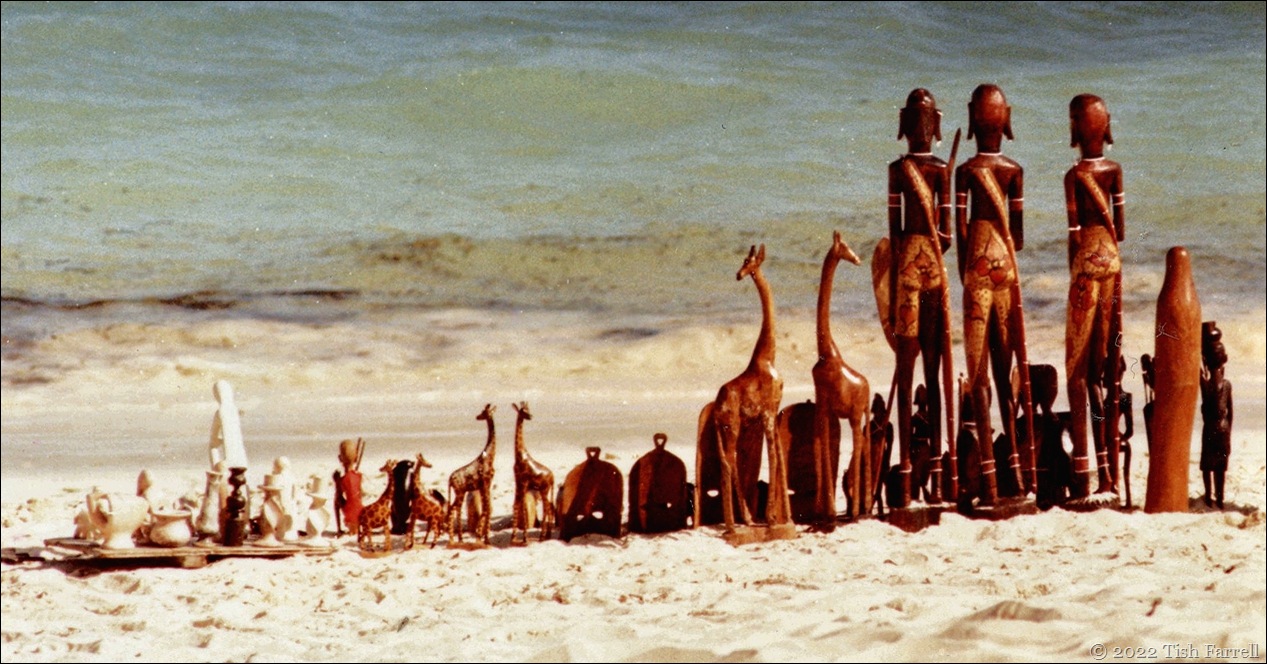
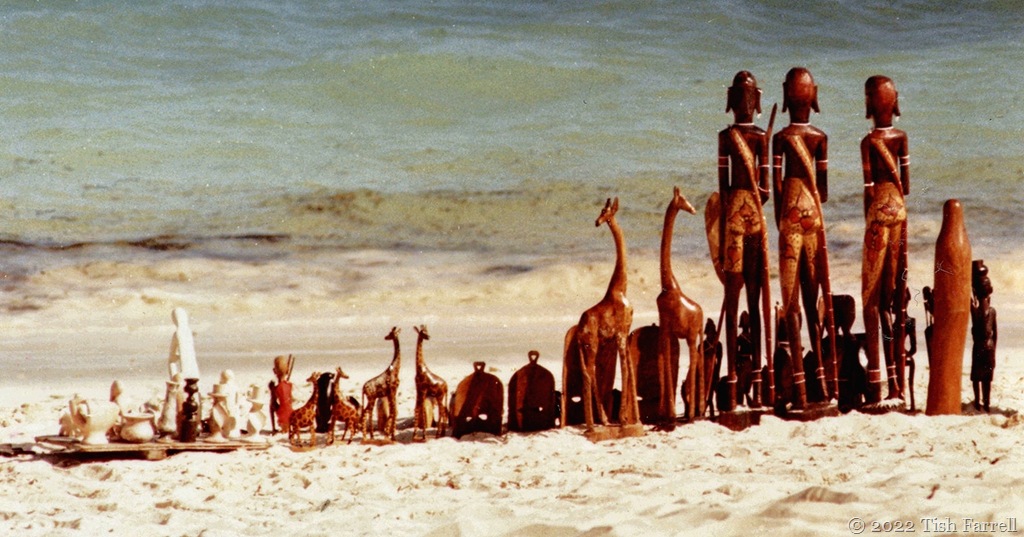
Hotel beachfronts around the world are places where business is done. Mombasa beach is no different and young Kenyan traders are smart, quick to cater to all tourist wants. The Akamba wood carvings and makeshift stalls of kanga wraps are among the more innocent lines of merchandise, although often the means of making contact and enabling further transactions.
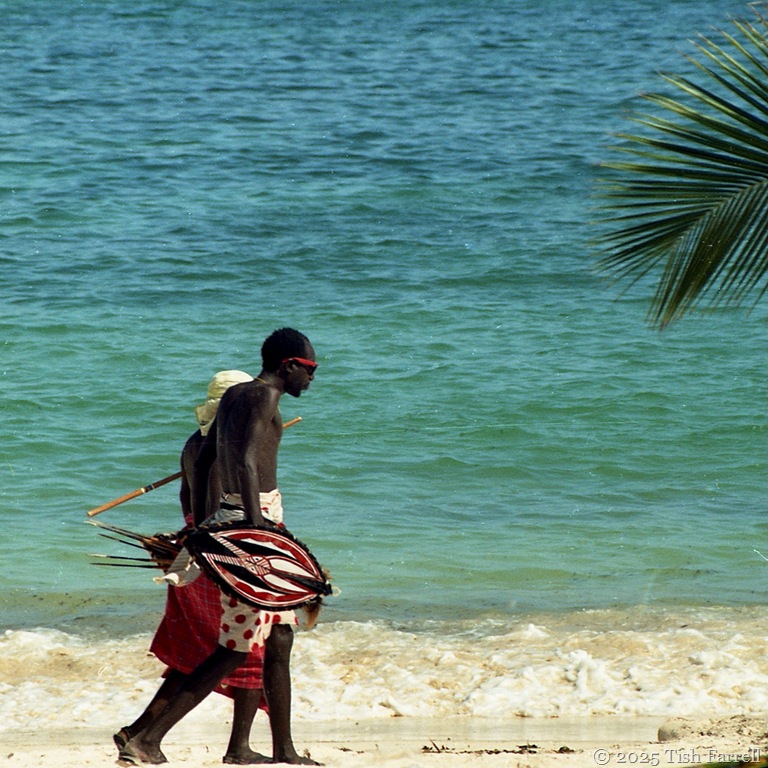
Needless to say the deemed exoticism of Maasai morani (young men of the warrior age set) can hold a particular appeal to visiting women of a certain age. So much so, enterprising lads of other upcountry communities might don the gear and pass themselves off as Maasai, or so a Kenyan friend told me.
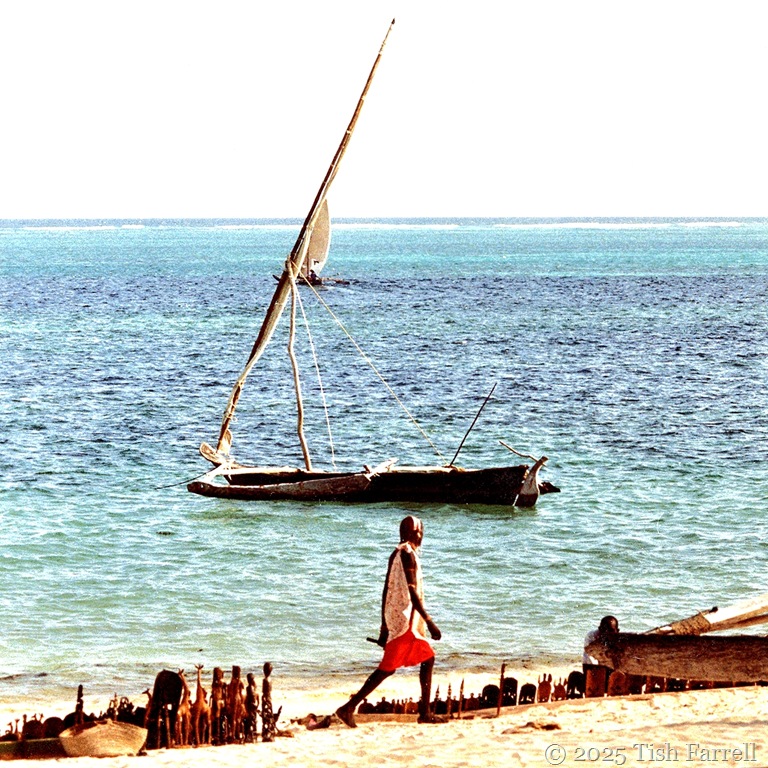
That said, I’d bet that the young man in the header is Maasai, that lilting stride and spare frame. He could be a member of one of the traditional dance troupes employed by the big hotels. These next guys, though, look more like beach-wise traders with their made-for-tourists weaponry. Very cool sunspecs and matching kanga wrap though:

a rather fabulous place to wait out a conference – must have been a very weird life though at times for you all the toing and froing over these few years
and I just love the composition of your square
Thank you, Becky 🙂
It was rather like being on an extended holiday in some ways. A camp follower in others.
well you do sound as resourceful and positive as Juana María de los Dolores de León Smith, aka Georgette Heyer’s The Spanish Bride!
Ha! Becky. Oh, to be have been as intrepid as Juana. I did have small moments though, and because I was often on my own in public places, which was an unusual circumstance for Kenyans to appreciate, and also when they could see I was not part of any safari tour, they used to talk to me about their lives. All to my great benefit. I learned a lot.
I think you may well have been as intrepid as her 🙂 and that is a definitely an upside of being on your own you do get to learn more from locals
I love Heyer and have almost all her books, including “The Spanish Bride.”
so do I 🙂 I have all of her historical ones but couldn’t quite cope with her mysteries!
Thanks for sharing your African trips with us Tish! And for sharing their culture. Much appreciated.
My pleasure, Anne, There’s tons more where this came from. Lately, I’ve wondering what to do with it all.
Take us on more trips! I’m just wondering how much these places have changed with the years.
Kenya’s pretty high tech these days, and was one of the first countries to have wide-spread cell phone usage/using phones for money transfer etc. But some things won’t have changed too much.
😊
Nice photos. Thank you for sharing. 🙂
Most interesting, Tish, and a smattering of red, too
Thanks, Sue.
😊
I always wanted a wooden giraffe, Tish. Not got anywhere to keep a real one xx
Some of the Kenyan woodcarvers produced near life-sized ones. They were fabulous.
Another interesting Africa snippet. I like the carvings.
Love your ‘delicate’ description of the goings-ons on the beach. 😀
🙂
Certainly sounds as if you went with the flow with all the coming and going Tish. What an interesting, memory packed time of your life
There was a lot of coming and going, Pauline. Not at all up for that kind of thing now 😉
Oh yes, energy levels and times change
I always love reading about your time in Africa, as the continent fascinates me so much! I was interested in what you had to say about non-Masai young men posing as if they were to attract women, and I can absolutely see how that might work, as the ‘real’ Masai have a low-key elegance about them, don’t they? As for those carvings, I would find it very hard to resist buying something – probably a giraffe!
Many of the young beach traders, lads and lasses, are simply hopeful that some rich mzungu will carry them off to a life of plenty. The relationships they strike up with tourists often have quite a romantic cast to them.