
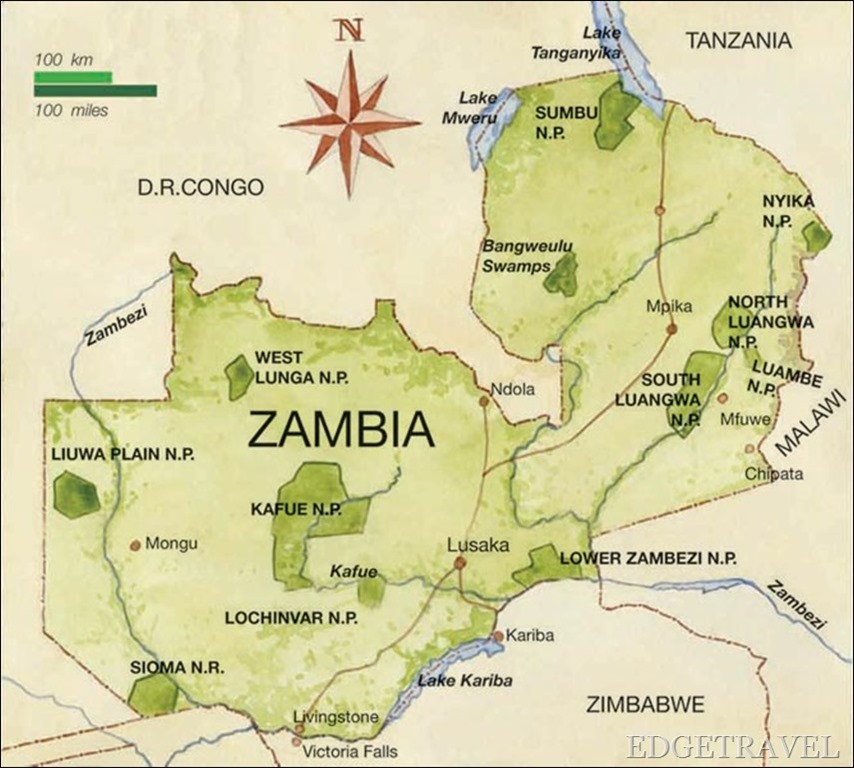
In 1992-1993, during the first years of Zambia’s multi-party democracy, we were posted to Lusaka, Zambia’s capital. Graham was charged with organising the distribution of European Union food aid to drought-stricken Zambians. (Part 1 is HERE, part 2 HERE, part 3 HERE, part 4 HERE, part 5 HERE, part 6 HERE)
*
*
July 11th 1993
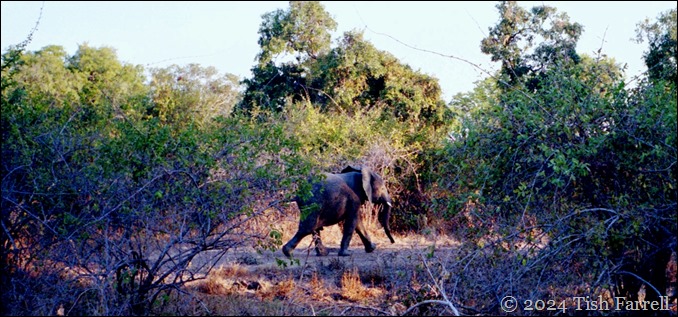
After two days at Tena Tena camp it’s as if we have fallen into a dream. As Robin Pope drives us across the game park to Nkwali camp, he talks about the problems of elephants ring-barking and uprooting trees. Their drive to create more grassland where once there was open forest is gradually changing the ecosystem right down the nature of the soil. It’s something to ponder on. Then we see two village men cutting sheaves of vegetation, and Robin says the dry season is thatch-mending time and local people are allowed in the park to cut the grass.
I’m trying to focus on his words, but my eyes are scanning the landscape. We pass through a zone of recent burning. The place is alive with birds mopping up the roast remains of insects and other small creatures. There are crowds of storks and a flock of stunningly coloured lilac breasted rollers. Flashes of purple, royal blue, turquoise and unlovely squawking.
One thing Robin says penetrates the reverie. He happens to mention that the current paramount chief for the district is a woman. That gives me something to think about.
*
Nkwali Camp is on the banks of the Luangwa, outside the park, but within a designated hunting block. Our new temporary ‘home’ is very ‘open plan’, one of six cabins, with a high sheltering thatch, open at both ends, and a large unglazed window overlooking the river. Out back, the flush loo is housed in its own thatched cubicle, but the shower is open to the sky, the water heated up in an oil drum on a charcoal fire.
There are three other guests, and in late afternoon we are driven to a spot on the Luangwa where migrant carmine bee eaters flock to breed along the sandy bank. Again I long for a camera that might capture the startling flurry of colours – brilliant Titian reds with turquoise caps and rumps. Instead, I watch them until the sun goes down and wonder, will I always remember this?
*
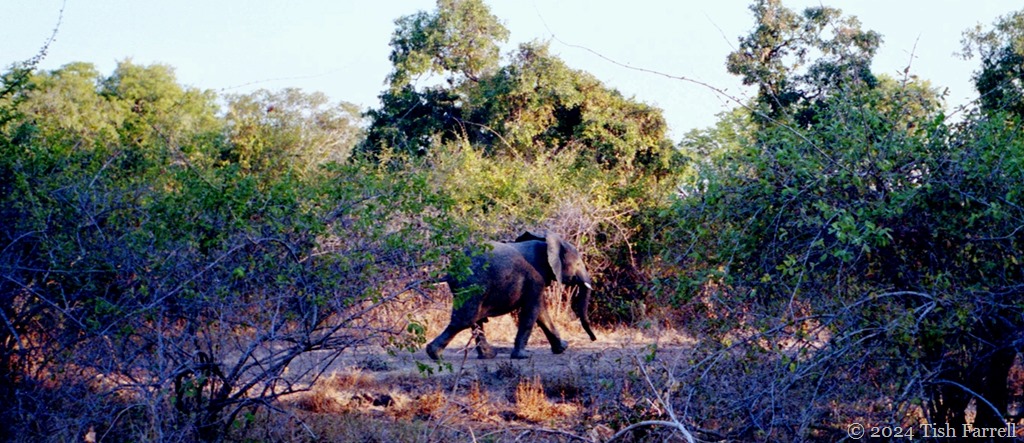
That night in our cabin, it isn’t hippos that keep us awake, but elephants. In the early hours they gather in the trees all around us, come there to eat chinzombo fruit. Now they are anything but silent. There are rumbling bellies and crashing vegetation and much munching. The cabin seems to shudder. I’m relieved when just after 5.30, our English guide, Hugh, comes to call us for the morning walk. He tells us he had to do much clapping before he could exit his own cabin; there was an elephant mother and child outside his door. He found three more in the camp bar, eating the thatch.
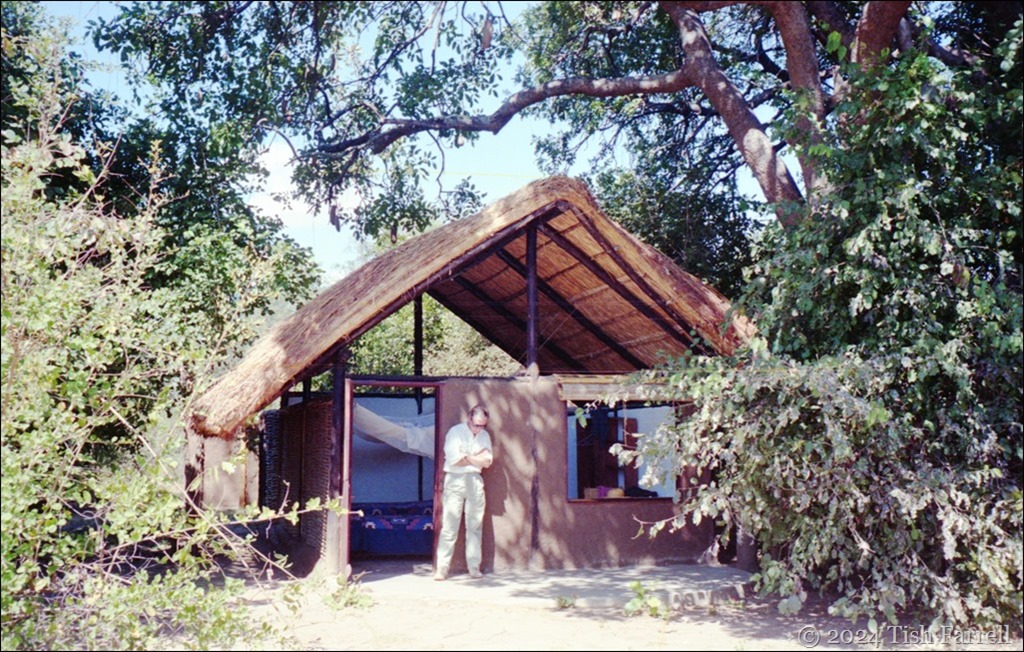
In the early hours our cabin is surrounded by chinzombo chomping elephants
*
![img20240926_17344961ed_thumb[7]](https://tishfarrell.com/wp-content/uploads/2024/09/img20240926_17344961ed_thumb7.jpg "img20240926_17344961ed_thumb[7]")
Nkwali camp bar as it was in ‘93. These days camp facilities are far more luxurious
*
I hear angry trumpeting from across the river, and find I am happy to not see the elephant visitors at close quarters. Even so, after breakfast, Hugh says we will go and look for them. Graham and I follow, along with James the ranger and tracker Reuben bringing the tea things. It’s a beautiful morning and we begin our walk through tall grasses, yellow hibiscus, white jasmine and orange turbaned Leonotis (Turkish pompoms) that sunbirds love.
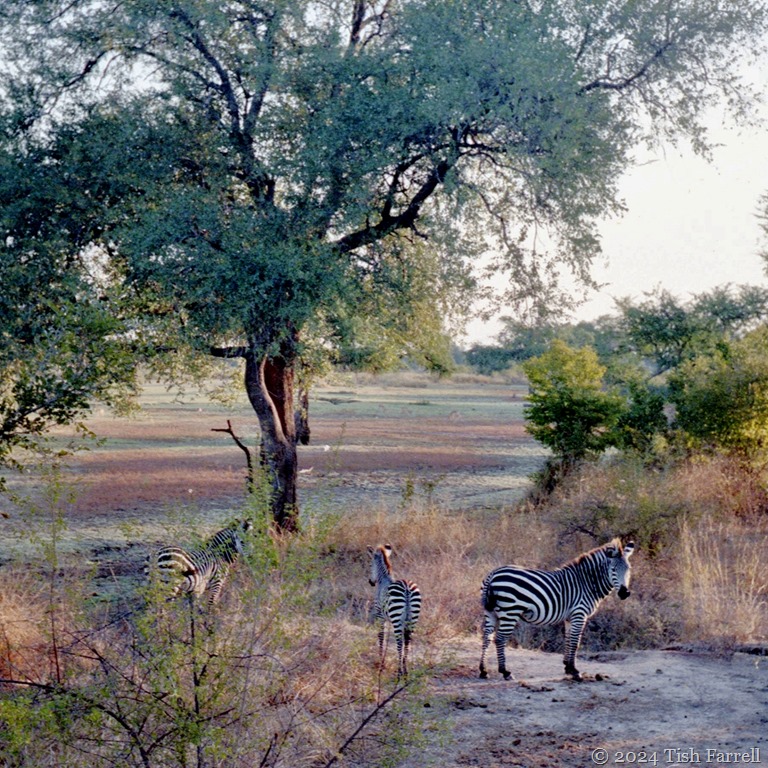
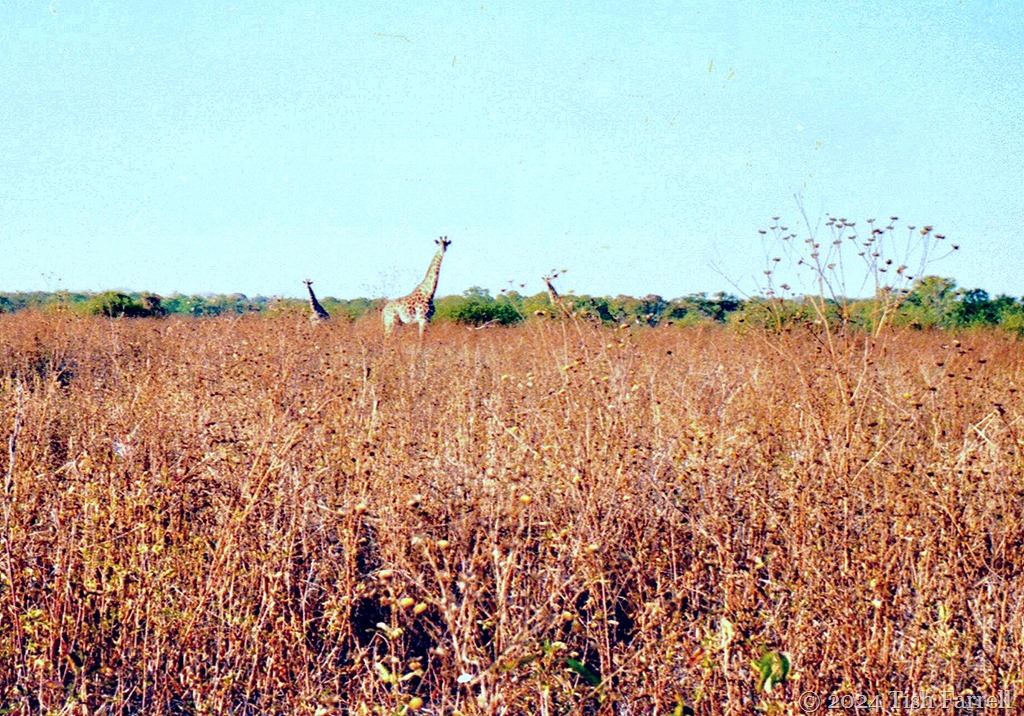
As we go, we are watched by a young kudu antelope. Hugh says it is an orphan, but it has attached itself to a herd of eland. Next we are watched by ten Thornicroft’s giraffe, a subspecies found only in Luangwa. They move quietly around us. It is like walking into one’s own wildlife film complete with knowledgeable narrator.
*
There are blue helmeted guineafowl everywhere, the land all round resounding with their raucous calls. There are also yellow canaries and more sightings of eagle owls. We examine a termite mound that has evidence of an aardvark assault. Their heavy duty claws are built for demolition, and their thick skin impervious to termite bites and ant stings.
Hugh soon has Graham crumbling aardvark dung that has been deposited nearby, inspecting the contents through the wrong end of our binoculars, picking out beetle and soldier ant parts. We then taste the fruit of the ebony tree, the fleshy part reminding me of lychees; we pick up porcupine quills; learn about the towering vegetable ivory palm, whose nutty kernel is worked into small items like earrings and passed off as elephant ivory; regard the leaves of the mahogany tree that are stuffed into pillows to induce sleep.
James and Hugh between them test the wind and manoeuvre us into safe viewing distance of our early hours elephant visitors. Later Hugh finds a warthog hole and, stationing us well back, throws a rock in to dislodge the resident. Warthogs, he says, go into their holes tail first, enabling a speedy exit. This morning, though, the usual occupant is abroad. Instead, out comes a cloud of brown and mauve butterflies.

*
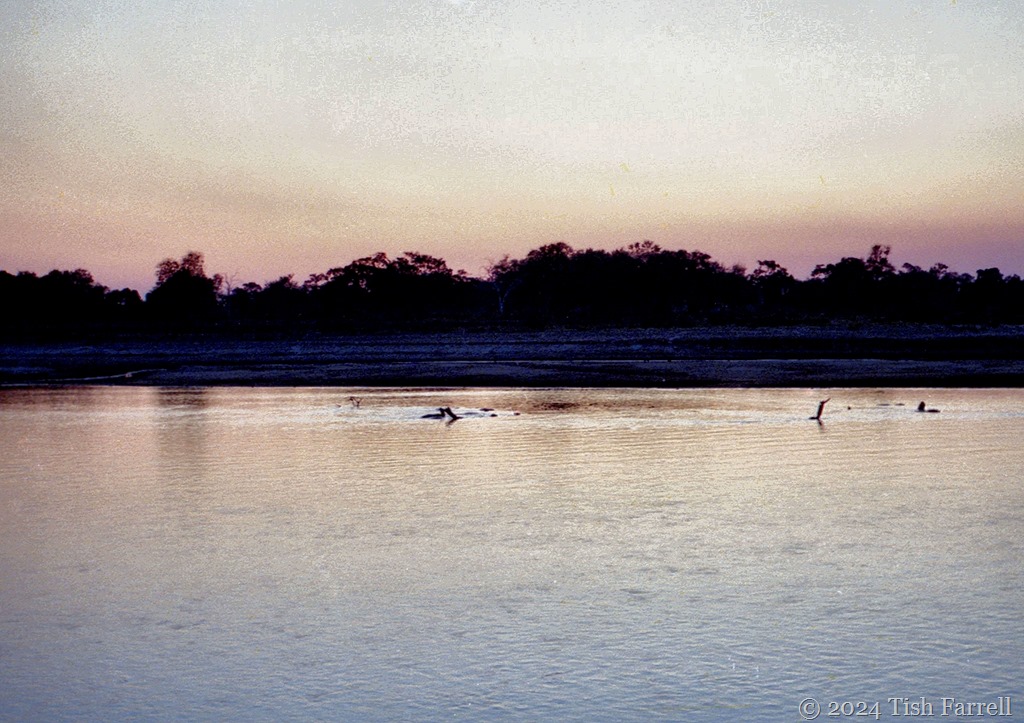
And then in early afternoon, after a scrambled egg brunch, it’s time to leave. We’re driven to Mfuwe airport, and soon we’re airborne above the Luangwa, and this time, thanks to something Hugh has said, I recognise features I missed before. The hippo trails striking through the bush from the river, their night-time paths to grazing. I think of the angry young bull who stayed out of the water too long. And I think about the fisherman killed by a hippo and wonder how it happened. And I remember a piece of vital safari wisdom I have read somewhere: never find yourself between a hippo and the water.
But now I realise I’m exhausted from the sights and sounds, the tramping, the bone jarring rides, the sleepless nights and early mornings. Come late afternoon, it’s a relief to find ourselves back in our little house on Sable Road. Perhaps none of it actually happened.
Copyright 2024 Tish Farrell
*
P.S. You can see the bee eaters here:
This year’s arrival of carmine bee eaters in South Luangwa – a short video clip
And the video after it explains the history of South Luangwa National Park and the legacy of game ranger Norman Carr who developed walking safaris and was passionate that local people should gain some benefit from tourism. Robin Pope trained with Carr and his company carries on vision for community orientated conservation.
https://www.youtube.com/watch?v=J4Q-ikCUiwU

You bring it all to life. I so enjoy your descriptions and narration.
Many thanks. Marie. It’s always good to know when the words work 🙂
Wow! What memories!
Yes, and still a bit hard to believe.
what an extraordinary experience – you have must have pinched yourselves at times to believe it was really happening. Wonderful squaring too
Yes, a lot of pinching then and again now as I’m ‘revisiting’ it. And thank you for so marvellously managing the September squares while in transit. That’s quite a feat. I’m sorry I didn’t participate until the last lap, but I can see there have been a lot of happy September squarers. So as ever, very well done, Becky.
awww thanks Tish
Another immersive piece. I imagine experiences like this remain fresh in the memory forever?
Hi Tish. We may be in Botswana now but your descriptions of the wildlife could be here and now, today. Even the guinea fowl are squawking just a few yards away as I read your words. The biggest difference is the temperature range – it’s over 40 in the afternoons and properly cold at night. It continues to be a strange feeling reading exactly what I’m experiencing (in many ways) yet stories 30 years apart.
Good to hear you’re having a fabulous time in Botswana.
As engrossing as your previous post – again, I felt I was there with you. No need of a better camera when your words capture the scene so vividly!
Thank you for that v. kind comment, Sarah.
Such magic. The words “Paradise lost” come to my mind… Maybe Milton had something to do with that. But then I think: “No not lost. Eternally there in my mind’s eye.”
Asante sana Memsahib mkubwa.
Ah, yes – the mind’s eye, Brieuc. Mine’s been doing a lot of ‘hindsighting’ lately. Thanks as ever for reading.
🙏🏻
Oh how amazing it all must have been. Remembering my own wildlife sightings in Africa, feeling as if I was in a movie, helped me immerse myself in your experience. And oh those bee eaters! Stunning!
Alison
That’s really lovely to know – your memories and mine – safari alchemy 🙂
A much more colourful bee eater than we have here, Tish. I could picture sitting in that spot watching the sun go down. What an experience overall, and you tell it so well!
I’m playing catch up between UK visitors departing and Polish family arriving. Life is rarely dull.
You are a star – reading my blog post AND fielding family gatherings. Lovely that you have your Polish family visiting. Happy days!
Wonderful images and narration Tish. Did you keep a journal during this time? It’s great that you remember it all so well. Will there be another installment?
Many thanks, Anne. I did keep some notes of our trips, but also my two lovely aunts (no longer with us) kept all my letters to them. As to another installment – there may well be.
What fun, to read your old letters that prompt your memories.
Yes, Graham’s been fascinated by how much he had forgotten!
That’s why we journal and take pictures!
Yes!
😍
Thanks to Becky’s gallery I find myself here on your post, to remind me that I have been saving the pleasure of reading all of your letters from Lusaka for a winter’s day. I must remember to go back to the start of these memories. I recently passed back to my eldest children the letters they wrote to me when they were in South Africa in the 1990s. And enjoyed reading the ones I wrote to my in-laws about my year in Kent. Letters are such wonderful reminders of life.
Jude, that’s very nice of you to save up my Lusaka posts for a ‘rainy day’. And yes, letters, the stuff one finds in them that we’ve quite forgotten. G. has just this week been sorting out the letters that I have computer file copies for. He’s feeling a bit snowed under…I’m wondering if I can edit them all into some sort of narrative. Big job though.