
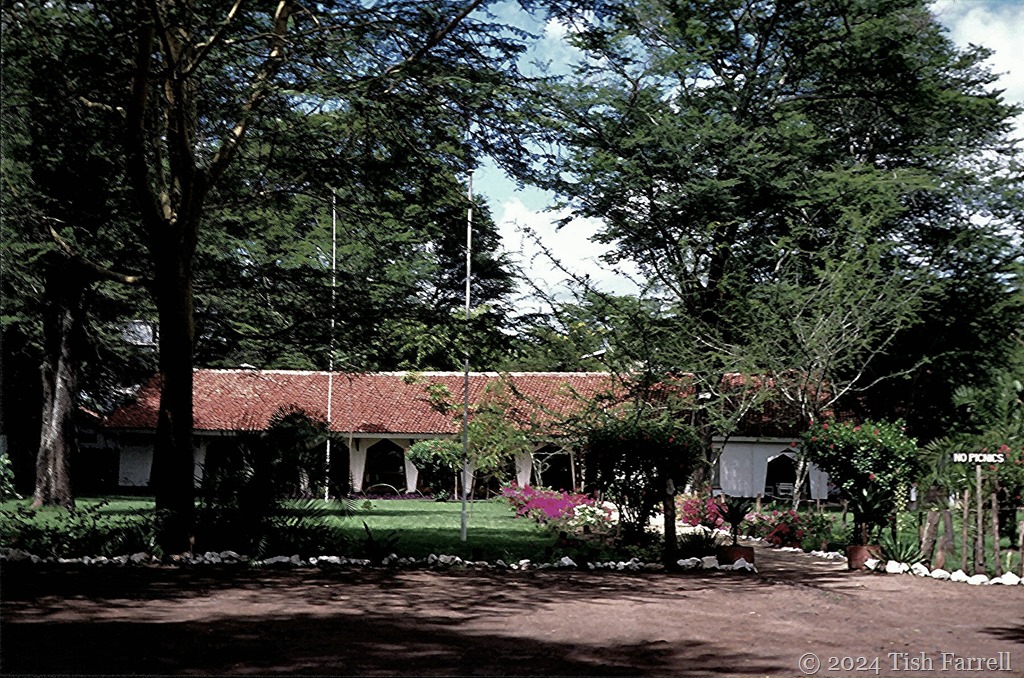
Every time there was that gasp of relief, as if we’d not been breathing for the last hundred miles. Ahead, through the heat haze, appeared the stand of fig and fever trees, rising tall and green above the dry bush country. After two hours of truck fumes, heat and dust and no shred of shade since leaving home in Nairobi, it seemed like an oasis.
It could be a mirage of course. But no. Next the scene would solidify and we’d see the Akamba wood carvers’ stalls set out under the trees. And then, thanks be, we’d be turning off the Mombasa highway, bumping along the dirt track, that was scarcely more bumpy than the road, and into the cool sanctuary of Hunter’s Lodge.
*
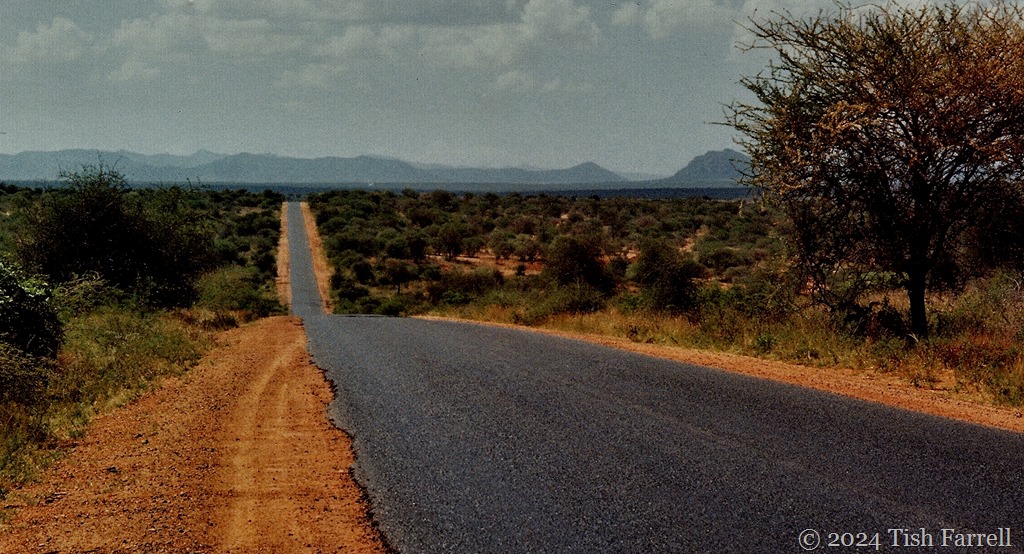
And this is what we had left behind – the highway looking north towards Nairobi, caught here in a rare truck-free moment. There is currently talk of this route being replaced by a 300-mile multi-lane, super highway-toll road to be built under the auspices of the US government. Some Kenyans are sceptical of its ever happening.
*
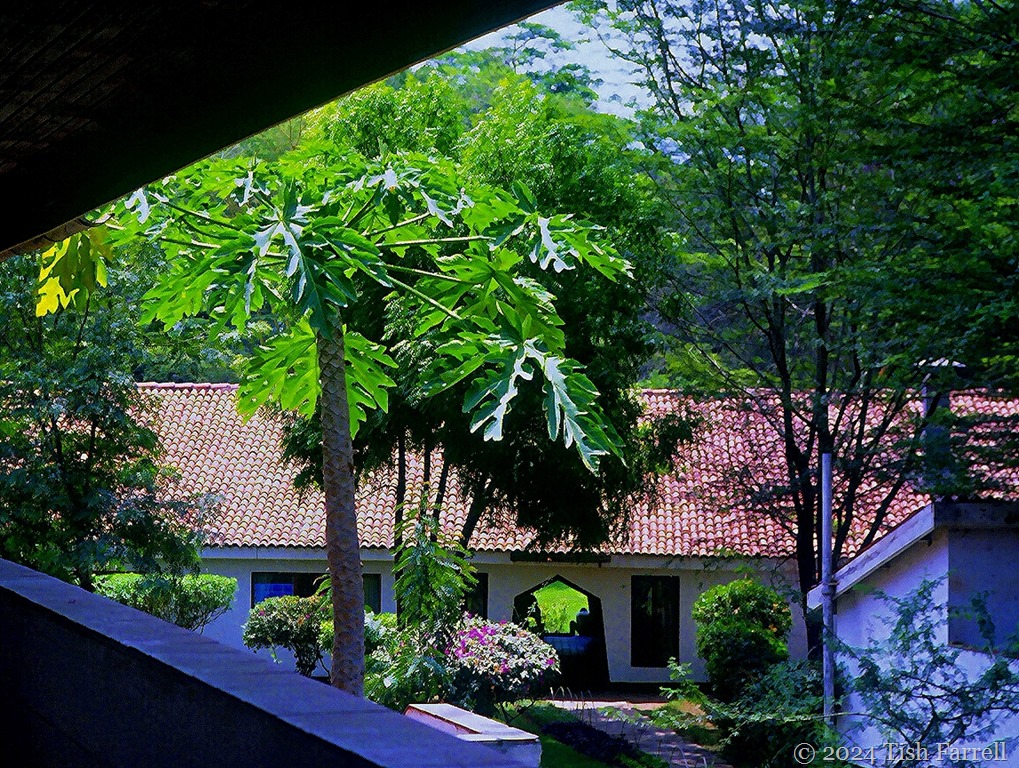
The trip to Kiboko and Hunter’s Lodge was one we made every other week during our first year in Kenya. Graham had been seconded to the Kenya Agricultural Research Institute to work on the eradication of the Larger Grain Borer, a voracious pest of stored grain, introduced to the continent on consignments of food aid. The project had its base at Kiboko field station, which, most conveniently, was behind the garden at Hunter’s Lodge.
There’s more back story here: Once in Africa: everyday moments at Hunter’s Lodge…until the crocodile
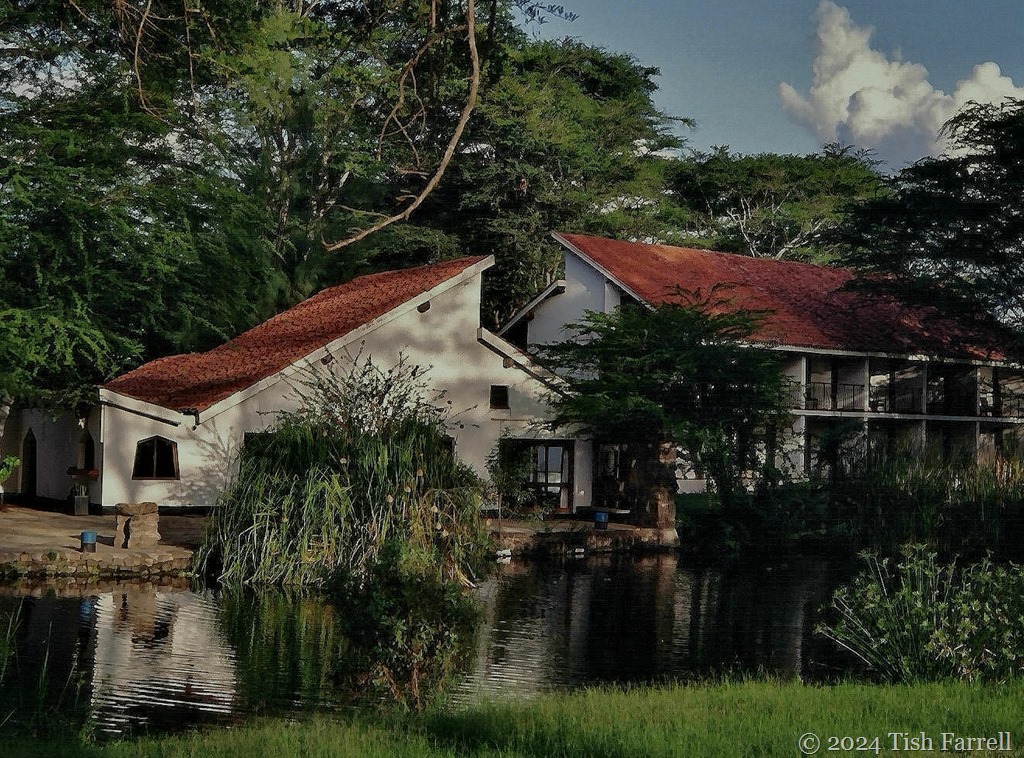
The Lodge was built in the 1960s as the retirement home of big game hunter, the blunt-speaking, no-nonsense Scotsman, John Hunter. He belongs to the era of grand shooting safaris for maharajas and European nobility. (Out of Africa Bror Blixen and Denys Finch Hatton were colleagues and friends). He also spent much of his shooting career working for the colonial game department, tracking down ivory poachers while ridding the lowland bush country around Kiboko of ‘troublesome’ rhino and elephants. The former were terrorising the Akamba farmers, the latter destroying the sisal and orange farms of British settlers. He chose this spot for his home because he remembered it as an elephants’ waterhole, where he had enjoyed much time simply watching them. He seemingly saw no irony in the fact that he’d helped eradicate the local population.
The waterhole, which was fed by a rare local water source, the Kiboko River, was remodelled into a garden lake, and traversed (in our day at least) by an extraordinary bridge that led to the vegetable shamba.
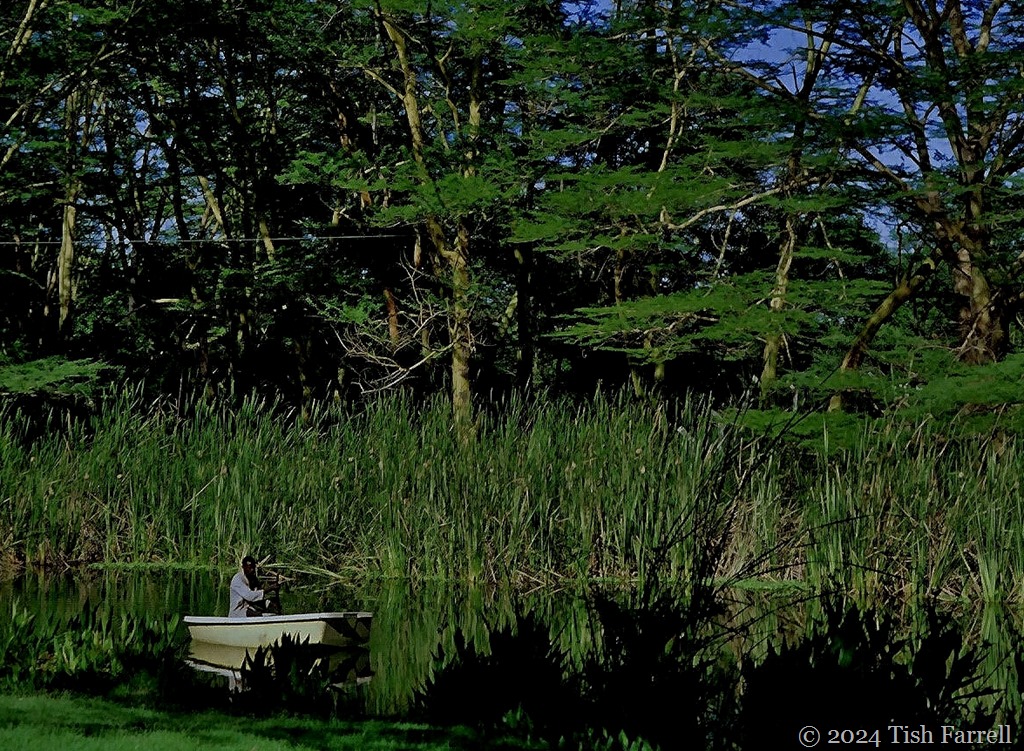
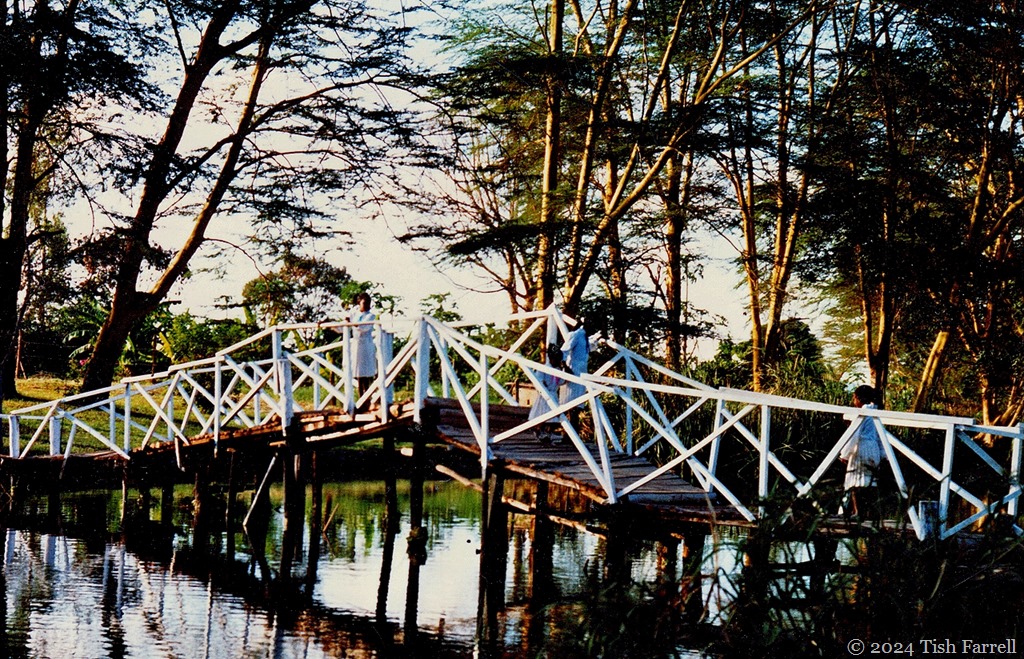
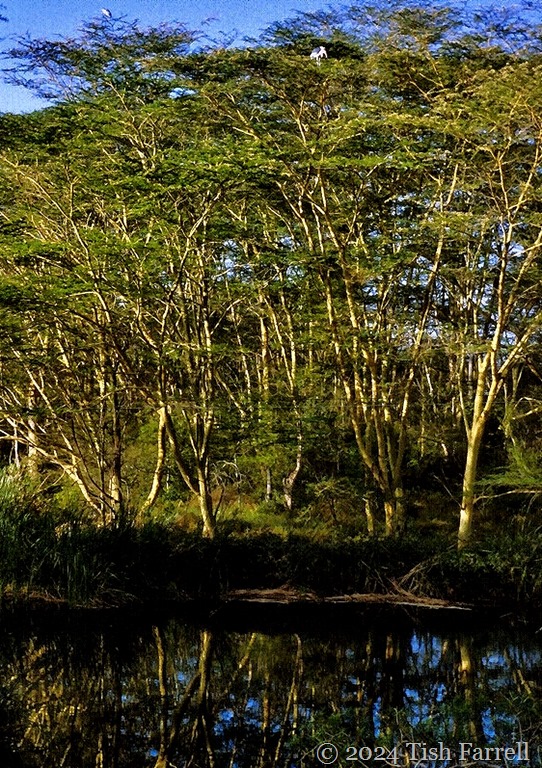
There was said to a leopard living at the top of the lake, though I never saw or heard it. We did hear bush babies screaming at night, and also watched the nightly firefly show over the water. It was also a fabulous place for birds: over two hundred species including many varieties of kingfishers, weaver birds, herons and storks. Sadly, I had only my small Olympus – trip camera, so there are few bird photos. The very distant marabou storks in the next photo’s tree tops are actually huge in real life.
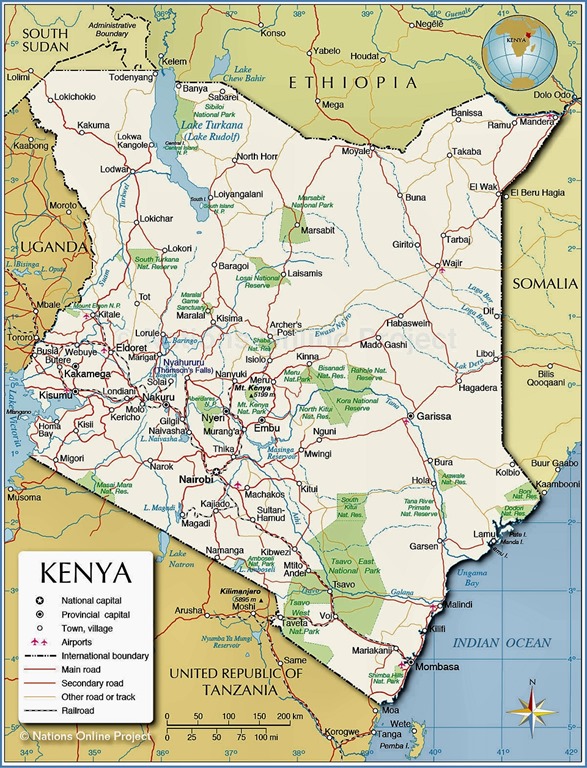
Kiboko isn’t marked on the map. It’s a centimetre above the border with Tanzania, due north of Kilimanjaro, roughly midway between Sultan Hamud and Kibwezi. The area east of the highway north of Tsavo East Park is Ukambani, traditional territory of Akamba farmers and herders. To the west is Maasai land, though you will of course see Maasai herders along the road, at the trading centres, and spot the red flash of their shukas as they drive their herds across the bush country north-east of Kiboko.
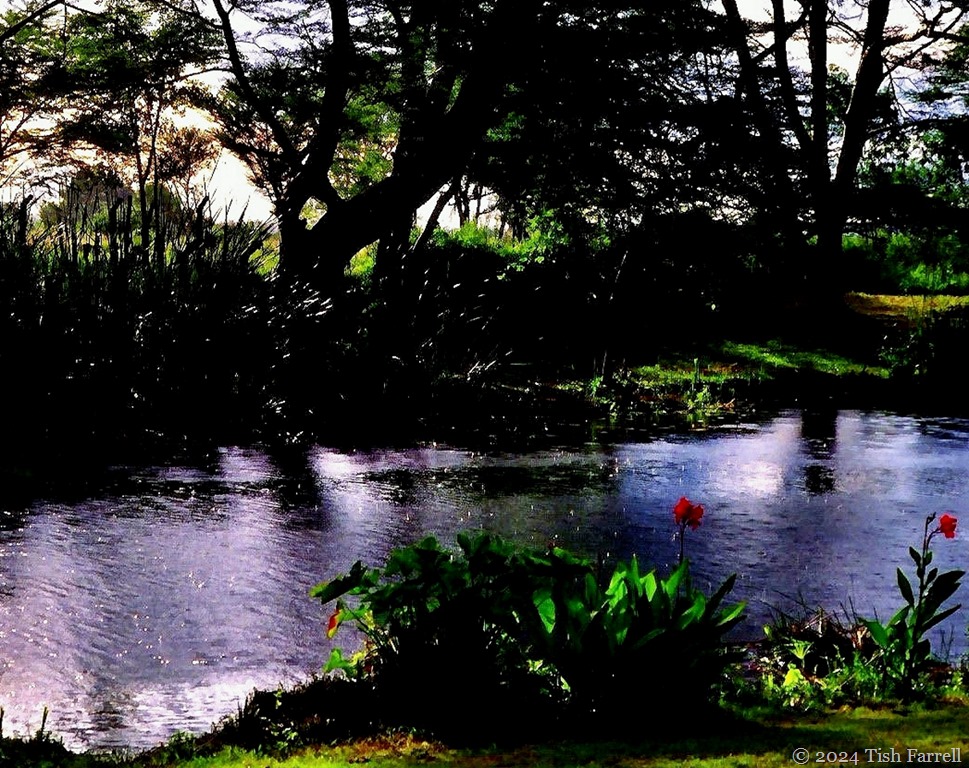
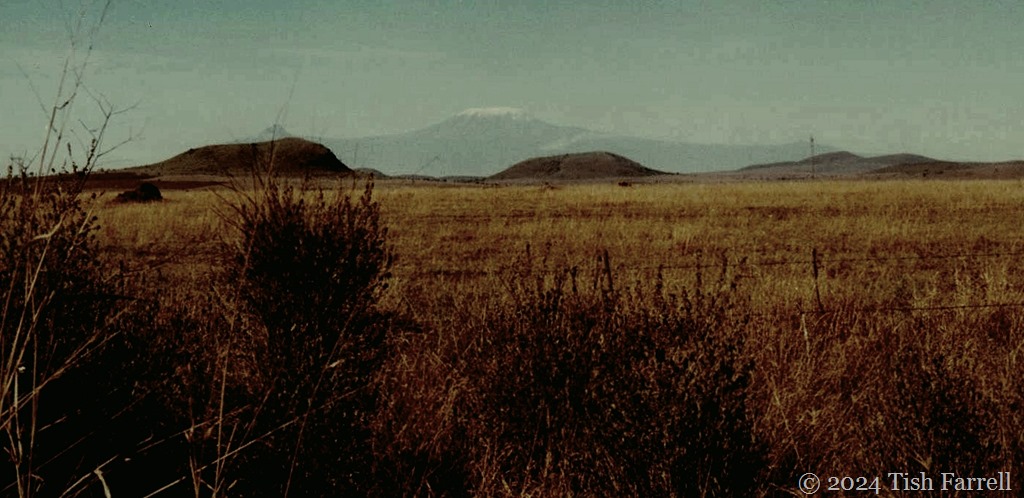
Sometimes along the road you may also catch a glimpse of Kilimanjaro, on those odd occasions when the mountain chooses to show itself. As you can see, lowland Ukambani is a sear land of thorn scrub and savannah. It hardly rained at all in the times we visited. The header photo was one of those rare moments.
*
Lens-Artists: Cool Colours John at Journeys with Johnbo sets this week’s theme and says he is open to any or all interpretations.

How cool that you were able to have this experience Tish. Lovely photos. Thanks for taking us there.
So happy to take you on this little safari, Anne 🙂
😍
Beautiful!
Thank you!
After two hours of unrelenting heat and dust on those roads I can see how arriving here must have been sheer bliss. A wonderful oasis. And yes the irony of the elephants didn’t escape me!
Thanks, Jude. It certainly was an experience.
You sure know how to live, Tish!
Rather more quietly these days, Thom 😉
Nothing wrong with that.
What a fascinating interlude in the adventurous life you have lead! …and you have the pictures to prove it! Wonderful!
Thanks, Cora. As ever, lovely to find you here.
Out of Africa has been a fave movie since it first came out.Maybe that is why I enjoy your “”trips” so much. It was out about the same time we “lost””our farm so I just felt a connection.
A favourite film here too. I think we even watched it when were IN Africa. As we drove out of Nairobi centre and turned into our neighbourhood, we could see the Ngong Hills on the horizon. Sorry about your farm though. That must have been distressing.
It was but in life we just have to move on to the next chapter.
That sounds very brave.
Fascinating and beautiful. We’re not in Kansas anymore! (Wizard of Oz.)
Many thanks, John. And no, definitely ‘another country’ 🙂
What an adventurous life you have had, Tish!
Sometimes, though, I do wonder if it was actually me 😉
This is such an interesting post – must have been an amazing experience.
Many thanks. I have to say, living in Kenya for seven years was both a gift and a very big education.
You know I always enjoy these stories and, loving in a desert, I can well imagine how welcome that water was/is! I loved seeing the map, as we support a group taking care of close to 100 orphans in Machakos, Masii Town and I found Machakos on your map. 🥰
That’s fascinating, Janet. Machakos is the main town in Ukambani, up in the hill country before the descent to the hotter plains.
The Akamba are amazingly resilient people, from the early 20th century with a tradition of serving in the army and police force. Also great traders and makers.
In the more distant past they were cattle herders and elephant hunters, with great trade routes across East Africa to the coast where they traded with Arab dhow crews and the towns of Swahili coast.
As with most of Kenya, much poverty is down to lack of cultivatable land, (plus water) and the inherited system of British land ownership when Kenya became a British Protectorate and then a colony, i.e. all land belonging to the Crown, and, after Independence, to the state.
In the past, communities had all manner of flexible mobility strategies across huge territories to enable them to survive periods of famine and disease. British rule did not cater to flexibility, hence the Reserve system that kept every ethnic community in its allotted territory. As far as I could tell while in Kenya, this system still survives with regard to land occupancy. It’s one of causes of increasing poverty, as overworked, over-divided land (through inheritance father to sons) becomes degraded. Sorry, this sounds like a lecture, but I know you’d perhaps like a bit of historical context.
Thanks, Tish. There are so many orphans partly because people can’t afford to take care of them, so they’ll sometimes just leave them somewhere. Duncan takes in as many as he can, but money is always an issue. Then the recent floods washed away some of their buildings and other things. They’re striving to be self-sufficient and also teach each child a marketable skill. Thankfully our money goes much further there, but it’s still tough.
It sounds a brilliant effort, Janet. Children of course bear the brunt of the multiplying effect of poverty.
This same lethal system was a lot of the reason the Irish famine drove more Irish out of Ireland than remained in it. The British again. I know Americans get blamed for everything but I’m still waiting for the Brits to actually accept responsibility for the messes they made in every place they colonized.
The Brits did indeed make some hideous messes. The first settlers in Kenya were largely from the aristocratic class. In fact as the Protectorate took bureaucratic form, there was a deliberate policy to encourage only settlers of a certain class (as in upper). Along with them came all the class ingrained notions of landed sporting estates and pilfering peasants.
I love these Blast from the Past memories you write about from time to time, Tish. Bring ’em on as often as you want to! Did Graham and his colleagues have any success eliminating that Borer? How ironic that aid intended to help had the opposite effect.
So happy you like these ‘flash-backs’, Margaret.
As to the pest, the strategy was to introduce a natural predator beetle from LGB’s homeland in Central America. (G. spent some time in Mexico before Kenya). It of course had to be screened first to ensure it would not become another potential pest. Graham’s project team were working with farmers around Kiboko, monitoring the effect of the predator release.
It seemed a promising tactic, but the predator did not thrive. Chemical dosing in grain stores is currently the only strategy and LGB is now in 21 African countries. It chomps essential subsistence crops like maize and cassava to dust. (You can actually hear them chomping inside a grain store).
https://www.sciencedirect.com/science/article/pii/S0022474X21000990
How depressing. And following acts which were meant to help and support too.
Yes, and it’s not an uncommon outcome of well-intentioned aid projects.
😦
I’m always fascinated by your posts describing your time in Kenya and this one is no exception! That looks a lovely place to stay 🙂 There’s a hint of ‘poacher turned gamekeeper’ about John Hunter I guess, if he tracked down poachers but also killed big game himself. Different times …
He did rather do both at the same time, Sarah. His shooting of elephants was justified by the game department, either for clearance purposes (and I think he had a share of the ivory) or by licence on safari. If Africans killed big game they were treated as poachers. There are tales too of officials selling off recovered ‘poached’ ivory.
My dad’s been to Africa several times, visiting quite a few different countries. He said you can never forget it, it’s almost like you leave a bit of our soul there. I have a sense that it’s the case for you too. Wonderful post.
Yes, Sofia, you do get changed. It feels quite visceral, and not really explainable. We were both a bit shell-shocked after we left for good.
hello . wow! great post love it! kambas my people . am filled with joy as i read this. once again great post!
Asante sana 🙂
Karibu are u a kenyan or what
No. English. I lived in Kenya during the 1990s.
Interesting. So, u are from England
Yes.
Seems u like Africa so much
Tish, you and Aletta in her post have reminded me and revived my excitement for going to Africa. My wife and I will be traveling to South Africa to spend a few days on a photo safari in Kruger NP in early October. Thanks for sharing your images of Kenya!
That trip sounds so exciting, John. Do you follow De Wets Wild on WordPress? Fabulous S A wildlife essays to add to your excitement: https://dewetswild.com/blogposts/
I’ve followed Dries for about ten years. In fact, he will be our tour guide, picking us up in Capetown from the airport.
His team in Kruger will include Hannes Rossow, pro photographer and Irving Knight Safaris.
Oh how very fantastic. That will be one brilliant experience then.
What a marvelous time you had in Africa. Your photos are terrific.
It was a very big adventure. Thanks, Jennie.
You’re welcome, Tish.
Oh the magic of Africa! Thanks for taking me back once again. I do wish I’d had the chance to spend more time there, in one place as you did, and really get to know at least a bit of it in greater depth. When I read your stories I come to understand how we barrelled through. Your photos have survived well.
Alison
Thank you for joining my safari, Alison. Spending time in one place certainly does have its rewards, though there were days when I felt I was stuck in a waking meditation, especially at Hunter’s Lodge; also situations where it felt only appropriate to quietly observe.