
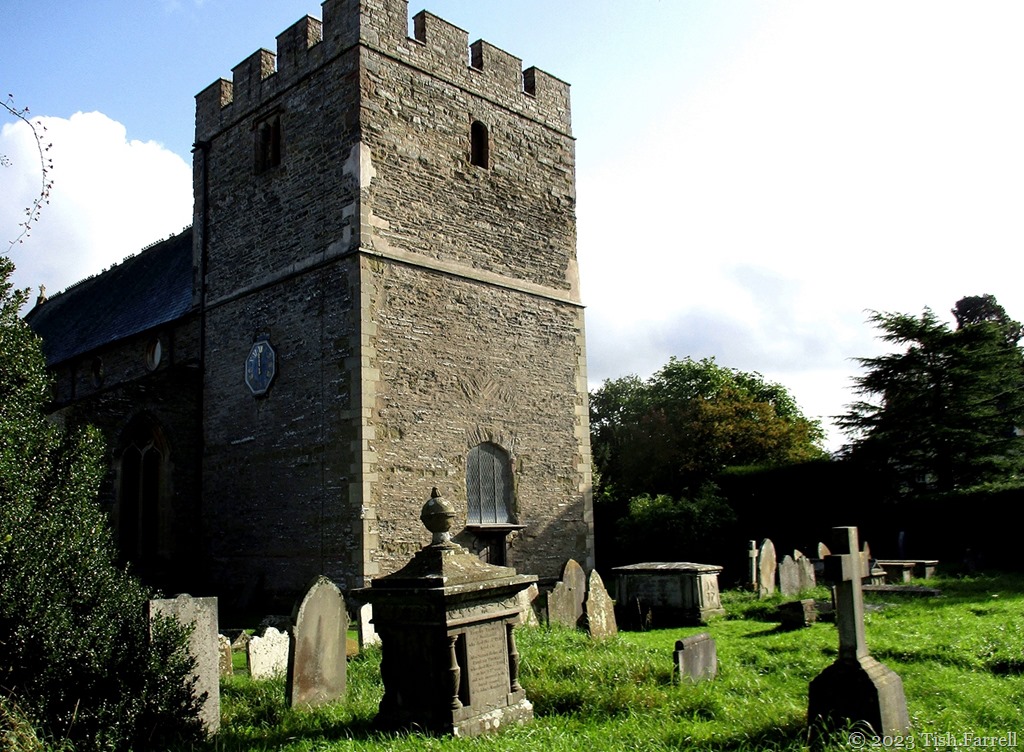
My last post featured a recent visit to Bishop’s Castle’s parish churchyard and the mystery surrounding the grave of an unnamed African who died in the town in September 1801. This week I returned to the visit another intriguing grave. It stands in sight of the great Norman tower of 1291, and marks a death that occurred in May 1802, a few months after I.D.’s burial, and also the year of a general election.
And what an epitaph it is. What a swingeing ticking off of the town’s ‘worthies’; very much in the vein of ‘you know who you are’. (And doubtless everyone else in the town knew too).
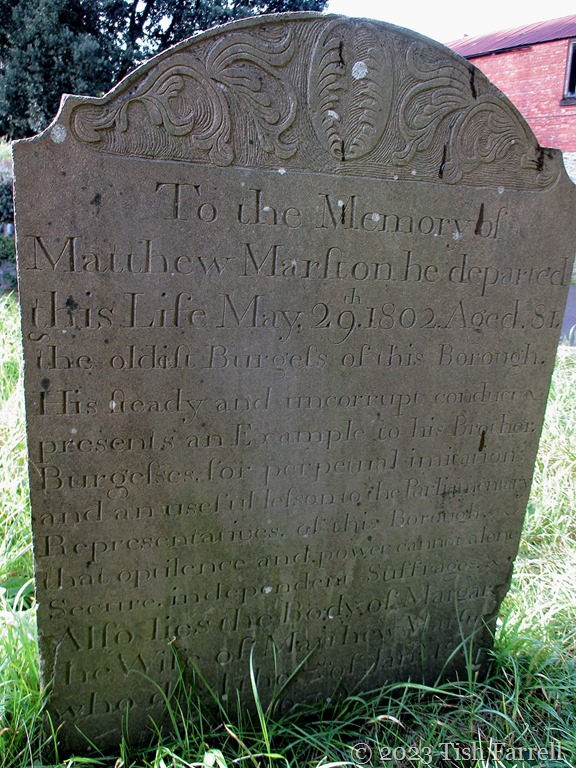
Here’s what the headstone says:
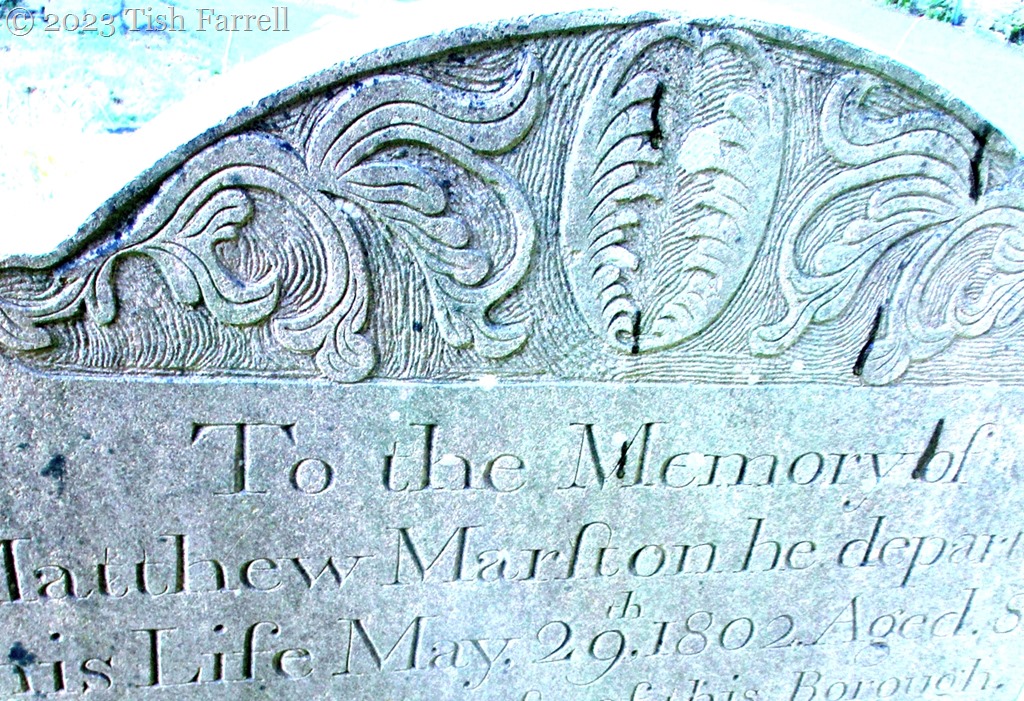
To the memory of Matthew Marston. He departed this life May 29th 1802 aged 81, the oldest Burgess of the Borough.
His steady and uncorrupt conduct presents an examples to his brother Burgesses for perpetual imitation and a useful lesson to the Parliamentary Representatives of the Borough that Opulence and Power cannot alone secure universal suffrage.
*
*
And to what particular corrupt practice is the Marston stone referring?
Bribes for votes, that’s what, and the fact the town’s burgesses controlled the electoral roll. Only they could vote in elections, and only they had the power to admit new burgesses to the roll. And these were the men who managed all aspects of the town’s affairs, from market trading to judicial and coroner’s courts.
In 1802, when there were around 170 burgesses on the roll, the going rate for a vote was 25 guineas – well over a thousand pounds by today’s values, and enough then to buy 2 horses or 5 cows or employ a skilled tradesman for 173 days (National Archives currency converter).
For a small rural town, Bishop’s Castle seems to have earned itself a big reputation for shady political dealings: a ‘rotten borough’ from 1690-1763, and a ‘pocket borough’ from 1763 – 1832. During these years the town returned two parliamentary representatives, all members of the landowning class, or in the case of the pocket borough, all relatives or favoured associates of Robert Clive. (He had returned from India, where he had risen from lowly agent in the East India Company to Governor of the Bengal Presidency, amassing a fortune equivalent to 48 million pounds). Only with the Reform Act of 1832, did the parliamentary borough of Bishop’s Castle meet its end. We now have 5 regional county representatives.
During the rotten and pocket eras, parliamentary representatives were obviously intent only on furthering their own and sponsors’ interests and causes. This situation was compounded by the fact that several times the entire manor of Bishop’s Castle changed hands with the new owners seeking to secure a seat for their own man. In 1683 it featured in a marriage settlement between one Anne Mason and the Earl of Macclesfield. It was Anne’s ne’er-do-well cousin Richard Mason, seemingly the Earl’s ‘placeman’, who then bribed and bullied his way to Parliament, standing as M.P. for 30 years.
In 1718 the new Bishop’s Castle owners, the Harleys, appalled that their own candidate had failed to win a seat, roundly condemned the town’s burgesses (‘profligate wretches’) for their ‘villainous roguery’ and ‘perfidy’ in voting for Mason. They sold the manor on to the Earl of Carnarvon (Duke of Chandos) who then, after considerable expense, secured his own placeman at the next by-election. His purposes doubtless served, he then sold the manor to his nephew, local landowner, John Walcot of Walcot Hall, who then found the means to further his interests through favoured candidates. And so it went on. On and on.
But what of Bishop‘s Castle’s ordinary folk? Over all these centuries of political vested-interest, one might well wonder how did life go for the ploughman, dairymaid, tavern keeper, clerk, cowhand and stonemason, or for the cooper, brewer, carpenter, apothecary, farmwife, cook, curate and chamber maid? How indeed?
You can well see that the Marston family had a point when they erected this headstone to their kinsman, the good burgess: a lone voice of integrity?
previous post The Man from Africa: I.D. unknown
source: The Story of Bishop’s Castle eds David Preshous, George Baugh, John Leonard, Gavin Watson, Andrew Wigley 2018 Logaston Press

Politics hasn’t changed, has it? Interesting piece of history! Thanks Tish.
You are right, Anne. Nothing really changes.
Nothing new under the sun. Isn’t it about time things changed.?
Quite agree, Beverly.
I hope these nefarious doings are no longer a common occurrence in the town you have chosen to call home.
Heaven forfend, Margaret 🙂
I am curious who came up with the headstone. The man himself or the family?
It’s most likely his family, though I guess it’s possible he wrote his own epitaph in advance, or at least told his family what he wanted said on the stone.
Curious things epitaphs. Of absolutely no use to the person they are commemorating, but possibly one last opportunity for your friends to have a laugh at your expense. For example, “Here lies X, she loved all the Sharknado movies”.
Ha! Now you’ve got me wondering what I might have on mine.
Hopefully not too many dodgy dealings these days!
I should hope not, Sue 😉
😊
You might say he had the last word. 🙂
🙂 🙂 🙂
I want a gravestone naming the people I hate and why I hate them 🙂
Only you could come up with such a comment!
😄
Ha! As ever, I like your style, Edouard 🙂
That is a brilliant epitaph. I don’t think there is any honest burgess member who deserves such an inscription. I suppose it’s comforting to know that however bad things seem, they have at other times been at least equally bad — or worse.
The more things change etc etc
The early days of political representation. We are having general elections in New Zealand. Be interesting to learn of any corruption here. We will know in a week or two. We have a two week early voting then election day itself.
Wishing you a corruption-free election, Pete. Tho these days I wonder if such a thing is actually possible.
I wonder. Thanks for your thoughts.
What a story! Unfortunately politics and corruption still exist today. The carvings on the headstones are beautiful.
An interesting slice of local history that I expect was replicated in many other parts of the country. I’m not sure it’s quite as easy to buy your way into power these days and yet …
Oh I think it probably is very easy, Sarah; the trail of transactions perhaps not so easy to spot.
Gee, we’ve got a couple of those running large countries at present. Cemeteries are fascinating places that give us small peeks into the past.