New Edition on the way ~ Mau Mau Brother

Screenshot 2015-11-05 10.37.32 (2) - Copy

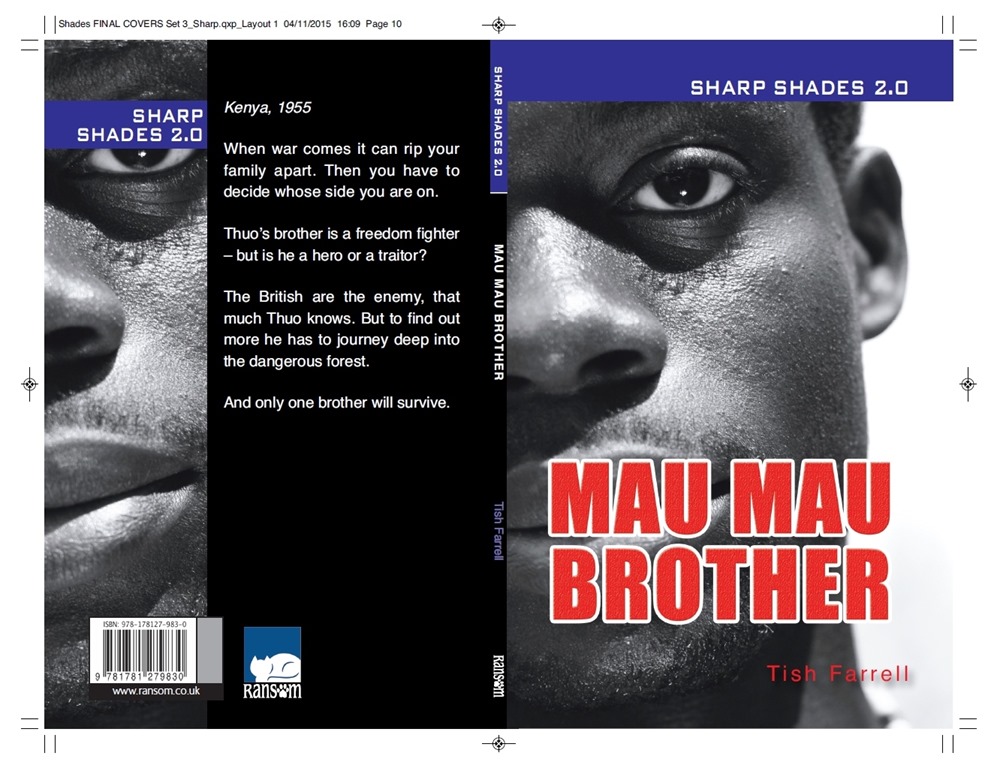
It’s always a thrill, nerve-wracking too, when the book proofs arrive. But then with this new Sharp Shades edition of Mau Mau Brother  there was no need for qualms. Ransom’s Art Director, Stephen Rickard, has done my story proud, both in the final edit, and the inclusion of some moody grey-scale images.

The story that was 6,000 words in the original Shades series has been chopped in half, but spread  over the same 64-page format to become a Sharp Shades edition. And it works. And I’ll repeat that for the benefit of any writers who are reading this, and who are a touch sensitive about heavy editing: three thousand words from my tightly written 6,000-word story (you can see an extract  of the original HERE) have been expunged, and the end result is great.

I’d better explain.

When I am not growing cauliflowers, making leaf mould and generally hanging about on WordPress, one of the very important things I do is write short fiction for teens who are striving to build a reading habit.

Back in the spring, Ransom, who publish these works, suggested that my latest title, Mau Mau Brother,  would make a good Sharp Shades edition if I was prepared to cut it by half. As I wrote in a post back in April HERE, I was doubtful that I could, but I said I would try. In the event, I found myself stuck at around 3,400 words and Ransom asked me to hand it back for some more pruning; they would let me see the finished text for my approval, they said.

A few days ago they did just that, and I am really pleased with the end result. They are great people to work with.

Not only that, Ransom Publishing are specialists in the production of accessible fiction and nonfiction for struggling readers of all ages. Their strap-line is ‘UNLOCKING LITERACY’. For those of us who can read and write fluently, it is hard to imagine not having these skills.  But if you can’t read well, you are effectively disenfranchised as a functioning member of the community. Locked out in every sense.

The Shades series includes some 60 titles written by many well known and seasoned children’s writers. The titles are aimed at young adults with an interest level of  12 years +, but a reading ability of 9-10 years. Many young people are also daunted by the size of a book, while still wanting ‘the excitement of a great story told with pace and style. ‘ At 64 pages, the books are compact, easy to handle. The cover images are striking, edgy, and with all the style of quality mainstream fiction. In other words, they may be small, but they don’t look  ‘less’.

Inside, the story is presented novel-style, in chapters, but with plenty of white space on the page.  To cater for the less able reader, the Sharp Shades editions have half the number of words of a Shades title, far fewer words per page, are set in a larger font and have added illustrations.

Personally, I think the books in both Shades series are appealing to any reader of any ability. They make for handy quick-reads that fit in most pockets. And just because they are aimed at people who struggle with their reading, doesn’t mean the stories are either simple or simplistic. They embrace themes that matter to all of us: love, hate, fear, injustice, belonging, relationships, families, overcoming threats and hardship. So I’m not going to say any more about Mau Mau Brother. The blurb on the back of the book pretty much covers it. Thank you, Steve Rickard.

 

Screenshot 2015-11-05 10.37.32 (2) - Copy


Related:

Killing Words ~ a case of verbal decomposing?

Losing Kui – an extract


@ransombooks  #RansomPublishing

@Literacy_Trust  #NationalLiteracyTrust

Our first autumn cauliflower

100_7997

Isn’t nature marvellous. I can’t believe that I grew this bee-eautiful purple-flowered cauli from one very tiny seed.  It looks a bit misty here, because it’s covered in fog. They weather has definitely turned here in Shropshire.

I was so excited when I first spotted it a couple of days ago. I’ve been nurturing the cauliflowers for a long time, feeding them liquid seaweed feed among other things. The seeds were sown in spring, then planted out in early summer in my new plot behind the polytunnel.

It was hard going too, clearing the ground for them. It had not been cultivated for several seasons and was choked with dandelions of epic proportions, and masses of creeping buttercups. The soil was heavy and claggy too. It seemed most unpromising, although I know that brassicas are fairly tolerant of these kind of conditions. For one thing, they like to be solidly rooted. In fact I’ve learned that caulis won’t flower properly if they are not well anchored from the start.

Once I’d planted out the young plants, (along with a handful each of Carbon Gold fertilzer, and worm casts, and an encircling of lime),  I had to make sure they were well defended with a covering of  mesh. This to stem the pigeon decimation that generally goes on at the allotment. The rotters line up on the overhead electricity cables and watch what we humans are up to, and plan their raids for when we’re not there.

Anyhow, they didn’t get this cauli, and we did. I steamed it, and then made a quick sauce with creme fraiche.  Here’s what I did.


Really Amazingly Quick Cauliflower Cheese

  • Break the cauliflower into florets and steam for a few minutes.
  • Drain, reserving a cup of the steaming water in case you might need it.
  • Melt a small piece of butter in the now empty pan.
  • Add some chopped garlic and/or sliced onion. Cook until soft and translucent.
  • On a moderate heat, stir in a small tub of creme fraiche. Stir it until it warms through. If it seems too thick, add a little of the reserved vegetable water, say a tablespoon at a time.
  • Season, and add any fresh chopped herbs of choice.
  • Stir in a couple of handfuls of grated hard cheese. I use pandano.
  • Then toss the cauliflower in the sauce and serve.
  • Any other quickly steamed vegetables can be included in this – peas, carrot sticks, chopped kale, chard, leeks, celery. Whatever appeals. Good served with a jacket potato, or Italian black rice.


So here you have MY flower of the day, as inspired by Cee’s Flower of the Day. I thought maybe we should give vegetables a look-in on the floral display front. Mind you, I don’t know what Cee will think. Aw, she’ll love it.

copyright 2015 Tish Farrell

The Carrion Crow

100_7827

A large black bird that feeds on the carcasses of beasts

Dr Samuel Johnson


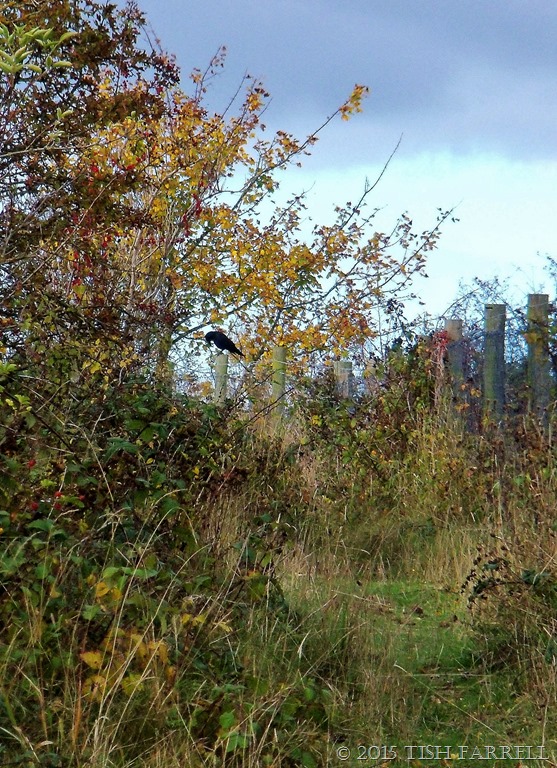
I didn’t think this shot would work. My little Kodak EasyShare was on maximum 5x zoom. But when I looked at the image on screen, I decided it was worth posting. It anyway illustrates an important fact about carrion crows. They are very hard to sneak up on, which is why I couldn’t get any closer and take a better shot.

The next second it was gone, flying off with its guttural ‘kraaar’ call.

Carrion crows are solitary birds unless, that is, they have a mate. This one does have a consort. The pair’s territory includes Windmill Hill, the Linden Field and Townsend Field behind our house; at least this is where I see them foraging together. They are usually a little way apart, rooting  through the grass. They are also notorious egg thieves and snatchers of poultry and pheasant poults, and so are much despised by country folk in general, and game keepers in particular.

When separated, the crows call one to the other. The single ‘kraaar’ that echoes through the trees, or across the fields. It is  a melancholy sound, but also a wake-up call. I find myself instantly responding, scanning the landscape, tuning in to its resonance. What’s going on out there?  Perhaps I have crows in my ancestry.

These birds are very clever. In nest-building season they perch in the tops of trees and watch where the other birds are building their nests.  They also, as their name and Dr Johnson suggests, eat dead animals. Well somebody has to clean up the environment.

You can tell them apart from rooks by their longer, sleeker profile. Rooks are altogether shaggier with a long, greyish bill and a face-patch. Rooks of course hang out in crowds, some of their rookeries being known to have several thousand nests.

But all in all, I like the crows best. They teach me to be watchful.

copyright 2015 Tish Farrell

‘Bench’ with a mission

100_7167

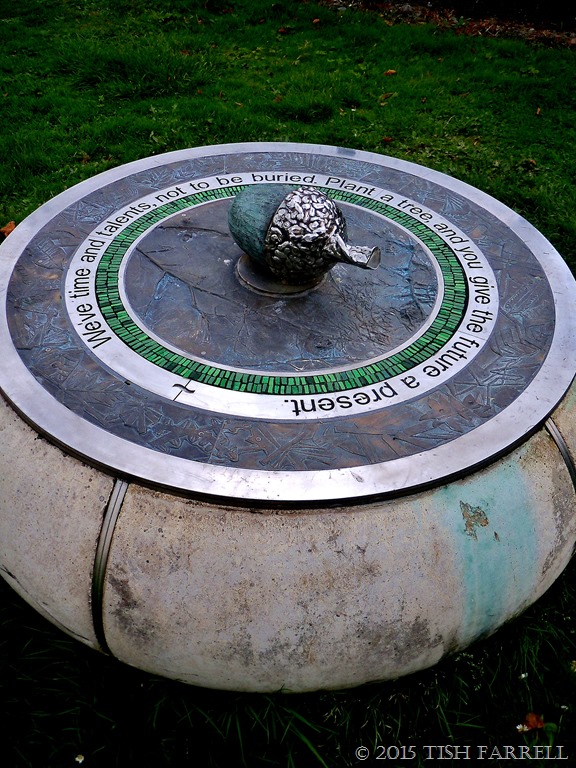
We’ve time and talents, not to be buried~

Plant a tree, and you give the future a present ~


Over at Travel Words’ Bench Series 44 Jude is charging us to find a bench with a message or an autumnal theme. This may not  be a bench as such, but it does have a message and a seasonal acorn. Also, along with the inspirational motto, it was designed to provide a perch and meeting point for the town’s passing visitors.

There are four more of these artworks-cum-tuffets sited around the perimeter of Much Wenlock’s Linden Field, the venue for the Wenlock Olympian Games since the 1850s. The works were created in 2012, the year in which the International Olympic Movement acknowledged Much Wenlock’s historical connection to the modern games by naming one of their one-eyed, androgynous mascots ‘Wenlock’.

Anyone remember he/she/it? Perhaps better not to. The mascots were apparently conceived by a committee, and delivered into the world by a company in Telford. The intention was well-meaning: not to make reference to an identifiable ethnicity, gender, or known human disability.

Here on home ground, members of our local William Penny Brookes Foundation decided to mark the town’s Olympics connection by commissioning community sculptor, Michael Johnson, to work with local school children, and Wenlock poet, Paul Francis. Their brief was to celebrate the life and work of the Wenlock Games’  founder, Dr. W P Brookes. If you click on the Michael Johnson link you can see the other four pieces. The designs on the bronze panels were derived from work by the town’s school children.

The frame is stainless steel with  stone side panels and bronze sections on top. Every tuffet has a piece of thought-provoking text, each one relating to William Penny Brookes’ major contributions to the town’s wellbeing.

100_7028

I love the idea of them, although I’m not too sure about the weathering capacity of the stone component. I just wish they were sited in places where more locals and visitors might see and appreciate them, and indeed sit on them for a spell: perhaps on the High Street, in the Square, on the Church Green opposite the doctor’s former home.

Anyway, this particular tuffet definitely has a mission to propose. Should you choose to accept it, please note, this tuffet will not self-destruct, but the world might be happier.

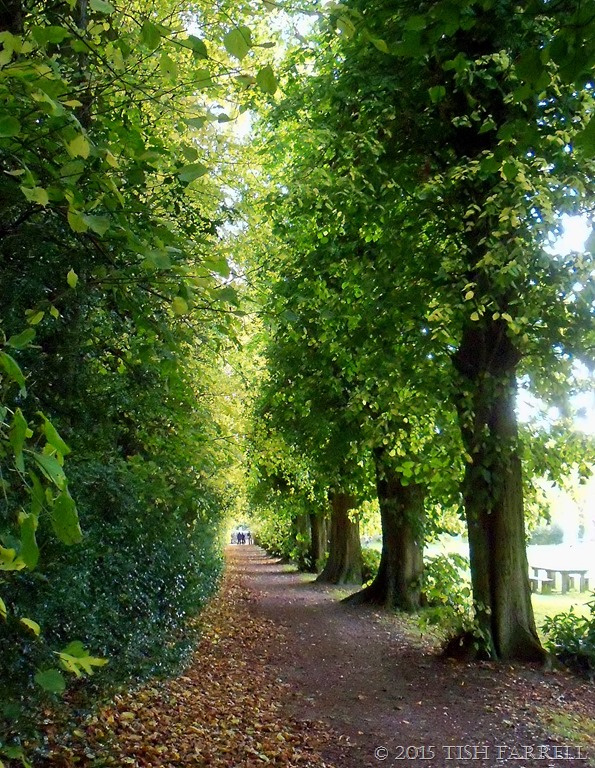
I’m thus leaving you with a view down the Linden Walk that borders the field and was planted by Dr. Brookes over a century ago. It is a joy to walk here whatever the weather, and whatever the season. So yes: more trees needed.

100_7851


We’ve time and talents, not to be buried~

Plant a tree, and you give the future a present ~