
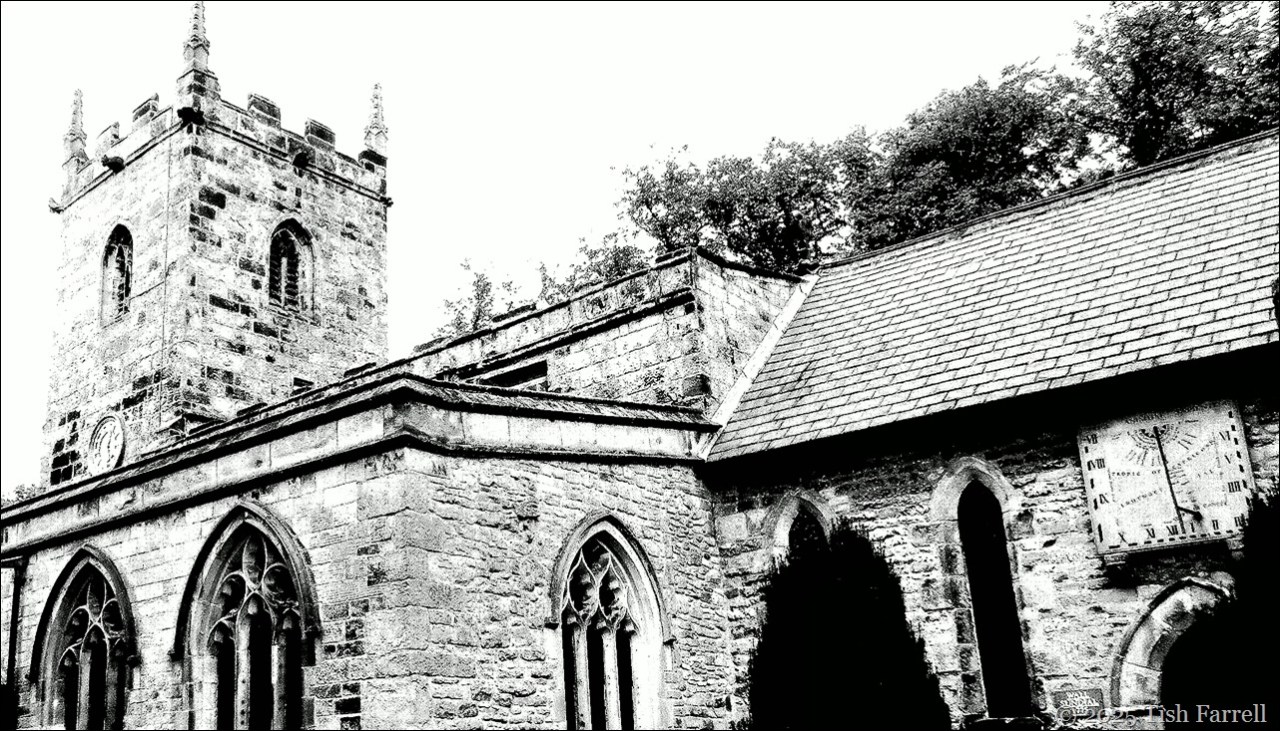
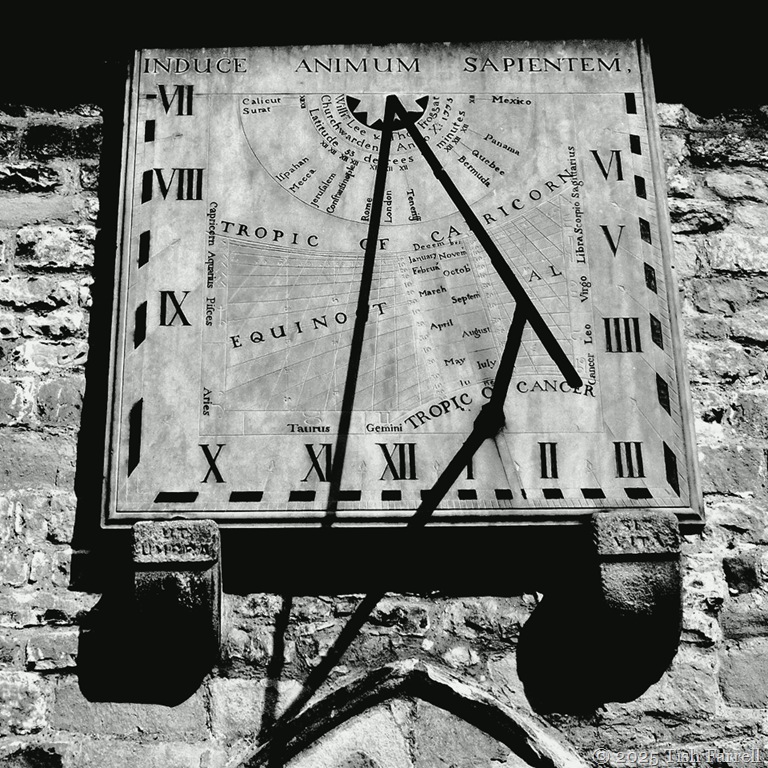
This magnificent sundial clock hangs on the wall of Eyam parish church in Derbyshire. It is extraordinarily intricate; something of a world-view 18th century style. It was installed in 1775 by a vicar with illustrious, wide-reaching connections, although the face itself was carved by local stonemason William Shore.
Eyam is probably best known as ‘the plague village’, the isolated High Peak community that chose to isolate itself completely during the 1665-1666 outbreak of the Black Death. A more recent discovery concerning the village is that the DNA analysis of living descendants of survivors shows a marker which indicates immunity to the disease. Amazing to think this can be detected.
Back in the 17th century, Eyam’s inhabitants made their living mostly from farming and lead-mining. The two pursuits went together, the mining carried out in the winter months in open-cast field seams called rakes. I have ancestral connections here. One Robert Fox, yeoman farmer and lead miner, who looks to have arrived in the area post-plague, married second wife Margaret Mower at Eyam church on the 4th June 1682. They are probably 6th great grandparents, but at the very least 6th great uncle and aunt. There are also much earlier Bennet ancestors around Eyam. They intersect with Foxes in the 19th century, that link arriving via 4th great grandfather, hatter, farmer, lead miner and property owner, Robert Jackson. He married Hannah Eyre at Eyam in August 1826. They would have known this clock.
And about that clock. You have to wonder how far Eyam villagers would have been impressed to know the time difference between their spot on the globe and Calicut, Mecca, or Quebec. The single shadow also marks the solstice and equinox days and, for good measure, the months of zodiac are included too. All these intricate details apparently suggest to clock sundial specialists that the designer was the eminent Derby scientist and clockmaker John Whitehurst FRS.
Besides a time marking facility, the clock includes some thought-provoking inscriptions. On the supporting corbels is says: Ut Umbra – Sic Vita – life is but a shadow. And across the top: Induce Animum Sapientem – cultivate a wise spirit.
This last should be a rallying call for our times. For all our, wizkiddery, wise minds seem sorely lacking. This 250 year old clock might be just the device for cultivating a little capacity for critical thinking. It certainly tests mine.

Monochrome Madness: clocks and timepieces This week Margaret at From Pyrenees to Pennines is setting the theme at Leanne’s Monochrome Madness
