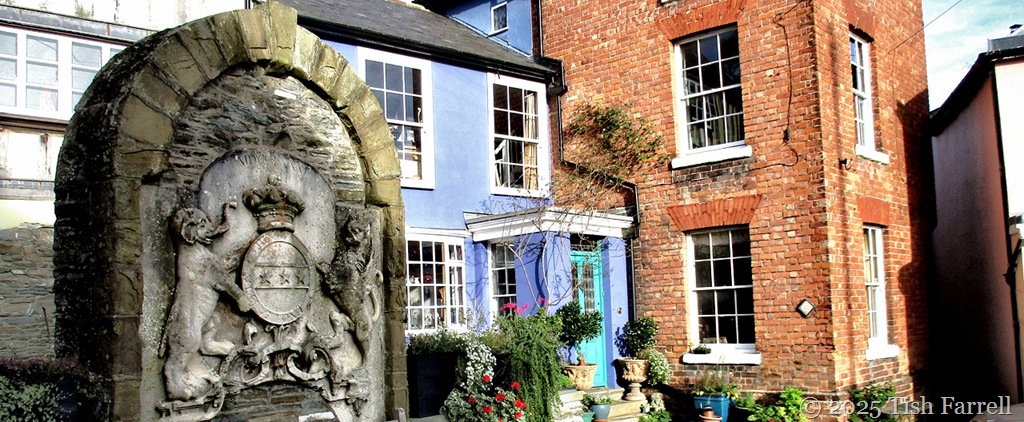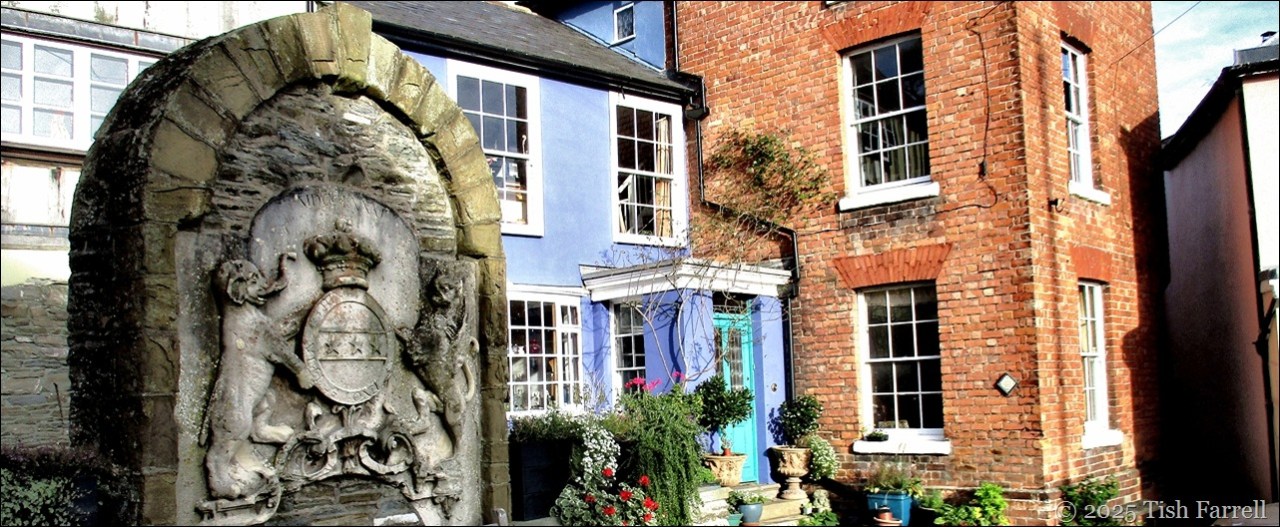

This is a fine spot for catching one’s breath after climbing Bishop’s Castle’s steep High Street. The bench sits on the footprint of a long gone market hall, built for the town by Edward, eldest son of Robert Clive (as in Clive of India) in 1781. At this time (and until 1926) the manor of Bishop’s Castle was owned by the Clive family, and above the bench is some surviving evidence. This is the Clive family’s (acquired) coat of arms: an Indian elephant and a griffin that once adorned the market hall, and so stood above the town, proclaiming the Clive wealth and power.
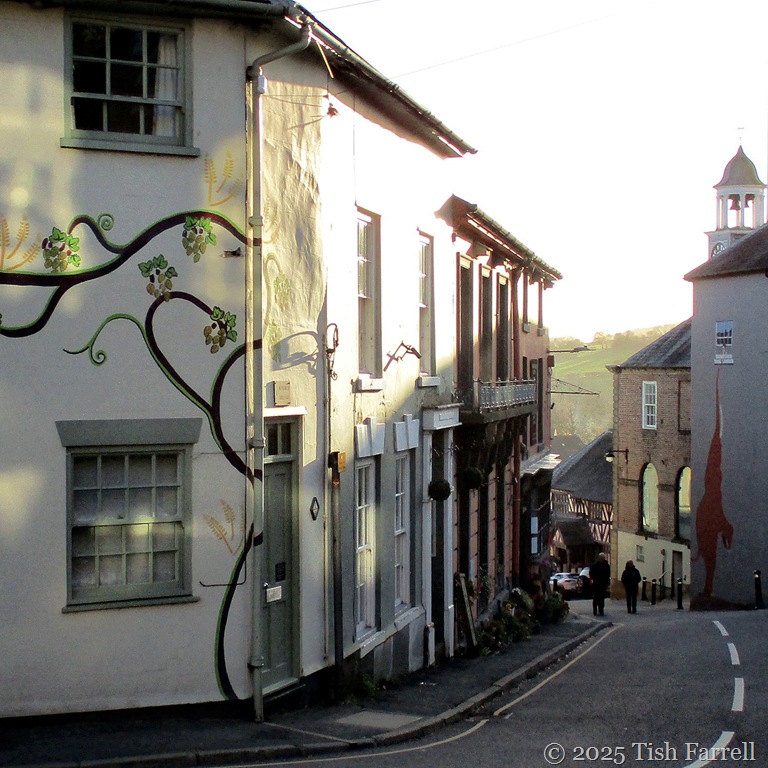
This, then, is the view from the bench in the Market Square. (I included it the other day on our walk around the town). All very picturesque. Except, even on a bright autumn afternoon, that Clive coat of arms sheds dark shadows that still linger.
Robert Clive (1725-1774), was the pugnacious offspring of a Shropshire land-owning family. He began his meteoric career as a clerk in the East India Company Madras in 1744. Once in India, he proved an able administrator and ruthless military commander, so efficient in fact, he is credited with securing the power of the East India Company and thus the establishment of British Rule in India.
He returned to England with a vast fortune, equivalent to some 30 million pounds by today’s values. That he was the subject of a parliamentary enquiry for corruption (including examination of his punitive policies while running the East India Company) did not stop him from securing an Irish barony and buying his way into government.
He lived in Mayfair, London and owned estates in Surrey and Ireland, but bought the Shrewsbury seat in 1761 and remained the town’s M.P. until 1774. (Shrewsbury is Shropshire’s county town and nowhere near London). He also deployed his wealth to secure the votes of Bishop’s Castle’s 150 burgesses, so ensuring that this town’s M.P. was also always a member of the Clive family fiefdom. The town already had the reputation as a ‘rotten borough’ i.e. votes for whoever could best bribe the burgesses. Now it became a ‘Pocket Borough’ ruled by Clive friends and relations, a situation that continued until 1832 when The Electoral Reform Act ended direct representation for the town and other ‘rotten boroughs.’
It’s astonishing perhaps to think how one man’s shadow can reach so far – through time and across the world. But then what about those among us today whose material ambitions and global reach affect the lives of millions; I wonder what future historians will have to say of them.
Jude’s Bench Challenge Anniversary