
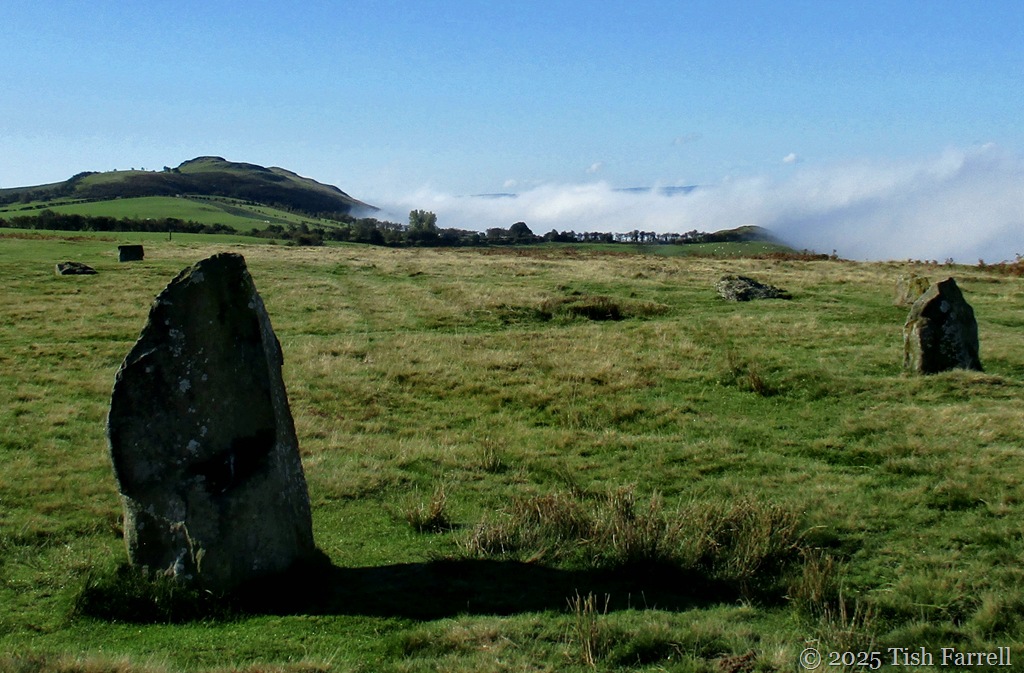
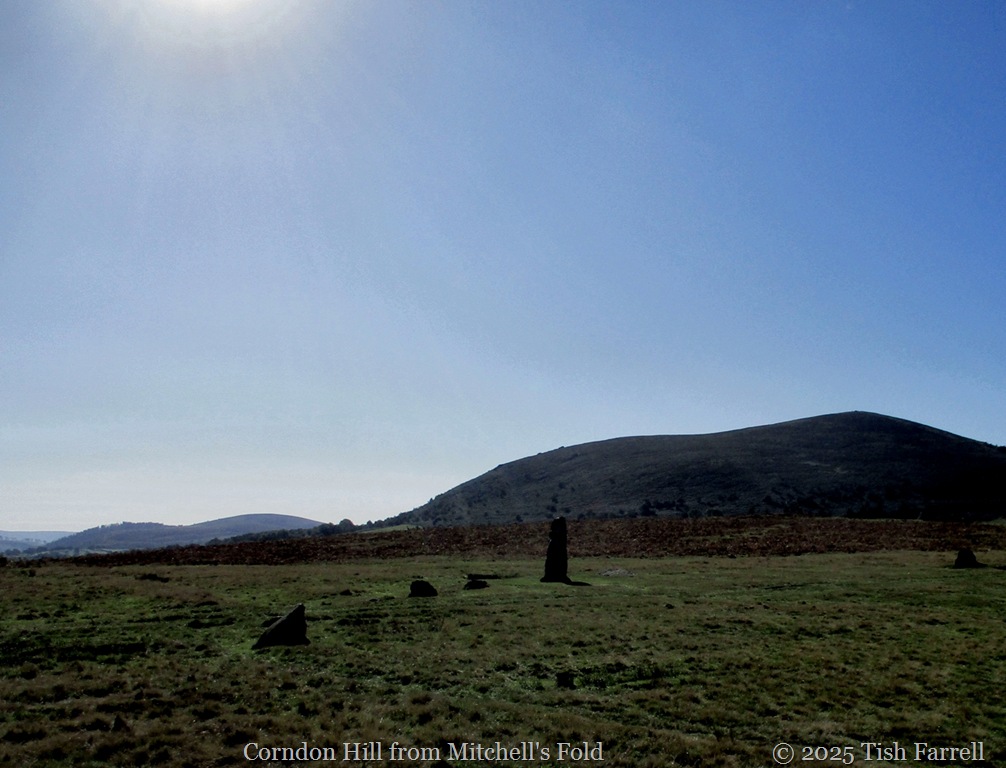
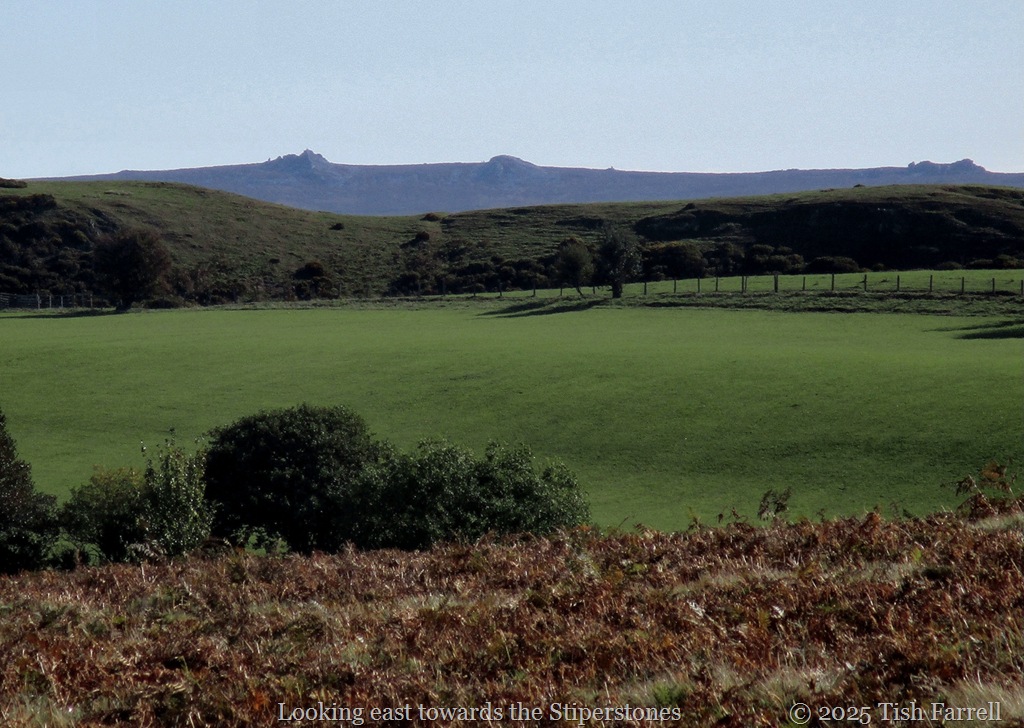
It’s a year or so since we last visited Mitchell’s Fold stone circle. I’m not sure why it’s taken so long to go back there. It’s only six miles from home and such a fine spot, sitting high on Stapeley Hill, with the Stiperstones to the east, Corndon Hill to the south and Wales rolling out in the west. Somehow we had let the summer go by when a sundowner visit would have been perfect for capturing light, communing with ancestors and gazing out on those wide Welsh vistas.
As it was, we waited until late September. And so last Friday, and well before coffee time, in hopes of some good light, we set off. The sky was clear, the sun brilliant and the air autumnally crisp. As we drove out of Bishop’s Castle, I conjured the landscape photos I would take up on the hill; those views into Wales…

Except when we set off on foot up the Stapeley Hill track I soon saw I wouldn’t. Westerly vistas were off.
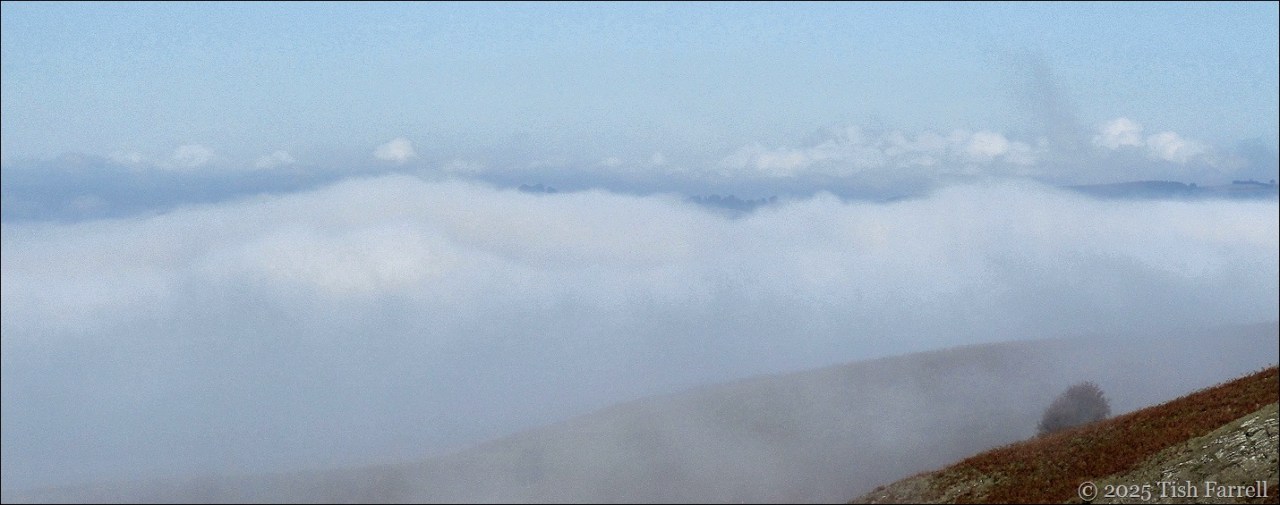
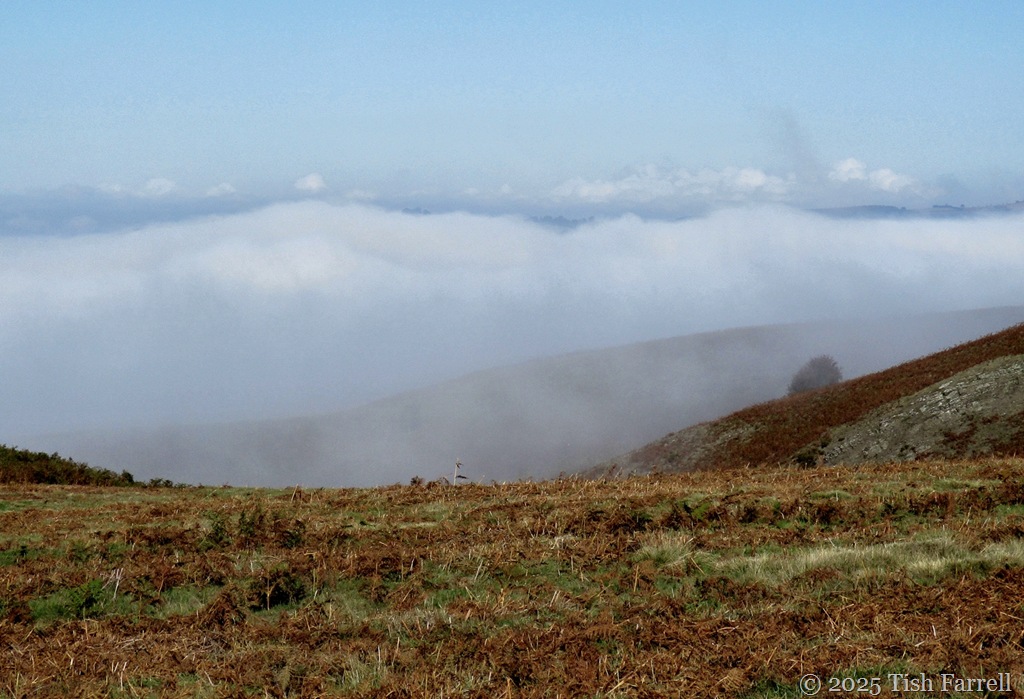
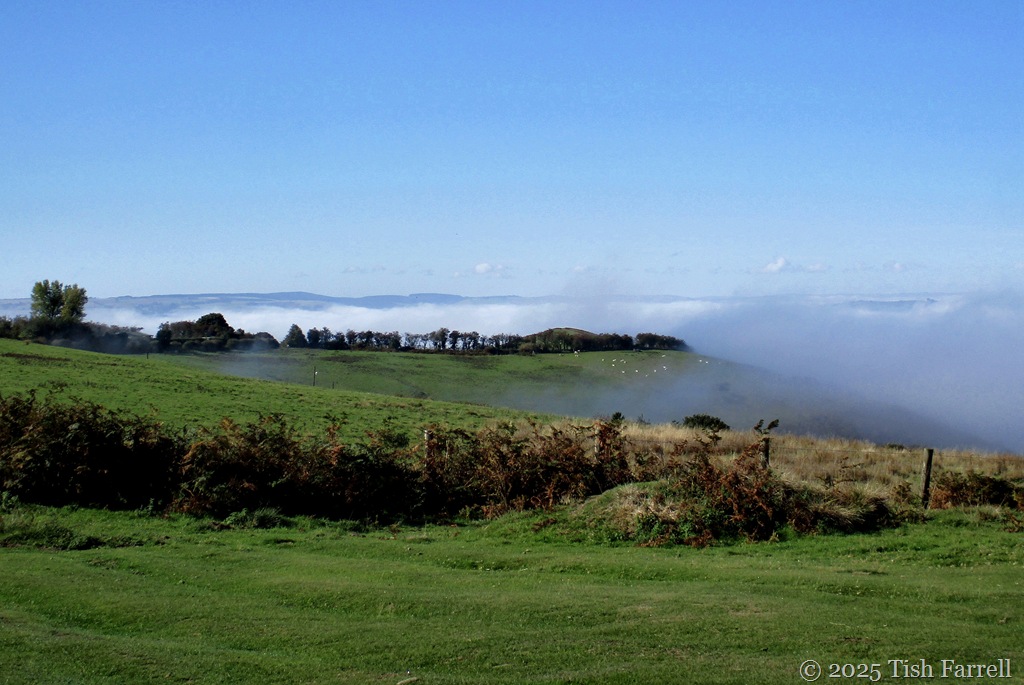
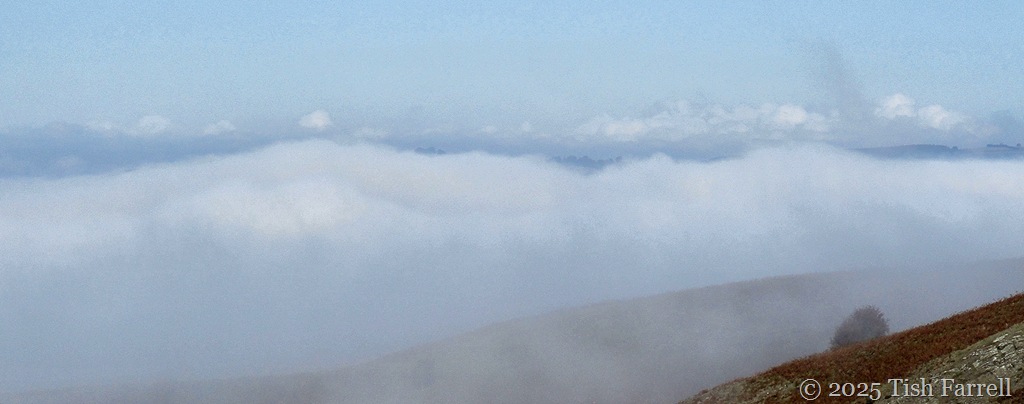
The uplands might be bathed in sunshine, but the low lying reaches had been invaded by rivers of mist, also known in literary circles as brume. We watched as this mysterious atmospheric phenomenon flowed by, whiffling up hillside clefts and gullies, some of its manifestations distinctly pink. At closer quarters you could see through it as if looking through gauze.
*
Seen in monochrome setting, there’s almost the sense of spray, as in breakers crashing against a rocky cliff-face…
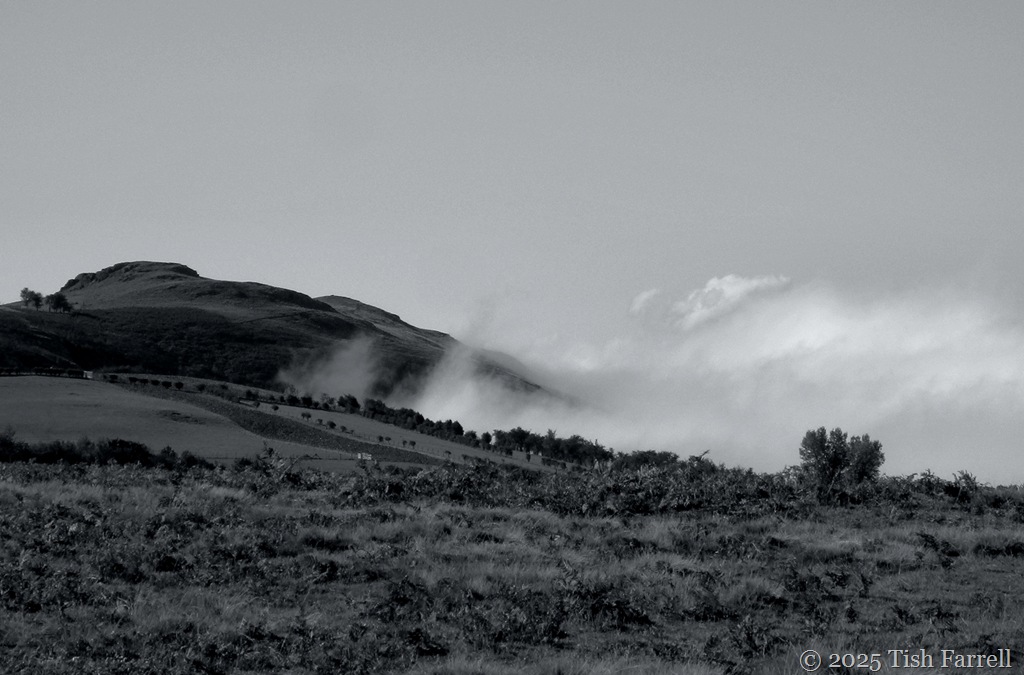
Of course this all added a frisson to the mystery of ancient stones.
I’ve written about them several times, including in a much older post Witch-catching in the Shropshire Wilds which mentions the myth associated with the place. But very little is known of them other than there were once 30 or so standing (now only 15 and some of them are recumbent.) And that they were sourced locally and hauled in place over 3,000 years ago. We can guess, too, that this was a place of great significance to local people (temple or gathering place?) for we know, too, that nearby hills (Corndon, the Stiperstones) have on their flanks many remains of Bronze Age burial cairns. There is also a lone standing stone and a supposed robbed burial cairn not far from the circle.
A landscape, then, of many meanings; the kind of meanings where sacred and profane coalesce, the subtleties of whose interconnectedness we offspring of industrial culture often fail to grasp, confusing the sacred with dogma.
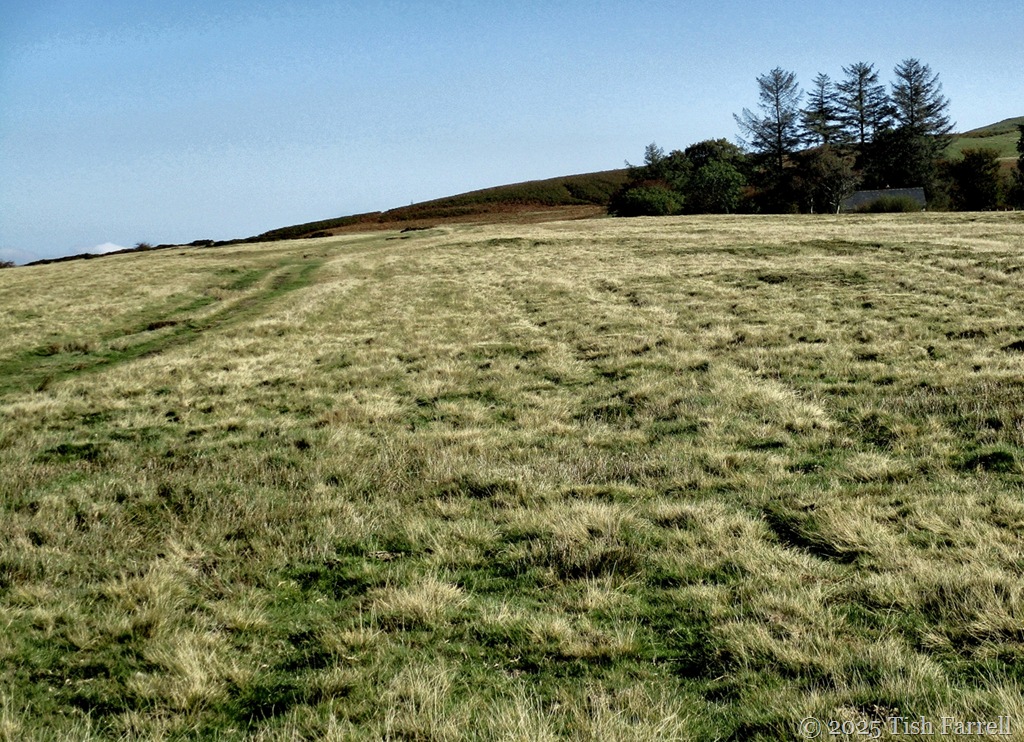
Around the stones, there are traces of more recent human doings. You can see them in the photos: the remnant ridges and furrows of a mediaeval field system. And also running through the middle of the circle, the ruts made by carts and, in particular, the stage coaches that are said to have run this way between our county town of Shrewsbury and Aberystwyth in mid-Wales. Can you imagine?
In a way, I find this last historical glimpse more exciting than the stones. Just think how it would be, racketing around in a draughty coach, being hauled over this bleak hill on a grey winter’s day, some real fog closing in and looking out on these standing stones…it could be a scene from Jane Eyre.

*
For now I’ll leave you with some more non-wintery views:

*
Copyright 2025 Tish Farrell

Marvellously mystic. We have so much more exploring of Shropshire to do.
Good morning, Margaret. You popped into my head as I was writing this, and for just that reason 🙂
Thanks Tish. This is a county I’m keen to explore.
Could actually do with exploring it ourselves!
I know what you mean. We feel that about Yorkshire, though we HAVE explored – a lot.
Glorious – I do love these cloud inversions. Had one this morning here in BoA. A wonderful sight to wake up to as I get to look down on it too
Hello, Becky. It looks like a good morning for interesting atmospherics. And you with a good view too.
Spine tingling atmosphere you have described and captured of this mystical place Tish. Hard to imagine how they could create this place so long ago
It is intriguing, Pauline. There were once two other stone circles not far from Mitchell’s Fold. We’ll never know the whys and wherefores.
Beautiful images and narrative Tish! I love the mist. Captured by the camera, it is so dramatic. Thanks for taking us along.
So very pleased you keep joining me, Anne 🙂
So happy to!
ooh, I love these scenes and narratives –
Thanks, Beth.
A mystical place and even more so with those mists and clouds. We only ever made it there once, in the snow and I regret not returning on a more clement day. Still your photos and words are excellent substitutes.
We first went there in the snow (one Christmas). Graham took some rather eerily good photos.
I’m sure the views on a bright day are lovely but for me these ‘rivers of mist’ are more interesting to photograph and full of appropriately mystical atmosphere. The layers of history here are fascinating, especially the old carriage tracks. I often imagine how uncomfortable such rides must have been!
I think riding in carriage over this kind of terrain must have been appalling. I guess those with wherewithal including farmers would have travelled on horseback.
They are scenes just made for mono!
Cheers, Brian.
Even if I hadn’t read your description of the history of the place, I would have found those photos of the brume rather bewitching
Thank you for being bewitched with me, I.J.
🙂
Fancy you bewitching I. J. What would the Family say! Seriously beautiful captures, Tish xx
🙂 🙂 🙂
We saw ancient stone ruins last year in Ireland. There was a certain eeriness to them out in the middle of no where. I expect those in Shropshire are as mystical. Perhaps like our indigenous cave sites. Lovely immersion into ancient times, Tish.
How fantastic that you spent time with the Irish old stones. They’re pretty special.
‘…confusing the sacred with dogma. …’ well said.
Thank you, Widds 🙂