
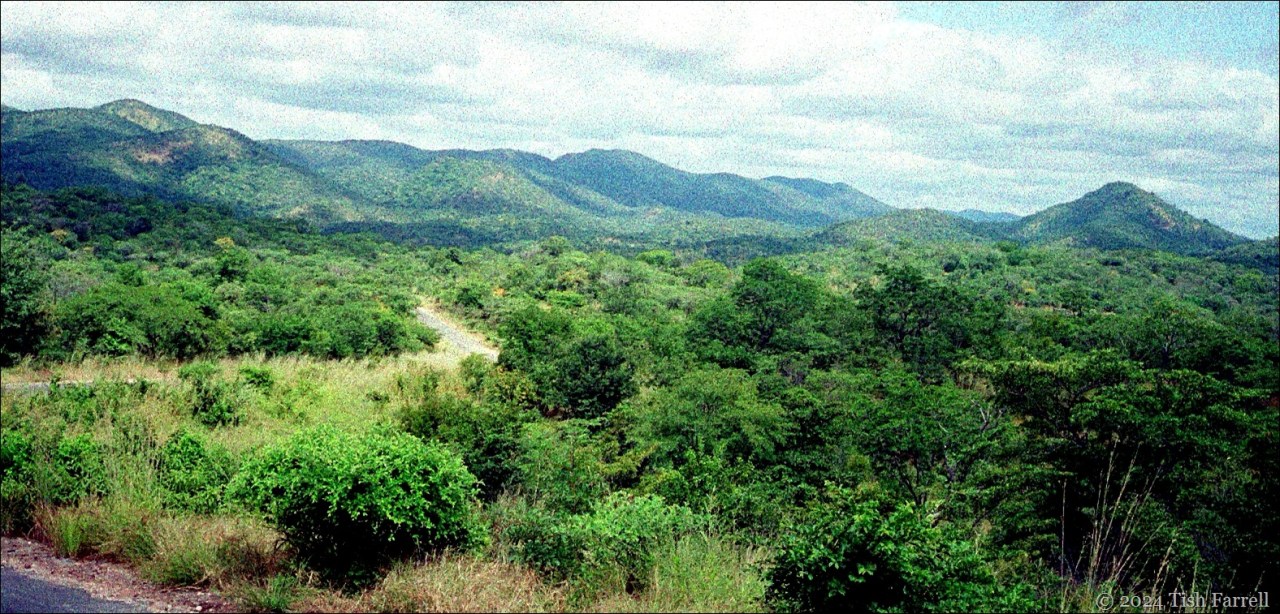
In 1992-1993, during the first years of Zambia’s multi-party democracy, we were posted to Lusaka, Zambia’s capital. Graham was charged with organising the distribution of European Union food aid to drought-stricken Zambians. (Part 1 is HERE and part 2 HERE)
*
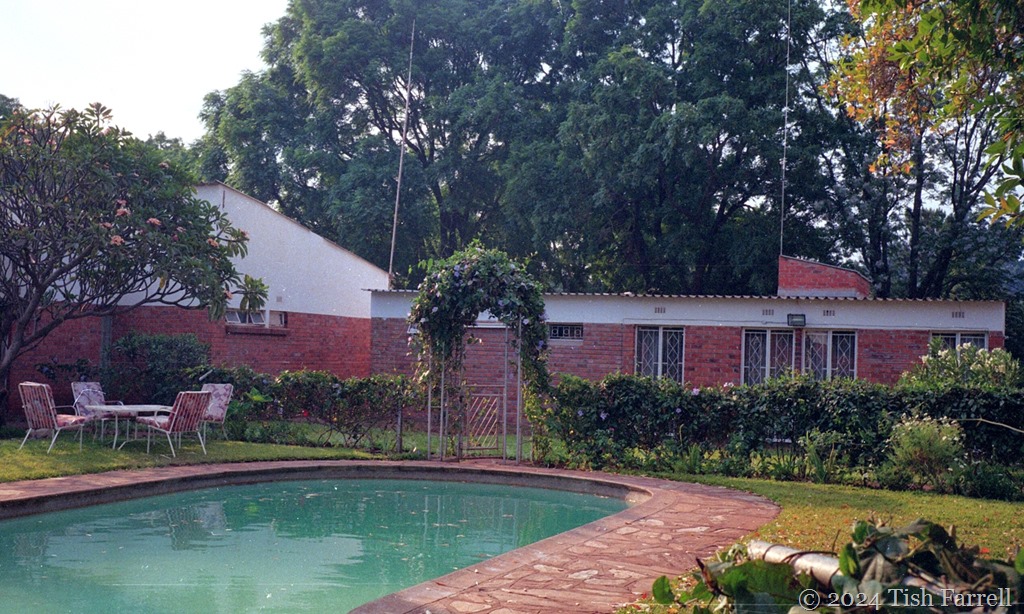
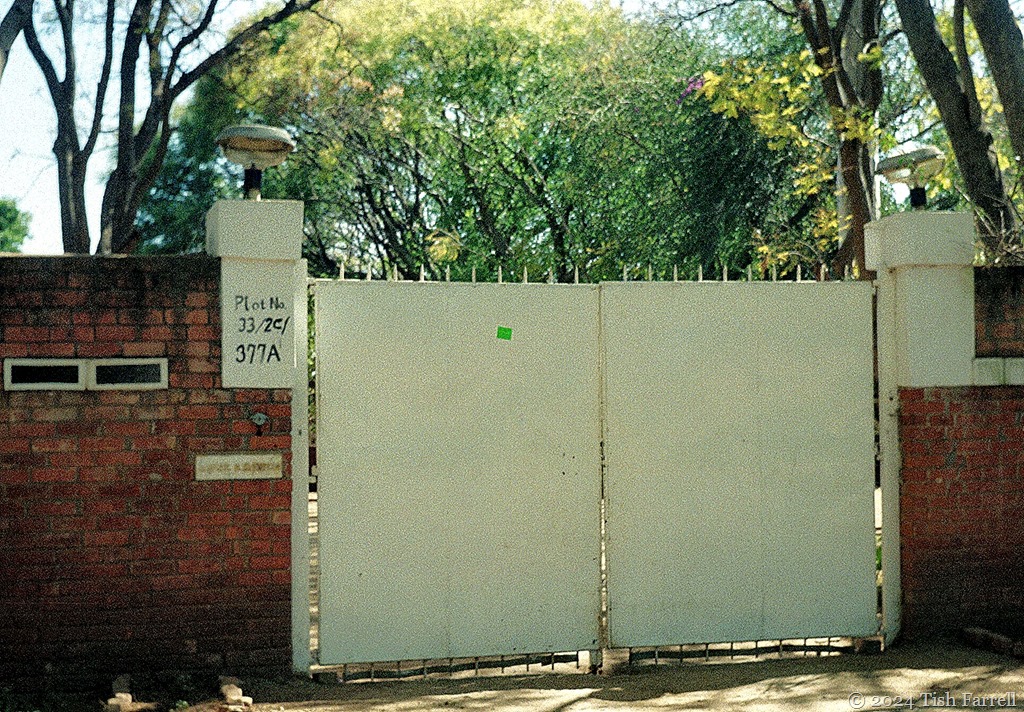
We soon discover that our household security provision falls short of official standards. European Union and British High Commission employees are advised to have internal security gates installed, external security lights, roof siren, alarm buttons, window bars, a pack of Dobermans and ridgebacks, a two-way radio and armed twenty-four-hour guards. The fortification of a property may cost around £5,000.
Somehow we survive without most of these devices, although the top of our garden wall, which also forms the rear boundary of the compound, is quite high and is further cemented with shards of broken glass.
The nights, though, can be nerve-wracking. Rounds of automatic gunfire are common after dark. Some European locals, we are told, have made a ritual of standing on their front lawn at 9 pm every night and shooting off their sporting rifles – just to let “the thieving bastards” know what’s what. These are the same people who will tell you that, when they are not trying to relieve you of your worldly goods, the Africans are really very charming.
But gunfire aside, it is anyway hard to sleep in the perpetual gloaming of the security lights dotted around our compound. The insects, too, grow louder as the night draws on, and then the dogs wake us.
I call it the Kabulonga Howling. For reasons unknown, it begins with a single canine, a lone keening which then swells from compound to compound in a relayed dog lament until finally a monstrous crescendo resounds across the suburbs. But once howling pitch is reached, it quickly subsides, and instead we are left with the beat of Zambian dance music, thrumming away beyond our perimeter wall.
*
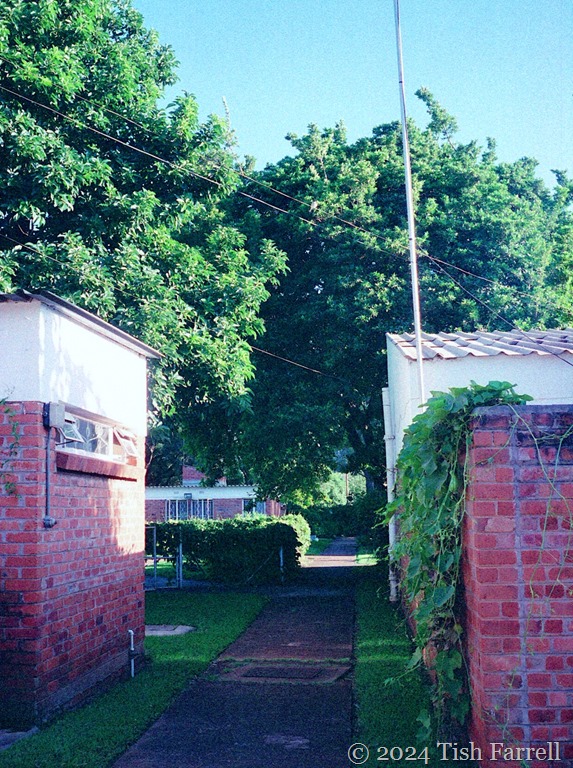
We have no idea who lives beyond our glass-spiked rampart. I have tried standing on the brick barbeque in the back yard, but I still cannot see over the wall. Instead, I often hear a Zambian boy badgering his little sister whose name is Lorna. Lorna is always being ordered to do something or other. There is meek compliance in her little voice. It is the lot of many Zambian women to defer to men. Already I feel sorry for her.
One day I find an arrow in the back garden – a stiff plant stem tipped with a bent Mosi beer bottle cap. For a moment, as I examine this makeshift missile, I think of Robinson Crusoe finding unsettling signs of life on his confining island shore.
*
By day, Graham leaves early for the EU Delegation. It is only a five minutes’ drive away. I begin to tend the back garden, sowing beans, courgettes, carrots. Things quickly sprout, but the land snails are as big as my fist. I write and read, although finding books is a challenge. We can find no bookshops in Zambia since the nation can no longer support a publishing industry. Once a week we drive down to the British Council on Cairo Road to borrow books from their library. We do this, ignoring white Zambians’ warnings that our Suburu will be car-jacked if we park anywhere downtown. Whenever we go to the library, most of Zambia’s students seem to be there, studying hard. Every seat is taken. It is hard to gain qualifications in a land without books.
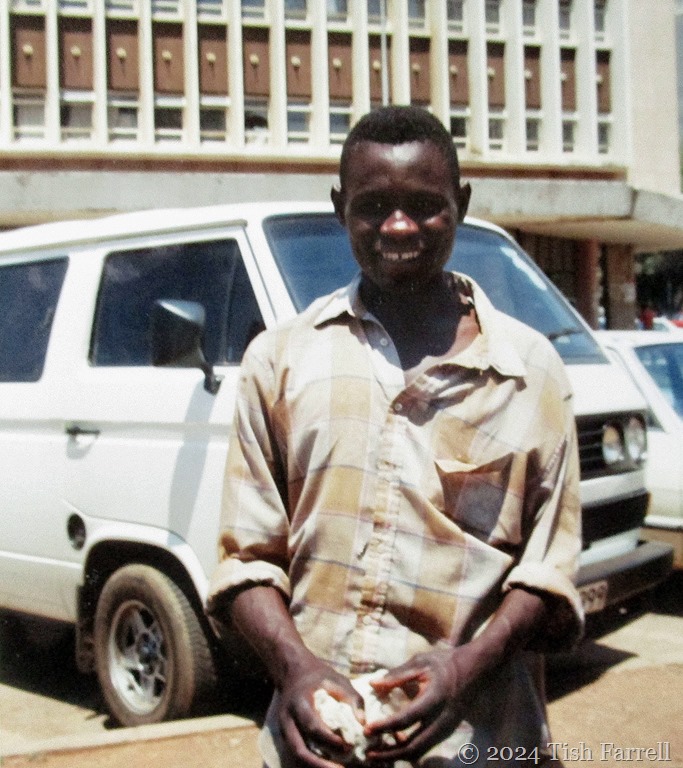
One of the parking boys who minds our car whenever we visit the British Council library. In ten months of parking on Cairo Road neither the car nor any of its parts go missing.
*
And not only is there a lack of books, but newsprint, too, is hard to come by. Newspapers sell out quickly each day and I have to rely on Graham bringing the Delegation copy home at lunch-time for quick scan through. Soon we hear that four Zambian Daily Mail accountants have been arrested for ripping off their own company’s limited newsprint stock and selling it to a rival newspaper.
Then there is the challenge of household shopping. Our local shop is Kabulonga supermarket where I frequently search the shelves to strains of Michael Bolton’s The Lady in Red. A beautiful girl in cobalt blue chitenge and matching head-cloth tied with great flourishes, is often on the till. She has the poise of a princess.
It’s basically a matter of buying whatever is there and then thinking of something to do with it. Treats include cartons of delicious Ceres grape juice, and jars of sweet pickled beetroot imported from South Africa. The local yogurt comes in big tubs, plain or strawberry. Other staples include corned beef and South African wine. On the other hand, there is never a shortage of cleaning products, all heavily perfumed. At Christmas we see them parcelled up into apparently enticing gift packs along with small bales of second hand clothing.
![Kamwala-roadside-furniture-market-ed[1]](https://tishfarrell.com/wp-content/uploads/2024/08/kamwala-roadside-furniture-market-ed1.jpg "Kamwala-roadside-furniture-market-ed[1]")
We bought our bed from traders in Kamwala Market
*
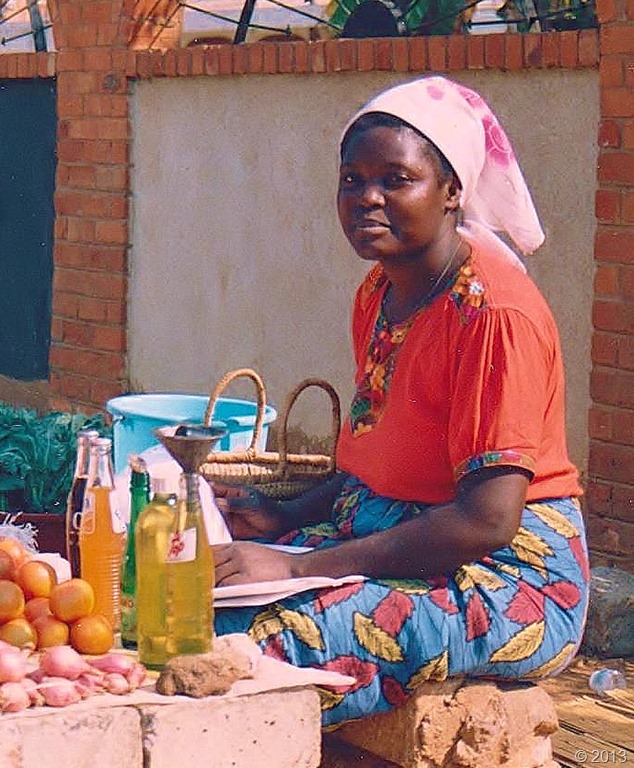
There are of course shopping opportunities everywhere along Lusaka’s streets – cigarette and used clothes stalls, a man selling bread, another with his scrawny hens, fish from a freezer connected to nothing, caterpillars dried or roasted, large woodland mushrooms the colour of cygnet down, little pyramids of tomatoes. If I buy two piles of tomatoes from the young woman in the photo, she gives me an extra tomato as a “special gift”, and then wraps the lot in computer print-out. It’s one of those frequent incongruity moments.
*
I also walk down to the Maluwa Co-operative in the hopes of something more interesting than beetroot and corned beef. Again, I never know what I will find there: perhaps, if I’m lucky, a good mission-reared chicken in the cold cabinet, or button mushrooms, some Gouda cheese, broccoli, new potatoes, French beans, bunches of roses. If he catches me walking, an elderly white Zambian in a pick-up, (his ‘boys’ in the back), always insists on giving me a lift. He means well, and it is easier to comply with his desire to save me from imagined predations of Zambians than to argue.
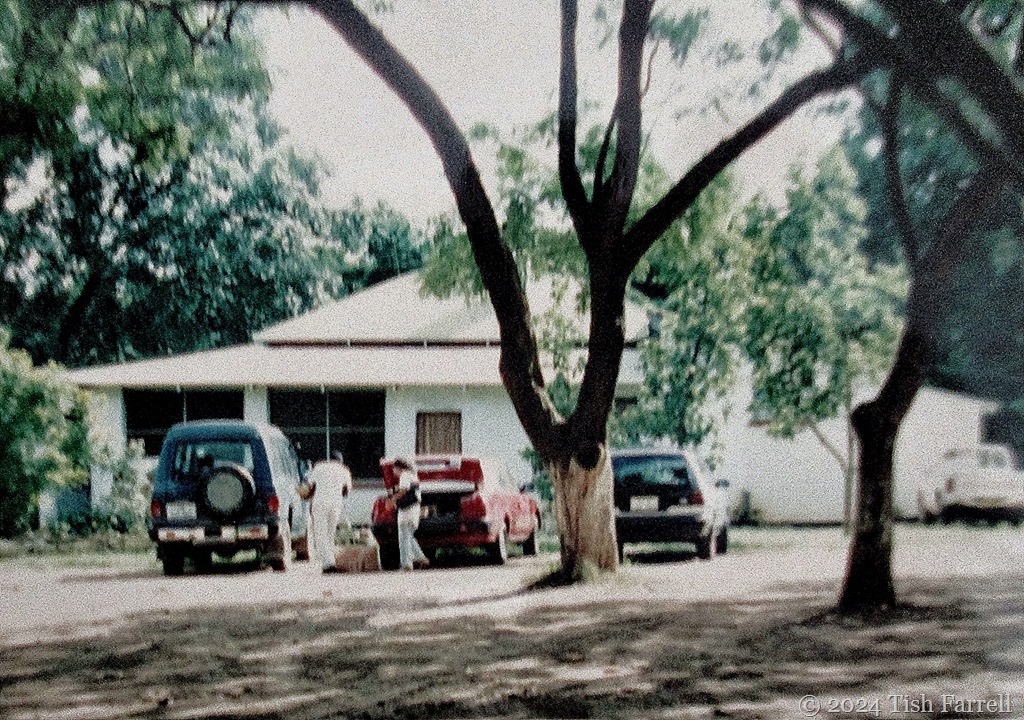
Maluwa Cooperative Store
*
But I like it out on the road. There is so much life outside the high walled, razor-wired residences of the elite. People greet me. One day a taxi driver, trying to mend his broken-down car, stops struggling with things mechanical and offers me a lift. For a second I’m rooted to the spot. I note the rear tyre lodged on the back seat. Does he think if I say yes the car will conveniently right itself. He looks a touch sheepish when I smile and say no thanks. I like his style though: never miss the chance to cut a deal. As I step out again on the dirt road that has lost its asphalt, my footprints join the countless prints of others in the red dust.
*
Graham spends his days rushing round to meetings with aid agencies. There are fears that donations of free maize will dissuade farmers from planting their own crops, despite the good rains. Too much free maize is also likely to depress the economy, and this must be avoided. Much is given out as payment for working on public enterprises such as road building or making bricks for the building of clinics. Unemployed women, in particular, are keen to do such work. Receiving a sack of mealie meal, sugar, beans and cooking oil in return for their labour gives them independence from menfolk who might otherwise take any cash earnings. Graham also has to travel down south to Choma and Kalomo to oversee the distribution of EU maize by the Red Cross. There are more trips out east and to the Copper Belt.

Villagers coming to collect cooking oil and maize meal from the Red Cross.
*
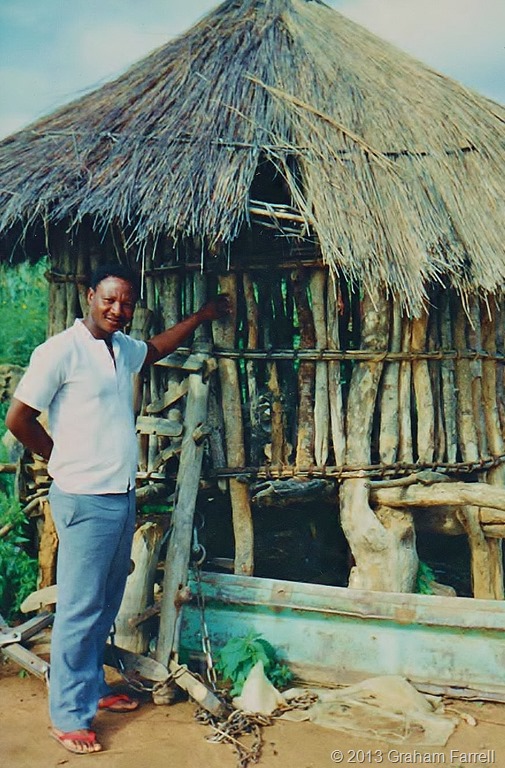
A farmer shows Graham his empty granary.
*
In March Graham comes home saying there is a bit of flap on. Brussels has phoned the E.U. Delegation saying that the BBC has reported a coup in Zambia: is everything all right there, they ask. The diplomats scratch their heads. No coup has been observed out in the suburbs. But then a few days later it is clear that something has happened. Major Rezi Kaunda, son of the long-serving and recently supplanted, ex-president, Kenneth Kaunda, has been arrested. He is reported as being under armed guard. Further details explain, somewhat bizarrely, that he is sitting in the yard of Woodlands police station with his flask of tea and a radio. Fourteen plotters in all have been arrested both in Lusaka and the Copper Belt. These include the editor-in-chief of the Zambia Times.
Later we hear that an incriminating document, The Zero Option, has been seized. It gives detailed plans of how members of the UNIP opposition old guard, led by Rezi, intend to make Zambia ungovernable by fuelling a crime wave, infiltrating the unions and government departments. It is mooted that this campaign of destabilisation has already been instigated and is responsible for the alarming crime wave.
President Chiluba has only been in office for a little over a year. His Movement for Multi-Party Democracy defeated Kenneth Kaunda in the first democratically held elections since Independence in 1964. Kaunda Senior had been in power all that time, but on defeat, chose to bow out gracefully. Meanwhile Frederick Chiluba claims that he is on a clean-up mission of this potentially rich, but now run-down state. He declares a limited State of Emergency while order is restored.
We all breathe a sigh of relief. No need for the emergency evacuation that the High Commission is so unlikely to provide for us. Besides, Graham still has much work to do, and there’s so much I still want to discover. One thing I am itching to know is how this copper-rich nation, with its deposits of sapphires and amethysts and airy upland mopane forests is one of the poorest on earth. Why are its impoverished, beleaguered but hard-working peoples being so ruthlessly ‘structurally adjusted’ by the World Bank? I am beginning to suspect that the spirit of Cecil Rhodes is restless and abroad once more, but that, as they say is another story.
*
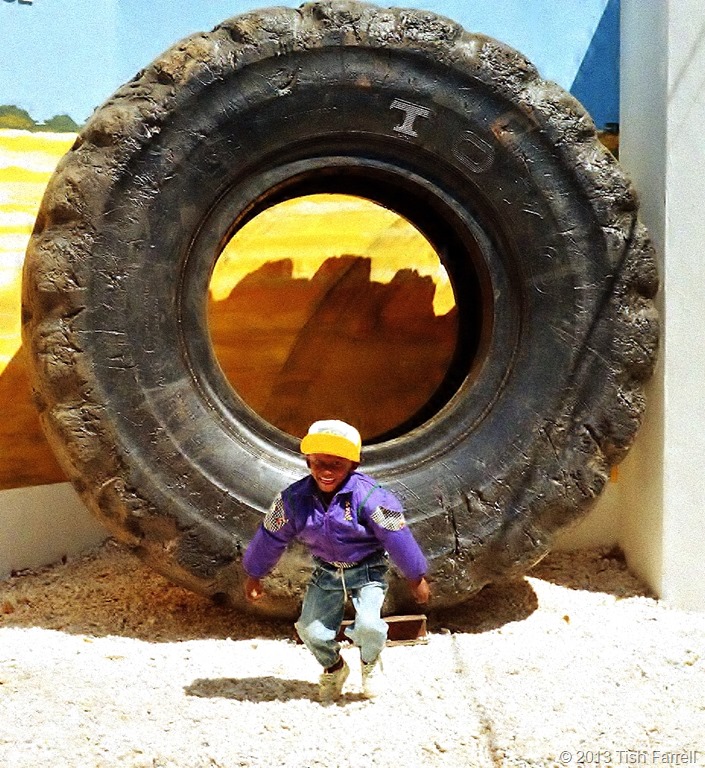
A view of one of the stands at the Annual Lusaka Agricultural Show. The 1993 show slogan is ‘Produce to Prosper’. Better, if less catchy, would be ‘Produce and get fair pay from multi-nationals.’
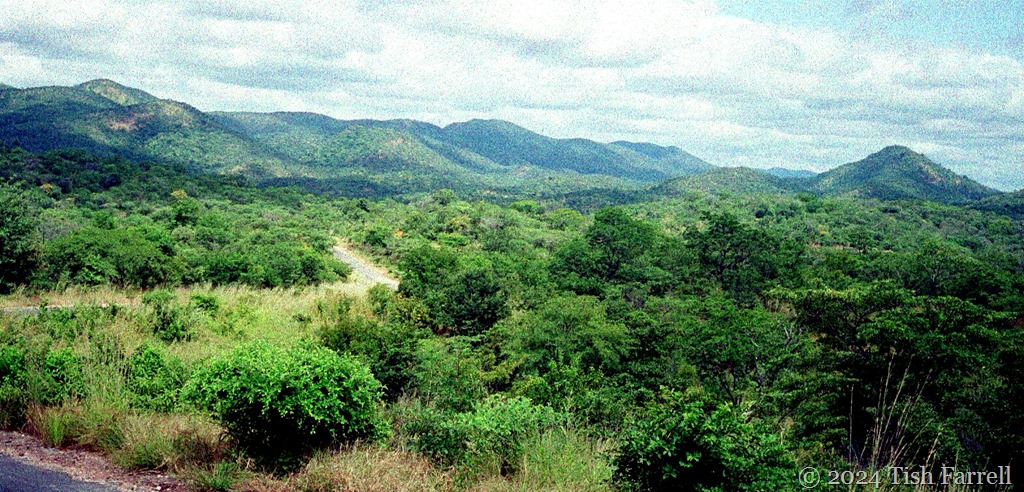
To be continued…
copyright 2024 Tish Farrell

It’s a fascinating picture you paint, Tish. Love the image of you striding along, and standing on a table to look over the wall. How did little Lorna fare, I wonder. It must be better for women now? So many questions, Tish. Will there ever be a happy resolution to Africa’s troubles? I have a friend currently exploring Mozambique, largely on foot. He is seduced by the place and people.
Plenty of powerful women if they’ve had the chance of a good education, but in some communities, traditional ways probably still tend towards putting men first. When we were in Zambia, Mrs Chiluba, the new president’s wife was telling women they must not go without food in order to feed their husbands.
while your stories are from the past I can’t believe much has changed. I do keep reading about Gesara(sp) and pray it is a coming reality for all of us.
Developing nations’ never ending indebtedness to international donors is a big problem. There was talk in our last Labour Government, twenty odd years ago, of writing off debt…
“…. bit of a flap on.”
My Dear Miss T, that must be as much of a pith hat, RAF, colonial style phrase as I could imagine…. dontcha know?
😊
Yep. That was expat Zambia for you – lodging somewhere in the 1950s when the place was still a British protectorate.
I still see the smiles on faces.
and, now, I too worry about Lorna. I also wonder how did your experiences then, shape your perceptions today?
Gosh, that’s a big question, Thom. I suppose I was not altogether surprised by much of what I saw/heard, culturally speaking. Years before I’d done a lot of reading about African traditions for my masters dissertation. What did shape my perceptions was grasping how much foreign interference/exploitation goes on in supposed sovereign nations under the guise of aid. I’m wondering for instance, how much Zambians will benefit from the rising world values of their copper, cobalt, gold and gemstone resources…
My guess would be, “very little” and I have not spent a lot of time in Africa, but I suspect you are right about the exploitation… and correct me if I’m wrong but it is not just the foreigners who exploit either???
No, you’re right. Local exploitation too, current and historically.
Just found this post re Zambia on the Extraction Industries Transparency website. Tracking down the beneficial owners of mines. It almost gives one hope: https://eiti.org/blog-post/talking-reform-how-zambia-can-benefit-beneficial-ownership-transparency
Thanks for sharing this. I am a big fan of transparency in both business and government.
It’s in negative supply at present, methinks, esp. in government.
That political thread runs throughout – so unavoidable when there are basic economic questions unanswered as big as Zambian elephants in the room otherwise your words are sprinkled with a real feel for the people you encounter on your trips – even eavesdropping over a wall. I had to smile at your allotmenteering vs giant snails – the empty granary photo was so touching, more so with the man’s enigmatic smile. Thanks Tish for sharing these entries – worthy of a bookl!
Hm. The geo-economics and questions thereof definitely bigger than a Zambian elephant. Clare Short has been having a good go at trying to unravel them a bit, as per https://eiti.org/ Extractive Industries Transparency. Thanks as ever for your thoughts, Laura.
I haven’t heard Clare Short’s name in aeons but the woes of Africa are akin to having to deal with a Gordian knot with no one willing and able to wield the master stroke – the EIT sounds well-intentioned …..
Yes, well-intentioned…but probably doesn’t cut much ice with Big Corp.
And the story continues, and I’m enjoying it. Looking forward to part 4!
You are a good cheer leader, Anne 🙂
I’ll always be late commenting on these posts, because I have to wait till I have time properly to focus on them. You obviously made a real effort not to be an ex-pat with all the negative connotations that has. Whether shopping in the market, or opening what is for me a largely closed book about African politics, you always have something interesting to say.
Thank you for your thoughtful reading of my posts, Margaret. Much appreciated.
oh wow Tish, this was enlightening and your photographs are wonderful. Love how you captured your day to day life as well as the political and economic machinations. Did you ever feel at a loss during the daytime or did capturing large snails and going for walks mostly keep you occupied?
Hi Becky. I don’t recall feeling at a loss during the day. It was a bit dream-like and I did write a lot of letters!
ah the days of letter writing – hope the recipients kept one or two of them
I was really drawn into your account from the dogs howling to drums and then all the anxiety over a coup. Certainly African countries are still suffering the impacts of colonialism, debt and poor governance and infrastructure. The assets are still not returning to the people there. Thanks, a bit overwhelming as we can feel so helpless. I have Congolese friends and life there can be so precarious.
I really appreciate this v. thoughtful response, Georgina, and thank you for reading my post with such attention. And yes, the Congo – probably the most resource-rich zone on the planet. Its peoples have long paid a heavy price for having high value resources that everyone else wants.
Thanks for sharing Memsahib. I must confess I’m glad I haven’t been back to Africa since the late 80’s. And I still wonder what kind of a curse hangs on Africa, that the people can’t live in peace. There seems ot be a coup wainting to happen everywhere and all the time…
Mbaya sana kabissa…
Such a wonderful place and people… I guess I’ll never understand…
All well with you I hope?
All well here, thanks, Brieuc. As to Africa – foreign plundering for the last five hundred years is surely an ongoing factor. Plus national boundaries created by outsiders for their own purposes; ill-fitting institutions left behind by colonisers, never deconstructed to fit local needs or aspirations of often multi-ethnic populations.
Interesting to think that Mali was once one of the richest, most highly developed and literate empires of the Middle Ages. Or in the 1890s when Sir Gerald Portal was riding through what is now Kenya on his mission to advise on the setting up of the British East Africa Protectorate (to replace the failed Imperial British East Africa Company) he wrote of Kikuyuland as if it were the land of milk and honey, so verdant and full of produce were the Kikuyu gardens…
Kenya was indeed an Eldorado. So many tried their luck with huge farms bought for a penny or two I guess. Some failed as Karen Blixen. Some prospered as Lord Delamere… Kikuyu land was quite prosperous. Now, I don’t know. I suspect climate change is not favourable. Your husband worked on corn if my memory serves me right?
Kwaheri sassa
Environmental degradation has long been a problem across many parts of Africa. E.g. Local and regional weather patterns are very much affected by deforestation. Mali is one example where there was huge tree loss leading to desertification in once verdant areas. And it’s certainly a key issue in Kenya where so much tree cover was removed from colonial times on, and continues to be removed.
Exposed soils blow away in rainless times, or wash away during the monsoon. The loss of forest ecosystems adds to flash flooding and also affects the movement of monsoon rain clouds and subsequent precipitation or lack thereof. Wangari Maathai also pointed out how the loss of deep rooted forest trees that continuously opened up ground water sources also explains the loss of numerous streams that once watered the cultivatable uplands.
In the 90s when we flew from Nairobi to Lamu you could see the good red earth of Central Province gushing out of the Tana River delta. Once the top soil goes it’s hard to rebuild soil fertility, especially for people with limited resources. Generations of smallholder farmers still being stuck within the land ownership confines of the old Reserve system aren’t helped either, their land endlessly divided fathers to sons until there’s too little ground to cultivate.
Sad. I didn’t know the old Reserve system is still in force. Means Kikuyu farmers cannot… “expand”? Tsss.
As far as I could tell, Independent Kenya basically inherited the British Crown Land structure of land ownership. So the new State ended up with all the land as per the colonial administration, and the Reserves were basically left as they were. Before the Brits left there were various schemes to provide plots for landless farmers – I think Escarpment just north of Nairobi was one such. Another, I think, down in Makueni. Then there seems to a hanging on of the colonial so-called squatter situation, where at Independence people were given land to cultivate on various government schemes. There always seemed to be unfathomable disputes about these when we were in Kenya. But you can rather see (if not condone) how when people achieve any kind of power they go in for land grabbing, chipping away at State owned holdings like former British agriculture research stations.
I didn’t know that. But then, there are so many things one doesn’t know… 😉
I remember reading about the “squatters” (Blixen, Merkham). A sad point you mention is that, one way or the other, the independent states just took over the colonial system, grabbing power without making necessary changes… Sigh…
Just one doubt: I’ve read – many times – about the reduction of wildlife through human encroachment. So I’d assumed isolated groups just grabbed land anywhere nobody but the animals claimed. So, in fact this constant human encroachment – and its consequences on wildlife is really done on State-owned land? 😳
Some of the encroachment is definitely on state owned facilities, but there’s a lot of muttering about large tracts between Lake Victoria and the Maasai Mara being turned into big wheat farms. Not sure how that was happening. But then there’s the complication that the Maasai also own large tracts of land in the form of group ranches i.e. land owned by a particular clan outside the National Park system. Some run their holdings as safari camps and these were usually rich in game. But then so much of Kenya is actually wilderness and uncultivatable, and so one would hope, still wildlife rich.
Oh my. One learns all the time… About this magic country we both knew… Of course I was only a teen and that was a long time ago.
I vaguely heard that the Maasai had become fairly rich (not sure whether that’s true) by clever management of their resources… Clan ownership would be an interesting variable to be considered in development analysis. (I’ll tell Daunghter # Mbili. She’s a consultant in development, though in other issues)
Fascinating. Again thank you Tish. You made my day… Merci infiniment… 🙏🏻
PS. I might include some of that fresh knowledge into another story of mine I wrote a few years back and I want to revisit…👍🏻
Happy to provide some new ‘source’ material 🙂
🙏🏻
PS. As an “addendum” to your excellent analysis, one could add the (counter) example of Latin America. The constant cutting down of forest to raise cattle. And not only in the Amazon. I’ve “seen” it here in Mexico, in the state of Chiapas where the Lacandon forest is torn dow for cattle. It was actually one the reasons for the Zapatista movement/insurrection, to stop large (often out of state) land-owners from cutting down the trees. Not to mention “Tala de bosque”… er… illegal tree felling (?) in many states, often tied to mafias…
Sigh…
It is indeed sad. We humans do muck about with the world. Degraded land truly represents the biggest threat to all of us. Yet the Loess Plateau restoration project in China shows what may be done to transform human-caused desertification into a thriving landscape. Where there’s the will to do it…
https://www.allcreation.org/home/regrowing-loess-plateau
Sounds promising. Hopping right there…
Well, the good news is that it can be done… So if it’s been done in a few places… eventually it might be done elsewhere… 🤞🏻
Thank you Tish.
Yes, I agree, but we need to keep talking about the successes. Every human ill is being put down to climate change, making us feel helpless. We’ve all forgotten about mending the environment, which is what actually needs doing.
Thank you ever so much for that thought. I have many qualms about the global warming/climate change concept, which as I see it, leaves no option but… “declinsim”, a drastic reduction of human activity to put it bluntly. Which I do not see as feasible.
Now, if we look at it as you do, it’s an entirely different “ball game” as our American friends say. It’s: “We screwed up here, and here, and there, let’s fix it. And that is something that humanity can do. And move up.
I like it very much. Asante sana Memsahib mkubwa. 🙏🏻
Another great instalment Tish. I think you were brave to walk outside the compound alone, but I also understand why you did, and that with a few outings I’d adjust to it. We are so often told to fear something when there is no real danger. I can feel the African experience through your writing.
Alison
V. touched by your comment, Alison. Many thanks.
Thanks for this excellent discussion of the long term effects of colonialism.
Very interesting and evocative writing Tish.
Many thanks for reading, Carol.