

Offerton Moor viewed from Callow Farm, Highlow, Derbyshire
*
I’ve been posting views of South Shropshire lately, the green and wooded hill country of my home county. It is a terrain that, on the whole, seems more amiable than rugged, although in bad winter weather the tops of Stiperstones and Long Mynd will ever prove challenging.
But today, on another hoar-frosted day in Bishops Castle, I’m thinking of the Derbyshire Peak District where my maternal Fox family ancestors farmed over many generations. What a tough life they must have led, running sheep on the high moors, struggling to raise essential oat crops in more sheltered enclaves, raising a few cattle to provide milk to make cheese and butter: the cheese a staple with ale and oatcakes, the butter to sell at market.
The header photo is the view from the former farmyard of Callow Farm, last occupied by 3x great grandfather George Brayley Fox in 1892.
Most of the High Peak farmers (even if they were yeomen owning some land and property) were also tenants of large estate owners – the Dukes of Rutland and Devonshire as well as lesser lords of manors. The farms provided food and shelter, but Derbyshire farmers were opportunists too. For centuries they mixed farming with other trades, butchery, hat making, grindstone making for milling and the Sheffield cutlery trade, weaving, haulage, and most dangerously of all, but potentially lucrative, lead mining; this last usually carried out in winter months when there was little farm work.
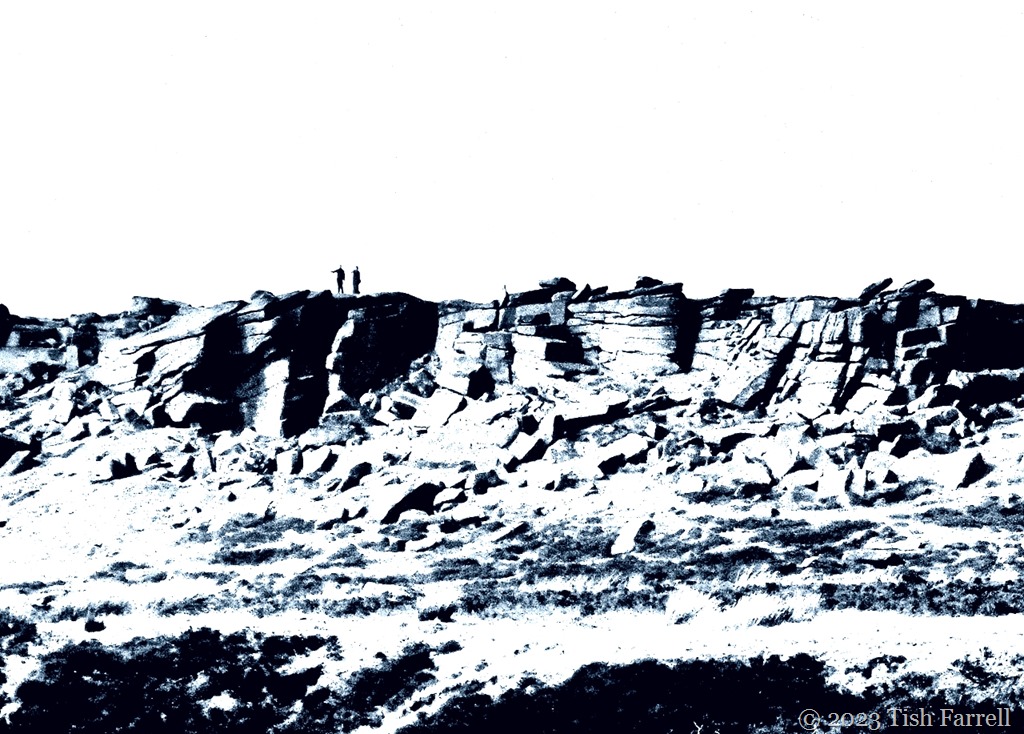
These next views are of Stanage Edge. This gritstone escarpment lies across the valley from Callow Farm. This is where millstones were once cut and hauled to nearby Sheffield. I know there were farmer Foxes who went in for this arduous trade, but none, as far as I know, in my immediate family tree.
*

*
This next photo is of Scraper Low Farm also known as Scraper Low Hall. It stands above Hathersage, and for a short time was the home of my 2x great aunt, Sophia Lister nee Fox who married Mr. Lister the silversmith while still attached to hill farmer, John Brocklehurst who himself had bigamously married a young next-door widow. You can read the story at the link.
When we first came upon Scraper Low, I was astonished that the Listers would choose to move to such a lonely place after living in a Sheffield city centre flat, to say nothing of taking on a farm in their sixties. But then when I walked up the long approach lane, I realised that whenever Sophia walked this way from her extraordinary castellated porch house, she would have been able to scan across the Derwent Valley and spot Callow Farm where she was born in 1814, the place where her brothers George and William still lived.
But then was she engaging in family feeling, or cocking a snook at the relatives now that she could pretend she’d finally made something of herself?

*
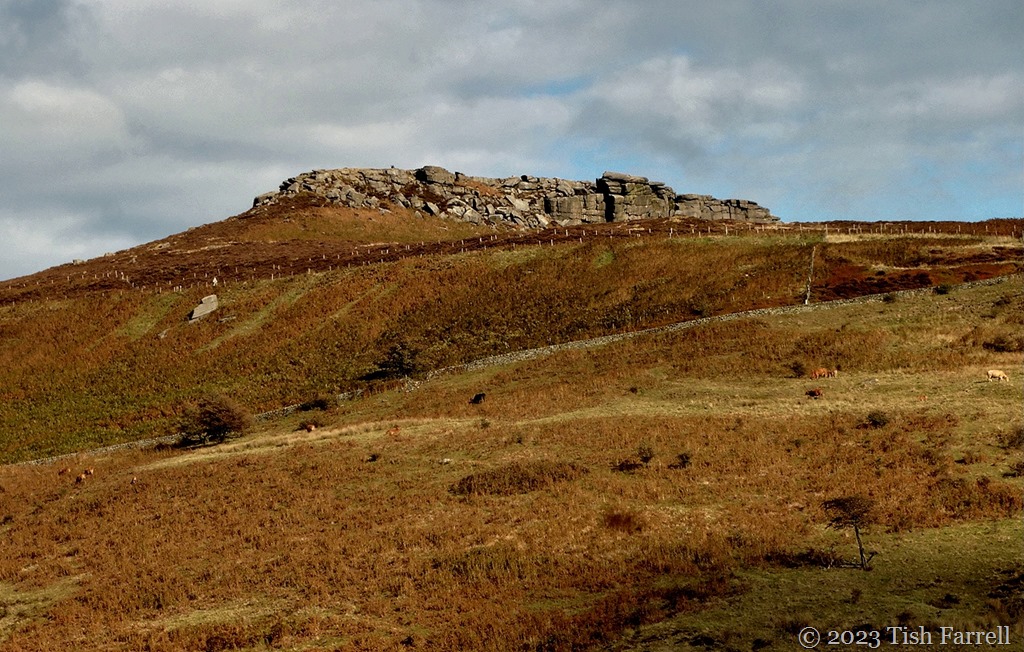
This is the view from Scraper Low: Hathersage Moor – Higger Tor, Carl Wark hillfort and Burbage Rocks. It’s a landscape that already looks bleak in September. Imagine it in winter:

*
And finally back to Callow Farm, a more benign scene of the fields below the house, once worked by four generations of Foxes: George, Robert, George and William.

*
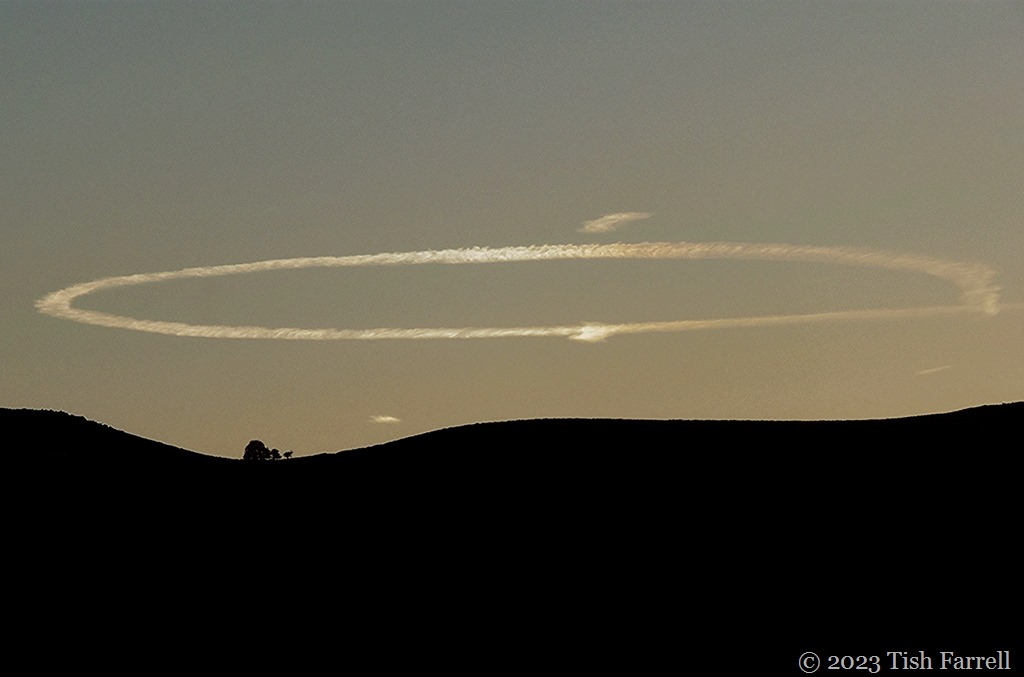
And an early morning flight trail across the valley. Not the sort of phenomenon the ancestors would have spotted, nor dreamed of seeing.
Lens-Artists: Empty Spaces Over this past week Patti has asked to show her empty spaces, however we chose to interpret the theme.

I enjoyed this post which certainly shows empty spaces. But I enjoyed it more for its history, both land and family. Great photos Tish!
Many thanks, Anne. I’m pleased you enjoyed the family saga.
I did. Because of the Holocaust, my family doesn’t go back beyond my grandparents who immigrated from Poland. Plus the U.S. history is young compared to Europe’s history.
That’s a sad and devastating circumstance, Anne. Family lines cut off by the Holocaust. I have to say I’ve been astonished at how much I’ve been able to discover about some of my ancestors. Recently Family Search alerted me to some mid 19th century tangental cousins who were involved in the Mormon pioneer treks to Salt Lake City, both having been Manchester cotton mill workers, before being converted. They off they sailed on a ship full of ‘Saints’ especially chartered for the purpose – Liverpool to New Orleans and then onto a wagon train. Hard to believe really.
My maternal grandfather immigrated in 1913 and once settled, he had my grandmother who was 7 months pregnant (with my mom) and two older children come over on a ship. I can only imagine what that trip was like for grandma. It’s too bad no one recorded her journey.
That must have been such a nerve-wracking trip, and in so many ways. But she made it!
A tough life
And astonishing that some of the male Foxes lived into the late 80s and early 90s. The womenfolk did not fare so well after years of giving birth, though a 5th great granny made it to 88 even after 8 children, 1683-1771. I think there must’ve been some millstone grit in the genes.
Millstone grit in the genes for sure!
Love the smoke ring
Tis a good smoke ring, isn’t it. Took a lot of puff.
Great spaces. Soooo empty. (I hate it when they cock a snook.) 🙂
I agree, John. It can be painful – a cocked snook 🙂
Ouch! 🙂
I loved this post, as I spent happy years in Sheffield and enjoyed this spot of rather different history. That last photo is extraordinary.
Happy to bring back happy memories. I was in Sheffield at the university, but that was a very long time ago. I used to love the way the city sort of ran into the Peak District on its westerly peripheries.
Yes indeed. And a seven pence bus ride took you there. You won’t have been there when the standard bus fare was 2p?
Goodness. Seven pence. I can’t even remember the bus fares now. I did a lot of walking!
It was policy in the late 70s. Most fares 2p. Longer distances (say right across town) 5p. And from Hunter’s Bar to Bakewell – 7p. Those were the days.
Ah those were the days. I was there in 70s. I used the bus for my first student digs, but they were so awful, I seem to have blotted much from my memory. My next digs were in walking distance.
😦 You’ve survived!
Wonderful post, Tish.
Were your Foxes Quaker or am I getting things muddled in my head? Sarah
There was a very famous Fox Quaker, but not in my family line, Sarah. The Callow Foxes were obliged to put in a regular appearance at the local parish C of E church, as were all tenants on the Duke of Devonshire estate. Interesting because running in the background in this area was quite a strong force of recusant Catholics, who were regularly fined for not attending the parish church.
Peaceful photos of empty spaces, are a dream to me. Beautiful, Tish.
Many thanks, Sofia. Lovely to invoke dreaming 🙂
Aliens at work in that last shot, Tish? Ancestral manoeuvres in the dark. Definitely not easy times or place.
No easy times, for sure, Jo. But I’m always impressed how resilient and enterprising people were back then. The lead-mining rules and regulations (courtesy of Royal assent) which gave prospectors free access to mineral resources wherever they were, meant they were a bolshie, stick-up-for-their rights lot in the face of uppity landowners who would try curtail their activities.
I was just about to comment on your last post that this landscape is in your blood, Tish. I loved the golden leaves.
Wow Tish – a circular cloud! Have never seen anything like that! Loved all of the ancestral views – gives new meaning to the term “wide open spaces”. So lovely but somehow I’m thinking when the winter winds come I’d be in the house by a warm fire! Lovely response to the challenge.
Always interesting info and good photos.
Family lore is always fascinating. Lovely photos, albeit a rather barren landscape.
Thanks, Jennie.
You’re welcome!
It’s a bleak landscape, but lovely to see and I always enjoy your history tales. When I was working in Fulwood, Sheffield, I often used to escape into the nearby countryside for a long lunch, surrounded by gritstone walls and sheep.
So nice that you know this territory too, Jude. Am picturing you there now.
Tish, what beautiful photos and land you photographed.
Many thanks, Egidio.
What a fascinating story of your family. I am impressed that you know so much and I guess they are stories carried along for generations. So many vast a beautiful places we see and yet, for them it was work, and home. Four generations. Interesting , and beautiful, Tish.
Hello, Donna. I’m amazed to find out so much too. Apart from the Fox family name and Callow Farm location, I knew very little until I started trawling documents and wills on ancestry sites. And in fact, those scraps that had come down in family hearsay, proved to be pretty inaccurate. Then I came across 2 researchers, each of us descended from Fox siblings born at Callow in the late 1700s. Now that was exciting. I don’t think most people are aware of the vast amount of family history hidden in wills on sites like Find My Past. Not that it’s always easy to read them or piece the info together…
Fascinating. My sister in law has made great efforts, and has found other “lines” in different parts of our country. Together they can share what they knew. but wow. piecing it together. So interesting.
That last photo is pretty unique. I’ve never seen a ring like that; very still air far up.
I agree. It was an extraordinary sight.